
Key Takeaways
- Medicare Advantage HMO members with two or more serious chronic conditions lasting at least 12 months can qualify for coordinated chronic disease management centered around a primary care provider who oversees all treatment decisions.
- Starting January 2025, the new Advanced Primary Care Management (APCM) payment model gives primary care practices more flexibility to manage chronic conditions through 24/7 access, risk stratification, and population-level gap analysis rather than time-based billing.
- Special Supplemental Benefits for the Chronically Ill (SSBCI) may cover services like meal delivery, transportation assistance, and home modifications for qualifying chronic conditions—check your Evidence of Coverage document to confirm eligibility.
- Accurate medical documentation of all diagnoses, medications, and treatments directly impacts your care quality and HMO payment accuracy, making it essential that your provider documents conditions being actively managed during visits.
- Strong chronic disease management programs include written care plans, regular medication reviews, specialist coordination through referrals, remote monitoring tools, and screenings for social barriers like transportation or food access.
- Medicare Advantage HMO enrollment has grown to 19.7 million members (5% increase in 2025), making it critical to build a strong relationship with an in-network primary care provider who understands your complete health history and coordinates all specialist care.
Living with diabetes, heart disease, or another long-term condition can feel overwhelming. Add a Medicare Advantage HMO plan into the mix, and many patients wonder how their care actually gets coordinated. If you or a loved one is enrolled in a Medicare HMO, understanding how chronic disease management medicare hmo programs work can help you get more from your benefits and avoid gaps in care.
This guide breaks down how primary care teams manage chronic conditions within a Medicare Advantage HMO structure. We will cover what qualifies for chronic care management, how referrals and networks work, and what to expect from a well-run primary care practice. Whether you are new to Medicare or simply trying to make sense of your plan, this information can help you make smarter healthcare decisions in 2026.

Understanding Chronic Disease Management in a Medicare HMO
Chronic disease management is an organized way for your primary care team to help you stay healthy despite long-term health conditions. In a Medicare Advantage HMO, this means your care is centered around a primary care provider who coordinates everything else.
According to CMS guidance on chronic care management, Medicare beneficiaries with two or more serious chronic conditions may qualify for this type of coordinated care. These conditions must be expected to last at least 12 months, or until death, and carry a real risk of hospitalization or decline in function.
In an HMO setting, this coordination usually happens through your primary care provider. They act as your main point of contact, working with specialists, pharmacies, and hospitals to keep your treatment on track.
Common Conditions That Qualify for Chronic Care Management
Many long-term health conditions can qualify a patient for structured chronic disease management. Common examples include:
- Diabetes
- Hypertension (high blood pressure)
- Heart failure
- Chronic obstructive pulmonary disease (COPD)
- Asthma
- Chronic kidney disease
- Coronary artery disease
- Arthritis
- Dementia
- Depression
If you manage two or more of these conditions, ask your primary care team whether a formal chronic care management program fits your needs. Practices offering chronic illness management support often build a personalized plan around your specific combination of conditions.
How Medicare Advantage HMOs Are Structured
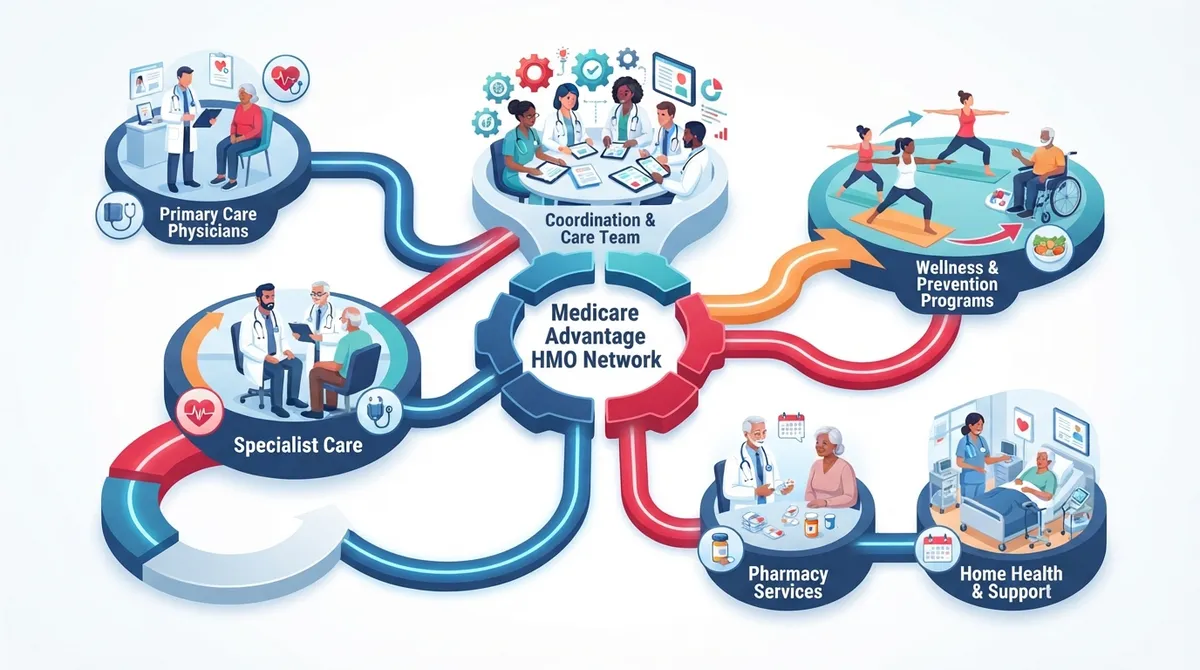
Medicare Advantage HMO plans work differently than traditional Medicare. Instead of open access to any provider, HMO members typically choose a primary care provider from an approved network. This provider becomes your main hub for all health decisions.
Here is how the structure generally works:
|
Feature |
Traditional Medicare |
Medicare Advantage HMO |
|---|---|---|
|
Provider Network |
Any provider accepting Medicare |
In-network providers only, with limited exceptions |
|
Referrals |
Not typically required |
Often required for specialist visits |
|
Primary Care Role |
Optional coordination |
Central hub for all care decisions |
|
Cost Sharing |
Set by Medicare Part B rules |
Plan-specific copays and rules |
|
Supplemental Benefits |
Limited |
May include SSBCI for qualifying chronic illness patients |
Enrollment in Medicare Advantage has grown steadily. According to the 2026 MedPAC status report, 34.9 million people were enrolled in Medicare Advantage as of July 2025. That is 55% of all Medicare beneficiaries eligible for the program. HMO enrollment specifically rose from about 18.7 million in July 2024 to 19.7 million in July 2025, a 5% increase.
Because HMO networks are more defined, it becomes even more important to build a strong relationship with a trusted primary care provider who understands your full health history.
What a Strong Chronic Disease Management Program Includes
A well-run chronic disease management program does more than just treat symptoms. It looks at your whole health picture and works to prevent complications before they start.
Here are the key elements you should expect from your care team:
- A designated primary care provider who oversees your treatment plan
- A written care plan that outlines your health goals and current medications
- Regular medication reviews to catch interactions or duplicate prescriptions
- Coordination with specialists and hospitals when needed
- Preventive screenings tailored to your risk factors
- Support during transitions, such as after a hospital stay
- Access to care outside of normal office hours for urgent concerns
- Screening for social needs, like transportation or food access, that affect your health
Practices that focus on comprehensive primary care often build these elements into every visit, not just when a problem arises.
The Role of Risk Stratification
Not every patient needs the same level of support. Risk stratification is a process where your care team identifies which patients are at the highest risk for hospitalization or serious complications.
This helps your primary care provider focus extra attention where it matters most. For example, someone managing both diabetes and heart failure may need more frequent check-ins than someone with a single, well-controlled condition.
New Medicare Payment Models in 2026
Starting January 1, 2025, the Centers for Medicare & Medicaid Services introduced Advanced Primary Care Management, or APCM. This new framework combines several older payment models into one simplified monthly payment option for primary care practices.
APCM is not based on tracking minutes spent on your care each month. Instead, it requires practices to meet a set of standards, including:
- Patient consent to participate in the program
- 24/7 access to care and continuity with your regular provider
- Up-to-date medical information available to your care team
- Population-level analysis to find gaps in care across all patients
- Risk stratification to identify high-need patients
- Ongoing performance measurement
For patients enrolled in Medicare Advantage HMOs, this means your primary care provider may have more flexibility and better tools to manage your chronic conditions in a coordinated way. However, exact benefits and costs still depend on your specific plan documents.
Special Supplemental Benefits for the Chronically Ill
Some Medicare Advantage plans offer what is called Special Supplemental Benefits for the Chronically Ill, or SSBCI. These are extra benefits designed specifically for members with qualifying chronic conditions.
SSBCI benefits must have a reasonable chance of improving or maintaining your health or daily function. Examples may include:
- Meal delivery services
- Transportation assistance to medical appointments
- Home safety modifications
- Pest control or air quality improvements
Not every plan offers these benefits, and eligibility rules vary widely. Always check your plan's Evidence of Coverage document or speak directly with your primary care team to understand what is actually available to you.
How Primary Care Teams Coordinate Specialist and Hospital Care
One of the biggest challenges in managing chronic disease is keeping every provider on the same page. In an HMO, your primary care provider typically serves as the coordinator for all of this activity.
Here is how that coordination usually works:
- Your primary care provider identifies a need for specialist input
- They submit a referral through the HMO network
- The specialist shares results and recommendations back to your primary care team
- Your primary care provider updates your overall care plan
- If you are hospitalized, your primary care team follows up after discharge to prevent readmission
This kind of coordination reduces the risk of conflicting treatment plans or missed follow-up care. Practices that emphasize coordinated care over fragmented care tend to see better outcomes for patients managing multiple chronic conditions.
Why Documentation Matters
Medicare Advantage plans are paid based on a risk-adjusted model. This means accurate documentation of your diagnoses, medications, and ongoing treatment matters for your plan and your care team.
Your primary care provider should document conditions that are actually being assessed, monitored, or treated during your visits. This is not just a billing formality. It ensures your full health picture is reflected in your medical record, which supports better long-term care planning.
Cost Considerations for Chronic Care Management
Cost is often one of the first questions patients ask about chronic disease management. Under traditional Medicare Part B, chronic care management services may be covered after your deductible, with standard coinsurance applying.
Medicare Advantage HMO members should confirm how their specific plan handles these services. Some key things to check include:
- Whether chronic care management is billed separately or included in your plan's overall structure
- Copay amounts for specialist visits related to chronic conditions
- Whether remote monitoring devices are covered
- Prior authorization requirements for certain treatments
Your Evidence of Coverage document will have the most accurate answers. If anything is unclear, your care team can help you understand your specific benefits.
Remote Monitoring and Telehealth for Chronic Conditions
Technology has changed how chronic disease management works. Many Medicare Advantage plans now cover remote patient monitoring tools that track blood pressure, blood sugar, or heart rhythm from home.
These tools allow your primary care provider to spot warning signs early, often before you notice symptoms yourself. Virtual visits also make it easier to check in regularly without the need for an in-person appointment every time.
For patients balancing work, family, and health conditions, this kind of flexibility can make a real difference. It also supports the goal of preventing avoidable emergency room visits and hospital stays.
Why InCare Supports Medicare HMO Patients
At InCare, chronic disease management is built around personalized primary care, backed by modern tools and a team that knows your health history. With locations in Tampa and Riverview, Florida, InCare offers coordinated care for patients managing diabetes, hypertension, heart disease, and other chronic conditions.
Providers like Dr. Pramjeet Ahluwalia and the rest of the InCare team focus on building long-term relationships with patients, not just treating one issue at a time. This approach supports better outcomes for Medicare Advantage HMO members who need consistent, coordinated attention.
InCare also offers services that support whole-body wellness alongside chronic disease management, including cancer screenings, body composition analysis, and medically supervised weight loss programs. Patients managing conditions like diabetes or heart disease often benefit from these additional wellness services as part of a complete care plan.
Steps to Get Started with Chronic Disease Management
If you are a Medicare HMO member looking for better coordinated care, here are practical steps to take:
- Confirm your primary care provider is in-network with your specific HMO plan
- Ask your provider if you qualify for chronic care management based on your conditions
- Request a written care plan that outlines your medications and treatment goals
- Ask about remote monitoring options if you manage a condition like hypertension or diabetes
- Review your Evidence of Coverage document for supplemental benefits you may qualify for
- Schedule regular follow-up visits, especially after any hospital stay
Taking these steps early can help you avoid gaps in care and get the most value from your Medicare Advantage HMO benefits.
Patients across Tampa and Riverview have shared their experiences with InCare's approach to primary care. You can visit us on Google — InCare to read reviews and see how the practice has helped others manage chronic conditions with a coordinated, patient-first approach.
Building a Long-Term Partnership with Your Care Team
Chronic disease management works best when it is not a one-time event, but an ongoing partnership. Your primary care provider should know your history, understand your goals, and adjust your plan as your health changes over time.
This is especially true for Medicare HMO members, where network rules make it important to stick with a provider who truly understands your needs. Practices that prioritize whole-family and whole-person care tend to build stronger, more effective long-term relationships with patients.
You can also follow updates and health tips from InCare on Facebook, Instagram, and TikTok for ongoing wellness content and clinic updates.
Final Thoughts on Chronic Disease Management in a Medicare HMO
Managing a chronic condition under a Medicare Advantage HMO does not have to feel confusing. With the right primary care team, coordinated support, and a clear care plan, patients can stay healthier and avoid unnecessary hospital visits.
If you are ready to take control of your chronic disease management, InCare's team in Tampa and Riverview is here to help. Reach out to our care team today to discuss your Medicare Advantage HMO options, or book your appointment now to start building a personalized chronic disease management plan that fits your life.
FAQs
Q: What is chronic disease management in a Medicare Advantage HMO?
A: Chronic disease management in a Medicare Advantage HMO is a coordinated approach to caring for patients with ongoing health conditions. It typically involves a designated primary care provider who oversees medications, specialist referrals, preventive care, and follow-up after hospital stays.
Q: Does Medicare pay for chronic care management if I have two chronic conditions?
A: Traditional Medicare Part B may cover chronic care management for beneficiaries with two or more serious chronic conditions expected to last at least 12 months. Medicare Advantage HMO members should confirm with their specific plan how these services are covered and what cost sharing applies.
Q: What chronic conditions qualify for Medicare chronic care management?
A: Common qualifying conditions include diabetes, hypertension, heart failure, COPD, asthma, chronic kidney disease, coronary artery disease, arthritis, dementia, and depression. Any condition expected to last a year or more and posing a risk of decline may qualify.
Q: What are Special Supplemental Benefits for the Chronically Ill, and who qualifies?
A: SSBCI are extra benefits some Medicare Advantage plans offer to members with qualifying chronic illnesses, such as meal delivery or transportation assistance. Eligibility and availability vary significantly by plan, so checking your Evidence of Coverage document is essential.
Q: How can a primary care practice improve chronic disease outcomes for Medicare HMO patients?
A: A strong primary care practice combines risk stratification, personalized care plans, medication reviews, and coordination with specialists and hospitals. Practices that also screen for social needs and offer remote monitoring tend to see better outcomes for chronic disease patients.