
Key Takeaways
- Most popular peptide stack ingredients like BPC-157, TB-500, CJC-1295, and ipamorelin are not FDA-approved for human use, and human evidence for most stack combinations is limited.
- Combining multiple peptides makes it nearly impossible to tell which product causes which effect, so side effects and interactions become harder to predict and trace.
- "Research use only" peptides are not established as safe for people, and unverified sourcing can mean contamination, wrong concentrations, or mislabeled ingredients.
- Start with a primary care visit to review your medicines, health history, and goals, and if a peptide is appropriate, begin with one clinician-directed product rather than a stack.
Peptides are everywhere in wellness talk right now. Social media, gym forums, and online sellers promote "stacks" for fat loss, muscle gain, recovery, and anti-aging. If you are asking what should i know before starting a peptide stack, you are asking the right question at the right time.
A peptide stack means using two or more peptide products together. It is not a standard medical treatment. Some peptide medicines are FDA-approved for specific conditions. Many popular stack ingredients are not, and human evidence for most combinations is limited.
This guide compares two paths: starting with a single, clinician-directed peptide versus building a multi-peptide stack. We will look at safety, evidence, cost, and monitoring. Our goal is to help you decide with clear facts, not hype. In 2026, the smartest first step is a conversation with a licensed primary care clinician who knows your full health picture.

What Is a Peptide Stack, Exactly?
Peptides are short chains of amino acids. Your body makes many of them naturally. Some act as hormones or signals. A "stack" is a popular term for combining several peptide products at once, often to chase more than one goal.
Here is the key point: peptides are not one uniform drug class. Approval applies to a specific product and a specific use. It does not apply to "peptides" as a category.
- Some are FDA-approved medicines. These are prescribed for defined conditions, such as certain diabetes and weight management treatments.
- Many are not approved for human use. Popular stack ingredients like BPC-157, TB-500, CJC-1295, and ipamorelin fall into this group in many cases.
- Some are compounded. A pharmacy mixes them, and they are not FDA-reviewed for safety, effectiveness, or manufacturing quality in the same way as approved drugs.
Regulatory status can change. Always check current FDA information and speak with a licensed clinician and pharmacist before considering any product.
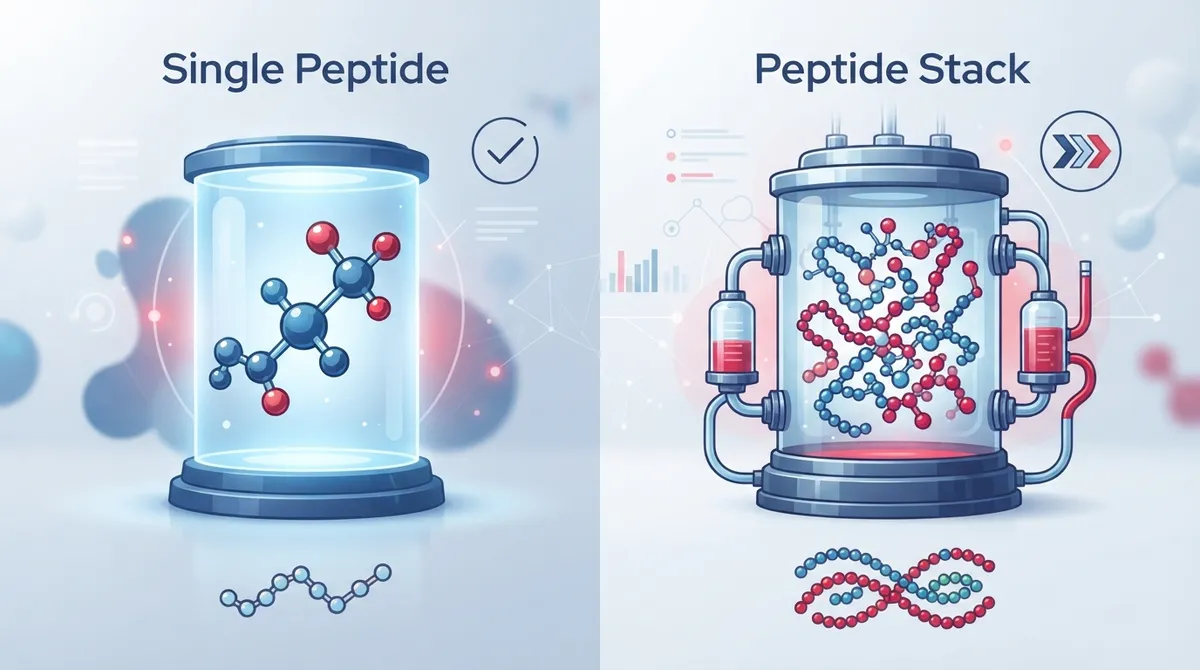
Single Peptide vs. Peptide Stack: Side-by-Side Comparison
The table below shows how the two approaches differ in practical terms. This is a general comparison, not medical advice for any one person.
|
Factor |
Single Peptide (Clinician-Directed) |
Multi-Peptide Stack |
|---|---|---|
|
Evidence base |
Stronger if the product is FDA-approved for your condition |
Often limited; many stacks lack controlled human trials |
|
Predictability of effects |
Easier to track one change at a time |
Harder to know which product causes which effect |
|
Side effect tracing |
Simple: one product, one signal |
Complex: overlapping effects and unclear cause |
|
Interaction risk |
Lower, easier to review with your medicines |
Higher and harder to predict |
|
Dosing clarity |
Label or clinical guidance often available |
Doses for combinations are frequently unknown |
|
Monitoring |
Straightforward lab and symptom checks |
Needs broader, closer follow-up |
|
Cost |
Often lower |
Often higher, with multiple products |
In most cases, simpler is safer. When you add products, you also add unknowns.
The Biggest Things to Know Before You Start
1. Evidence Is Often Thin
Many popular wellness stacks have not been tested in controlled clinical trials. That means benefits, correct doses, and long-term effects may be unknown. Online testimonials are not the same as clinical evidence. A product can sound convincing and still lack human safety data.
2. Combining Products Makes Risk Harder to Predict
When you use one product, you can watch how your body responds. When you use three or four at once, you cannot tell what is helping or hurting. Dosing, timing, and interactions all become guesses. This is the core safety issue with stacking.
3. Regulatory Concerns Are Real
The FDA has raised concerns about certain ingredients used in compounded peptide products. These include possible immune reactions, impurities, and incomplete safety information. A 2024 FDA review of three peptides noted adverse effects such as faster heart rate, chest tightness, headache, nausea, diarrhea, elevated liver enzymes, and injection-site pain or irritation. That finding is not a general risk estimate for every peptide, but it shows why caution matters.
4. "Research Use Only" Does Not Mean Safe
Products sold online as "research use only" are not established as safe for people. Unverified sourcing can lead to:
- Contamination or impurities
- Wrong concentration or mislabeled ingredients
- Unsafe storage or handling
- No clear way to report problems
A clinic offering a peptide, or a prescription for one, also does not prove the product is FDA-approved or proven effective. Ask direct questions about the product's status and source.
5. Your Health History Changes the Answer
The right choice depends on you. Your conditions, medicines, supplements, allergies, and plans for pregnancy all matter. A product that suits one person may be a poor fit for another. This is why a medical review comes first.
A Step-by-Step Plan Before You Start
Use this simple checklist to slow down and make a safer decision.
- Define your goal clearly. Is it weight loss, recovery, energy, or sleep? A clear goal helps your clinician suggest proven options first.
- Schedule a primary care visit. Share every medicine and supplement you take, plus your health history and allergies.
- Ask about alternatives. Many goals can be met with approved treatments, nutrition, exercise, sleep, or lab-guided care.
- Check the product's status. Ask whether it is FDA-approved, compounded, or unapproved, and what that means for you.
- Verify the pharmacy. Use a legitimate, licensed pharmacy. Avoid unverified online sellers.
- Plan your monitoring. Agree on baseline labs, follow-up visits, and warning signs before you begin.
- Start simple. If a peptide is appropriate, begin with one product under clinician direction rather than a stack.
Who Should Be Extra Careful?
Some people should be especially cautious and should speak with a clinician before considering any peptide product:
- People who take prescription medicines, especially for heart, blood sugar, or hormones
- Anyone with heart, liver, kidney, or autoimmune conditions
- People who are pregnant, breastfeeding, or planning pregnancy
- Those with a history of allergic reactions or immune concerns
- Athletes who may face testing rules
Do not stop a prescribed treatment to try a stack. Do not self-inject unverified products. If something feels wrong, get medical help.
Warning Signs That Need Prompt Medical Attention
Seek urgent care or emergency help if you notice any of these after an injection or new product:
- Chest tightness, chest pain, or a racing heartbeat
- Trouble breathing, swelling of the face or throat, or hives
- Severe or spreading redness, warmth, or pain at the injection site
- Fever, severe headache, or persistent vomiting
- Yellowing of the skin or eyes, or dark urine
Report suspected adverse events to your clinician and to the appropriate regulator. If you need same-day help, urgent care can evaluate concerning symptoms quickly.
Why Primary Care Is the Right Starting Point
Many people jump straight to a stack because it feels like a shortcut. Primary care offers a safer route. A clinician can review your whole picture, order the right tests, and match treatment to evidence. That whole-person view is the heart of primary care, and it is especially important when a product has limited human data.
At InCare, patients in Tampa and Riverview, Florida, get personalized care that combines medical expertise with advanced tools. If your goal is weight management, you can explore a doctor-guided weight loss program that uses proven options and careful monitoring. If you want to understand your baseline first, services like DNA gene testing and body composition analysis can add useful context.
You can also read more about how our team approaches this topic in our guide on peptide therapy in Tampa, and learn how to spot third-party tested peptides. For a broader view of what is approved today, see FDA-approved peptides to know in 2026.
Questions to Ask Your Clinician
Bring this list to your visit. Clear questions lead to clearer answers.
- Is this product FDA-approved for my condition, or is it compounded or unapproved?
- What is the evidence in humans, and how strong is it?
- What are the known side effects and interactions with my medicines?
- What baseline tests do I need, and how often should we recheck?
- Is there an approved or lifestyle-based option I should try first?
- Which pharmacy supplies this, and how is it stored and handled?
- What symptoms mean I should stop and call you or seek urgent care?
A good clinician welcomes these questions. If answers feel vague or pushy, take that as a signal to pause.
The Bottom Line: Which Path Is Safer to Start?
For most people, starting with a single, clinician-directed treatment is the safer path. It gives you clearer evidence, easier monitoring, and fewer unknowns. A multi-peptide stack adds complexity without proven benefit for most goals, and it makes problems harder to trace.
That does not mean peptides have no place in care. Some are approved, valuable medicines. The point is to match the right tool to your goal, with medical oversight and a trusted source. Learn more about the science and the limits in our overview of what peptides are and how they relate to wellness.
You can follow InCare for health tips on Facebook, Instagram, and TikTok. For a closer look at patient experiences, you can see what our InCare patients say on Google. For trusted background on regulation, the FDA's human drug compounding information explains how compounded medicines differ from approved drugs.
Take the Safe First Step
Before you buy a single vial, talk with a licensed clinician who can review your goals, history, and options. Our team at InCare in Tampa and Riverview is here to guide you with personalized, evidence-based care. Book your appointment today, or contact our team with questions. Your health deserves a plan built on facts, not guesswork.
FAQs
Q: What is a peptide stack, and how is it different from an FDA-approved peptide medication?
A: A peptide stack is the use of two or more peptide products together, often for wellness goals like fat loss or recovery. It is not a standardized medical treatment. An FDA-approved peptide medication is a specific product approved for a defined condition, with reviewed safety and effectiveness data.
Q: Are peptide stacks safe?
A: Safety depends on the specific products, their source, and your health history. Combining peptides makes dosing, interactions, and side effects harder to predict, and many popular stacks lack controlled human trials. A primary care clinician can help you weigh the risks before any decision.
Q: Are BPC-157, CJC-1295, ipamorelin, or TB-500 FDA-approved?
A: These popular stack ingredients are not generally FDA-approved medicines for human use, and regulatory status can change. Compounded versions are not FDA-reviewed in the same way as approved drugs. Check current FDA information and consult a licensed clinician and pharmacist.
Q: How can I tell whether a peptide product or pharmacy is legitimate?
A: Ask whether the product is FDA-approved, compounded, or unapproved, and use a licensed pharmacy with a valid prescription. Be cautious of "research use only" labels and unverified online sellers. Third-party testing and clear sourcing are good signs, but they do not replace medical oversight.
Q: What symptoms after a peptide injection require urgent medical attention?
A: Seek urgent help for chest tightness or pain, a racing heartbeat, trouble breathing, facial or throat swelling, hives, severe injection-site redness or pain, fever, or yellowing of the skin or eyes. Report any suspected adverse event to your clinician and the appropriate regulator.