
Key Takeaways
- Demand batch-specific Certificates of Analysis (COA) tied to exact lot numbers and verify testing labs are independently accredited to ISO 17025 standards; generic product-line COAs provide little assurance of actual purity.
- Avoid direct-to-consumer online purchases and instead work with licensed clinicians at accredited compounding pharmacies, which removes guesswork and places quality control in the hands of accountable medical professionals.
- Most online vendor rankings are self-generated or affiliate-driven; evaluate quality yourself by checking for named independent labs, realistic pricing ($80-$120 per 10 mg range), and clear distinction between CJC-1295 with DAC versus no DAC versions.
- Watch for red flags including purity claims above 99% without verification, pricing dramatically below market range, missing business information, and untraceable payment methods—these often indicate corners cut on testing or product quality.
Searching for CJC-1295 trusted brands online can feel overwhelming. Dozens of vendors claim to sell the purest peptides at the lowest prices. But how do you know which ones actually deliver what they promise? For Tampa and Riverview residents exploring wellness optimization, this question matters more than ever.
CJC-1295 is widely discussed as a research peptide in anti-aging and performance circles. It is important to understand that it is not FDA-approved for general clinical use in the United States. This means the online marketplace for CJC-1295 is largely unregulated, filled with vendor-generated rankings and self-reported purity claims. Before you spend a dollar, you need to know how to separate real quality signals from marketing noise. This guide breaks down what actually matters when evaluating sourcing, testing, and safety, and explains why working with a licensed provider changes the entire equation.

Understanding What CJC-1295 Trusted Brands Actually Means
The phrase "trusted brands" gets thrown around a lot in the peptide space, but it rarely means what people assume. Most rankings you find online are created by the vendors themselves or by affiliate marketing sites earning commissions on sales. That does not automatically make the information false, but it does mean you should treat every claim with healthy skepticism.
A genuinely trustworthy source focuses on three things: transparency, verification, and accountability. Vendors who publish batch-specific documents and use named independent labs are operating differently than those who simply post a purity percentage on their website. If you want to learn more about how this peptide is discussed in wellness circles, our guide on what CJC-1295 actually does for your health offers useful background.
Why Vendor-Led Rankings Deserve Scrutiny
A 2026 vendor audit compared 43 U.S.-based sellers of CJC-1295. Another guide ranked just 7 vendors based on testing transparency and third-party audit data. Notice the wide range in scope. This tells you that no single "best of" list is definitive.
- Many rankings are created by affiliate sites earning referral fees
- Purity percentages like 99% or 99.4% are often self-reported, not independently confirmed
- Regional recommendations may not apply to buyers in Florida or the broader U.S. market
- Pricing claims change frequently and should never be the only deciding factor
- Some sources named in these rankings include Ascension Peptides, Dynamic Peptides, Amino Club, and Orbitrex Peptides, but these mentions come from vendor-generated content, not clinical endorsements
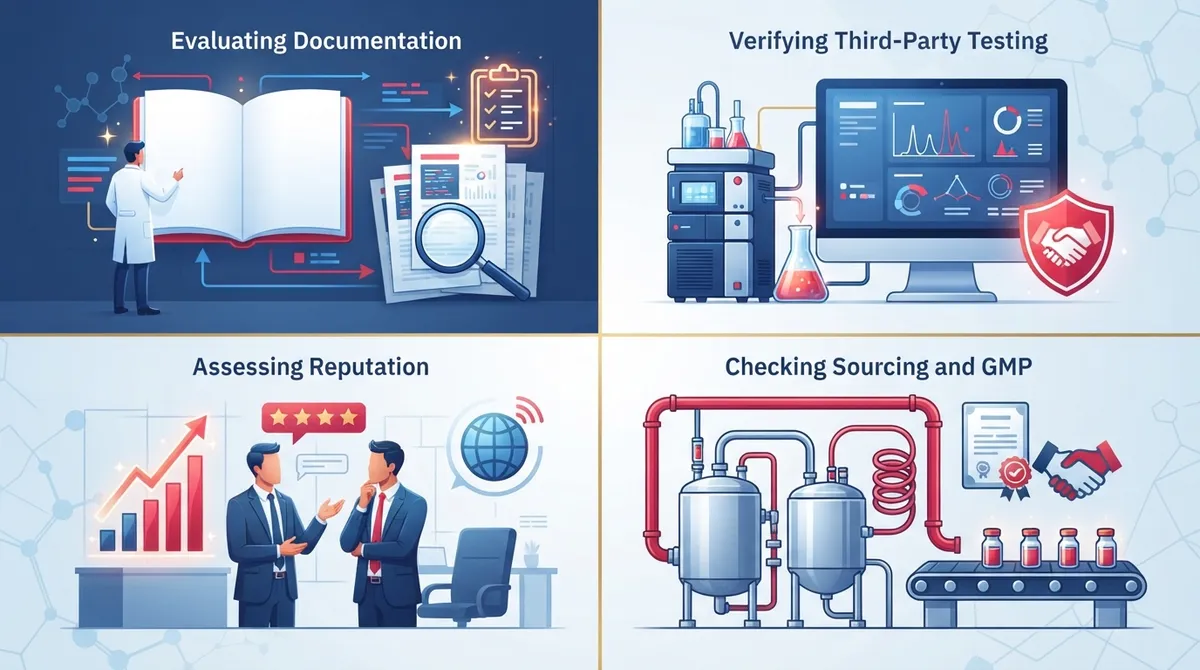
4 Ways to Evaluate Peptide Vendor Trustworthiness
Instead of relying on someone else's ranked list, you can learn to evaluate sourcing quality yourself. Here are four practical steps that apply no matter which vendor or product you are considering.
1. Demand Batch-Specific Certificates of Analysis
A Certificate of Analysis, or COA, is a lab report showing what is actually inside a specific batch of product. The key word is "batch-specific." A generic COA that applies to "this product line" tells you very little, because purity can vary from batch to batch. Look for a COA tied to the exact lot number on your order.
2. Verify the Testing Laboratory Independently
Credible COAs name the laboratory that performed the testing. You should be able to search for that lab and confirm it exists and holds proper accreditation. Independent-review sources emphasize that buyers should look for HPLC chromatograms, mass spectra, endotoxin results, and ISO 17025 lab accreditation details, not just a summary purity number.
3. Compare Pricing Against Market Norms
Pricing that seems too good to be true usually is. A 2026 vendor guide flagged prices significantly outside a typical range of $80 to $120 per 10 mg kit as a red flag. Separate comparison data found the lowest independently verified price at $5.00 per mg, with a median across carriers closer to $10.40 per mg. Extremely cheap products often cut corners on testing or purity.
4. Choose Medical Oversight Over Self-Sourcing
The safest path for most people is not shopping vendor websites at all. Wellness sources consistently note that the only reliable way to access medical-grade CJC-1295 is through an accredited compounding pharmacy, after a consultation with a licensed clinician. This removes the guesswork entirely and places quality control in the hands of professionals who are accountable for what they prescribe.
|
Evaluation Factor |
Low-Trust Signal |
Higher-Trust Signal |
|---|---|---|
|
Certificate of Analysis |
Generic or product-line COA |
Batch-specific COA matching lot number |
|
Lab Verification |
Unnamed or unverifiable lab |
Named lab with ISO 17025 accreditation |
|
Pricing |
Far below or above $80–$120 per 10 mg |
Consistent with independently reported market range |
|
Access Method |
Direct-to-consumer online order |
Accredited compounding pharmacy with clinician oversight |
Common Red Flags in the CJC-1295 Marketplace
Beyond the four evaluation steps above, there are specific warning signs that should make you pause before purchasing from any source claiming to sell research peptides.
- No lab documentation available on request, or documents that look generic and reused across multiple products
- Purity claims above 99% with no verifiable third-party source backing the number
- Pricing dramatically below the reported market range without explanation
- No clear return policy, customer service contact, or business address
- Marketing language that promises guaranteed results or downplays any research-use disclaimers
- Websites that only accept untraceable payment methods
These red flags do not guarantee a vendor is fraudulent, but they should raise your level of caution significantly. When in doubt, the safer route is always a licensed medical provider rather than a direct-to-consumer purchase.
CJC-1295 With DAC vs No DAC: Why It Matters for Sourcing
Part of evaluating any vendor is understanding what you are actually looking for. CJC-1295 comes in two primary forms: with DAC (Drug Affinity Complex) and without DAC. The DAC version has a longer half-life, meaning it stays active in the body longer between doses. The no-DAC version is shorter-acting and often paired with other peptides in wellness protocols.
Vendors that clearly distinguish between these two forms, and provide separate documentation for each, tend to demonstrate a higher level of product knowledge and transparency. If a seller does not clarify which version you are purchasing, that is worth questioning directly before you buy anything.
Why Medical Guidance Beats Self-Directed Purchasing
It can be tempting to research vendors independently and place an order without ever speaking to a clinician. But this approach carries real risks. Self-sourced peptides are not evaluated by a medical professional for your specific health history, current medications, or existing conditions.
Working through a primary care and wellness clinic changes this dynamic entirely. A licensed provider can review your health background, discuss realistic expectations, and coordinate care through verified pharmacy channels. This is one of the reasons InCare emphasizes physician-guided wellness services rather than direct product sales. Our team in Tampa and Riverview focuses on comprehensive evaluation before any advanced therapy is considered.
If you are curious about how peptide-related wellness services fit into a broader health plan, take a look at our overview of peptide therapy services in Tampa. You can also explore our team of providers, including Dr. Pramjeet Ahluwalia and Dr. Naveen Paddu, who bring clinical oversight to advanced wellness discussions.
Building a Smarter Wellness Strategy Beyond Peptides
Peptides are just one piece of a much larger wellness picture. Before considering any advanced therapy, most people benefit from establishing a baseline understanding of their health. This includes routine primary care visits, body composition analysis, and even DNA gene testing to understand your unique predispositions.
For those focused on metabolic health, our metabolic breath analysis service can offer insight into how your body burns energy. Combined with regular cancer screening and preventive checkups, these tools build a complete picture of your health long before any advanced peptide protocol should even be discussed.
- Establish a relationship with a primary care provider first
- Complete baseline lab work and screenings before considering peptide therapy
- Ask direct questions about sourcing if any therapy is recommended
- Request documentation for anything injected or ingested
- Prioritize providers who explain risks as clearly as benefits
How InCare Approaches Wellness Optimization
Patients across Tampa and Riverview trust InCare for a reason. The clinic combines advanced diagnostic technology with hands-on medical guidance, so patients are never left guessing about their treatment options. This is especially important in a space like peptide wellness, where marketplace confusion is common.
InCare holds a 4.8 out of 5 rating on Google from hundreds of patients, reflecting consistent satisfaction with both clinical quality and staff support. You can visit us on Google — InCare to read recent reviews and see what current patients say about their experience. The practice also stays active on Facebook, Instagram, and TikTok, sharing wellness education and clinic updates.
If you are weighing whether advanced peptide therapy fits your health goals, the smartest first step is a conversation with a licensed provider rather than a solo online purchase. Our Tampa and Riverview locations offer in-person consultations, and virtual visits are also available for patients who prefer telemedicine.
Final Thoughts on Choosing Wisely
The idea of "trusted brands" in the CJC-1295 marketplace is more nuanced than most rankings suggest. Real trust comes from verifiable lab data, transparent sourcing, and medical oversight, not flashy purity percentages or aggressive marketing. Before making any decisions, take time to ask hard questions and demand real documentation.
If you are ready to discuss wellness optimization with a licensed clinical team, reach out to get in touch with our team or schedule your appointment today. InCare's Tampa and Riverview clinics are ready to help you build a health strategy grounded in real evidence, not marketplace guesswork.
FAQs
Q: What are the most trusted brands for CJC-1295?
A: There is no single verified list of trusted CJC-1295 brands, since most rankings are vendor-generated or affiliate-driven. The most reliable indicator of quality is a batch-specific Certificate of Analysis from a named, accredited independent laboratory, not a vendor's self-reported purity claim.
Q: How do you verify if a CJC-1295 vendor is legitimate?
A: Request a batch-specific COA tied to your exact lot number and confirm the testing lab is independently verifiable and accredited, ideally to ISO 17025 standards. You should also look for HPLC chromatograms, mass spectra, and endotoxin testing results rather than relying on a summary purity percentage alone.
Q: Is CJC-1295 FDA-approved or legal to buy online?
A: CJC-1295 is generally sold and discussed as a research peptide and is not FDA-approved for general clinical use in the United States. Medical-grade access is typically described as available only through an accredited compounding pharmacy following a consultation with a licensed clinician.
Q: What is the difference between CJC-1295 with DAC and no DAC?
A: CJC-1295 with DAC has a longer half-life and stays active in the body longer between doses, while the no-DAC version acts for a shorter period. Vendors who clearly distinguish between these two forms and provide separate documentation for each tend to demonstrate greater product transparency.
Q: What red flags suggest a fake or low-quality peptide vendor?
A: Warning signs include missing or generic lab documentation, purity claims above 99% with no independent verification, and pricing far outside the reported market range of roughly $80 to $120 per 10 mg kit. A lack of clear business contact information or reliance on untraceable payment methods is also concerning.