
Key Takeaways
- Tesamorelin is FDA-approved (2010) only to reduce excess abdominal fat in adults with HIV-associated lipodystrophy, while sermorelin has no currently marketed FDA-approved product.
- Sermorelin is usually a compounded, unapproved preparation today, so product quality and safety are not reviewed by the FDA before reaching patients.
- Tesamorelin's prescribing information calls it weight-neutral and not indicated for weight loss, so it should not be expected to work as a weight-loss drug.
- Trial results for tesamorelin (about 15% visceral fat reduction) apply only to its studied HIV-associated population, not healthy adults seeking anti-aging or fat loss.
- Both drugs can raise IGF-1 and affect blood sugar, so baseline labs and follow-up monitoring with a licensed clinician are essential before starting.
- Tesamorelin is contraindicated in pregnancy and active malignancy, so anyone pregnant, planning pregnancy, or with cancer must disclose this to their clinician.
Patients often ask, "how is tesamorelin different from sermorelin?" The question comes up more in 2026 as peptide therapy spreads through wellness clinics and social media. Both drugs act on the same pituitary pathway, so many people assume they are interchangeable. They are not. Treating them as the same product is one of the most common and costly mistakes patients make.
Tesamorelin and sermorelin are both synthetic growth hormone-releasing hormone (GHRH) analogs. Their regulatory status, evidence base, and clinical roles are very different. One is an FDA-approved prescription medicine for a narrow condition. The other is mostly a compounded, unapproved product used in wellness settings.
This guide covers the three biggest mistakes patients make when comparing these drugs. It also explains what the science does and does not show, and how a primary care physician can help you make a safe decision. At InCare, we believe good wellness care starts with accurate information and a licensed clinician who knows your health history.

What Do Tesamorelin and Sermorelin Have in Common?
To understand how tesamorelin is different from sermorelin, start with what they share. Both are synthetic versions of growth hormone-releasing hormone, a signal your hypothalamus normally sends to your pituitary gland. That signal tells the pituitary to release your own growth hormone.
Neither drug is growth hormone itself. They stimulate your body to make more of its own. Growth hormone then raises levels of a related hormone called IGF-1, which affects metabolism, body composition, and tissue repair.
Key similarities include:
- Both are injectable peptides.
- Both work through the pituitary gland rather than replacing growth hormone directly.
- Both can raise IGF-1 levels, which is why clinician oversight matters.
- Neither is proven as a general weight-loss, anti-aging, or longevity treatment.
The similarity ends there. The next sections explain the differences that matter for your health and safety.
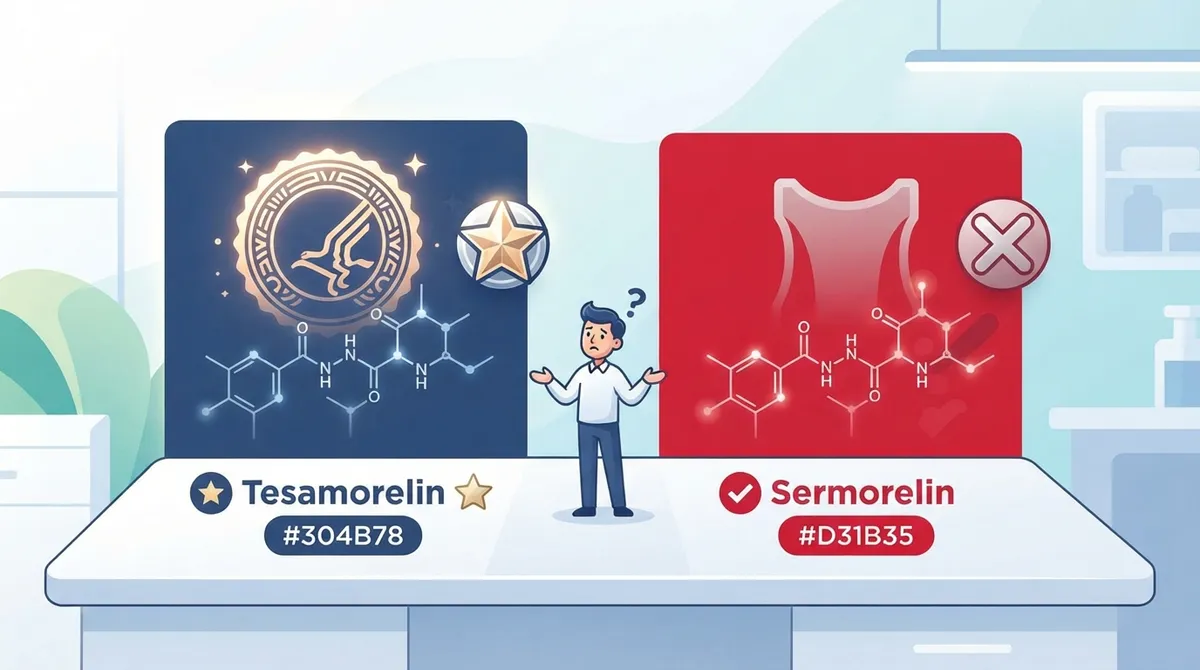
Mistake 1: Assuming Both Drugs Have the Same Approval Status
The biggest difference between these two peptides is regulatory. Patients who skip this fact often end up with the wrong expectations.
Tesamorelin: FDA-Approved for a Narrow Use
Tesamorelin is sold under the brand names Egrifta SV and Egrifta WR. The FDA approved it in 2010 to reduce excess abdominal fat in adults with HIV-associated lipodystrophy. This is a specific condition in which people living with HIV develop harmful fat buildup around the organs in the abdomen.
It is not approved for routine obesity, general weight loss, muscle building, or anti-aging. The FDA prescribing information for Egrifta SV states that it has a weight-neutral effect and is not indicated for weight-loss management.
Sermorelin: A Discontinued Brand and a Compounded Market
Sermorelin was once sold as Geref for limited pediatric growth-hormone-related indications. The branded product was discontinued in 2008, and its FDA applications were later withdrawn. FDA materials describe the discontinuation as not due to safety or effectiveness concerns.
Today, no currently marketed FDA-approved sermorelin product is identified. When sermorelin is offered at a wellness clinic, it is typically a compounded preparation. Compounded drugs are not FDA-approved. The FDA also does not review them for safety, effectiveness, or quality before they reach the market.
|
Feature |
Tesamorelin |
Sermorelin |
|---|---|---|
|
Drug class |
GHRH analog |
GHRH analog |
|
FDA status |
Approved (2010) as Egrifta SV and Egrifta WR |
Brand (Geref) discontinued; applications withdrawn |
|
Approved use |
Excess abdominal fat in HIV-associated lipodystrophy |
None currently marketed |
|
Typical source today |
Prescription product with FDA-reviewed labeling |
Compounded preparations, not FDA-reviewed |
|
Evidence base |
Controlled trials in its approved population |
Limited data for healthy adults |
Before you start any peptide, ask one simple question: is this product FDA-approved for my condition, or is it compounded? The answer shapes your risk and your expectations. Our guide on FDA-approved versus compounded peptides explains this distinction in more depth.
Mistake 2: Believing the Evidence Applies to Everyone
The second mistake is assuming that trial results apply to any adult who wants less belly fat or more energy. They do not.
What the Tesamorelin Research Shows
Tesamorelin has a defined clinical evidence base for its approved use. Trials in people with HIV-associated lipodystrophy found reductions in visceral abdominal fat. A 2026 Scientific American report summarized a trial of more than 400 people with this condition. Visceral fat dropped by about 15% among participants receiving tesamorelin.
That result is meaningful for the studied population. It should not be stretched to healthy adults, people with ordinary obesity, or anyone seeking body recomposition. The trial did not test those groups. Because the label describes the drug as weight-neutral, patients should not expect it to work as a scale-moving weight-loss drug either.
What the Sermorelin Evidence Looks Like
Sermorelin is now commonly discussed in wellness settings for adult growth-hormone optimization and anti-aging. Those uses are not FDA-approved. There are no large, robust controlled trials showing meaningful clinical benefits in healthy adults.
That does not prove sermorelin is harmful. It means the promise outpaces the proof. Marketing claims about youthful energy, sharper focus, or easy fat loss are not backed by the kind of data patients deserve to see.
For a broader look at what the science supports, read peptides for longevity: what the evidence shows in 2026. If you are weighing options for weight loss specifically, our comparison of retatrutide vs. semaglutide covers medications with stronger weight-loss data.
Mistake 3: Skipping Safety Screening and Monitoring
The third mistake is treating a GHRH analog like a harmless supplement. These are prescription-level peptides that change hormone signaling in your body.
Known Safety Considerations for Tesamorelin
The tesamorelin prescribing information lists several warnings and precautions. A clinician should review each one with you before treatment:
- Elevated IGF-1: Growth hormone signaling can push IGF-1 above a healthy range.
- Glucose intolerance or diabetes: Tesamorelin may affect how your body handles blood sugar.
- Fluid retention: Swelling and joint symptoms can occur.
- Hypersensitivity reactions: Some patients react to the drug.
- Active malignancy: Tesamorelin is contraindicated in patients with active cancer.
- Pregnancy: Tesamorelin is contraindicated during pregnancy.
Because it can affect IGF-1 and glucose, tesamorelin treatment calls for baseline testing and follow-up monitoring. A licensed clinician should decide whether it fits your situation.
Why Compounded Sermorelin Needs Extra Caution
Because compounded sermorelin is not FDA-reviewed, product quality can vary. Patients should ask where the product is made, how it is stored, and what testing supports it. Without product-specific labeling, there is also less standardized safety guidance.
Monitoring still matters. Any therapy that changes growth hormone activity should come with a clear plan. That plan should include lab work, symptom checks, and a defined point to stop or reassess.
How a Primary Care Doctor Fits Into the Decision
Peptide questions are a good reason to see a primary care physician. A trusted clinician can review your full history, order labs, and tell you honestly whether a therapy is likely to help. Here is a simple process for approaching the decision:
- Define your goal. Are you managing a diagnosed condition, or chasing a general wellness outcome?
- Get baseline testing. Metabolic panels, blood sugar markers, and IGF-1 give your clinician a starting point.
- Check the product source. Ask whether the drug is FDA-approved or compounded.
- Discuss alternatives. Nutrition, strength training, sleep, and proven medications often deliver more reliable results.
- Set a monitoring schedule. Agree on follow-up labs and clear stop criteria before you begin.
Sleep and metabolic health also shape how you feel, often more than any peptide. If fatigue is your main concern, review how to know when to see a doctor for poor sleep. If you are comparing clinics, 15 questions to ask a peptide therapy clinic in Tampa is a useful checklist. You can also read about finding tesamorelin peptide care near you in Tampa and how to find safe sermorelin therapy in Riverview.
Who Might Ask About Each Drug?
Different patients arrive with different questions. Here is how each group can think about the topic.
- Tech-savvy millennials and Gen Z explorers: Online content makes peptides look simple. Verify claims against FDA labeling and talk with a clinician before buying anything.
- High-income wellness seekers: Advanced testing is useful, but a high price does not equal proven benefit. Ask for the evidence behind each recommendation.
- Busy young families and preventive-health women: Focus first on screenings, sleep, nutrition, and movement. These deliver the largest return on your limited time. Tesamorelin is contraindicated in pregnancy, so anyone who is pregnant or planning pregnancy should tell their clinician.
No matter your profile, the same rule applies. A peptide is a medical decision, not a lifestyle accessory.
The Bottom Line on Tesamorelin vs Sermorelin
So, how is tesamorelin different from sermorelin? Both are GHRH analogs, but tesamorelin is FDA-approved for one narrow condition with a defined trial record. Sermorelin lost its approved brand years ago and now appears mostly as a compounded, unapproved product with thin evidence for adult wellness goals. Neither should be presented as a proven fat-loss, muscle-building, or longevity therapy.
The three mistakes to avoid are simple. Do not assume equal approval status. Do not assume trial results apply to you. Do not skip safety screening and monitoring.
You can follow our team on Instagram and TikTok for health education, or join the conversation on Facebook. You can also see what InCare patients say on Google, where the Tampa and Riverview clinics hold a 4.8 rating.
Ready for a straight answer about peptides and your health goals? Book your visit with InCare today, or contact our team with questions. We will review your history, order the right labs, and help you choose a safe, evidence-based path.
FAQs
Q: What is the main difference between tesamorelin and sermorelin?
A: Both are GHRH analogs that prompt the pituitary to release growth hormone. Tesamorelin is FDA-approved for excess abdominal fat in adults with HIV-associated lipodystrophy. Sermorelin has no currently marketed FDA-approved product and is usually compounded.
Q: Is tesamorelin FDA-approved for weight loss or anti-aging?
A: No. Tesamorelin is approved only to reduce excess abdominal fat in adults with HIV-associated lipodystrophy. The prescribing information states it has a weight-neutral effect and is not indicated for weight-loss management.
Q: Is sermorelin FDA-approved today?
A: No currently marketed FDA-approved sermorelin product is identified. The branded product Geref was discontinued in 2008, and its FDA applications were later withdrawn. FDA materials describe that discontinuation as not due to safety or effectiveness concerns.
Q: Are compounded sermorelin injections reviewed by the FDA?
A: No. Compounded drugs are not FDA-approved and are not reviewed by the FDA for safety, effectiveness, or quality before marketing. Patients should ask a licensed clinician about the product source and available testing.
Q: What monitoring is needed with a growth hormone-releasing hormone analog?
A: A clinician should assess your history and order baseline labs, including IGF-1 and blood sugar markers. Follow-up testing helps catch elevated IGF-1, glucose changes, and fluid retention early, and tesamorelin is contraindicated in pregnancy and active malignancy.