
Key Takeaways
- Peptide therapy is a broad marketing term covering FDA-approved drugs, compounded medicines, and unapproved research-labeled products, each with very different evidence and risk levels.
- FDA approval applies only to a specific drug, dose, formulation, and indication; clinician supervision does not make an unapproved product approved or proven safe.
- Ask any Tampa provider whether a product is FDA-approved or compounded, what the exact indication is, and what human studies support its use.
- Walk away from products labeled 'for research use only,' sold without a prescription, or promised to deliver tissue repair, anti-aging, or enhanced recovery.
Peptides are everywhere in wellness conversations right now. Social media, podcasts, and online stores promote them for recovery, weight loss, energy, and aging. For Tampa residents, the real question is not whether peptides are popular. It is how to approach them safely. That is where medically guided peptide use in Tampa comes in.
The term "peptide therapy" covers a very wide range of products. Some are FDA-approved prescription medicines. Others are compounded drugs. Many are investigational substances sold with bold claims and limited human evidence. Knowing the difference protects your health and your money.
This guide explains what medical guidance should look like, how approved and compounded products differ, what risks exist, and how to choose a Tampa provider wisely. It is written for busy adults who want clear facts, not hype.

What Are Peptides, and Why Is Peptide Therapy Not One Treatment?
Peptides are short chains of amino acids, the building blocks of proteins. Your body makes many of them naturally. Some act as hormones, and some help cells communicate.
"Peptide therapy" is a broad marketing term, not a single standardized treatment. It can refer to very different things:
- FDA-approved peptide medicines prescribed for specific conditions, such as certain diabetes and weight management drugs.
- Compounded medications prepared by a pharmacy for an individual patient when legally permitted.
- Investigational or research-labeled peptides promoted for recovery, longevity, or performance, often with limited human safety data.
Each category carries a different level of evidence and risk. A responsible clinic will tell you exactly which category applies to the product being discussed. If a provider cannot or will not, that is a warning sign.
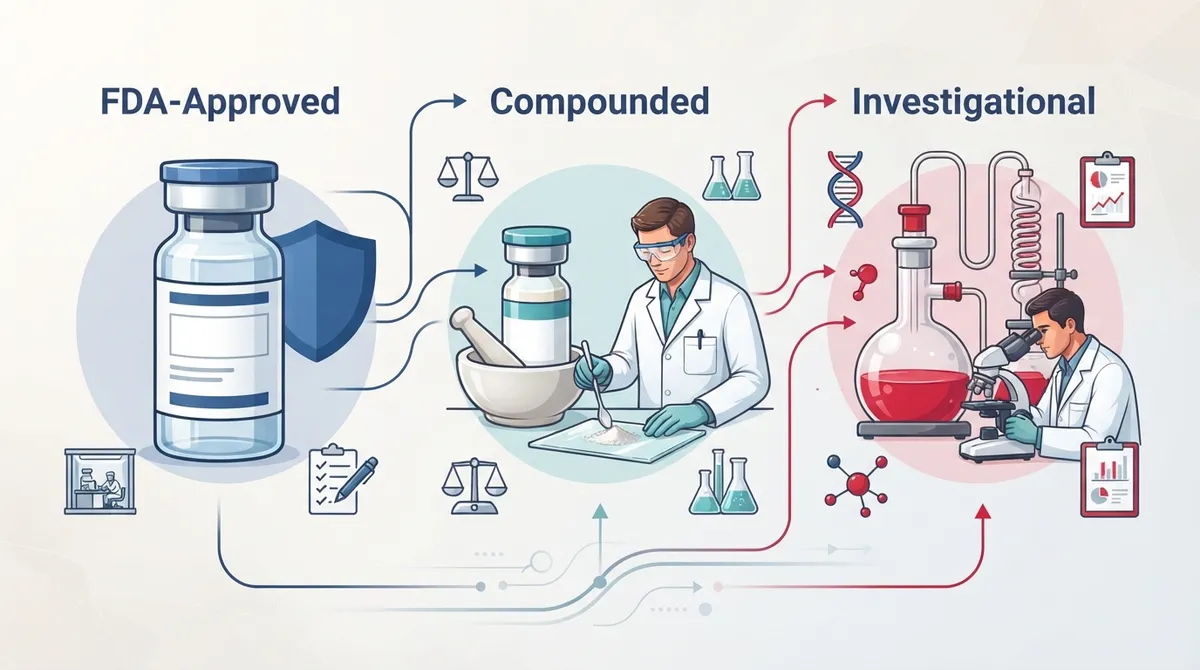
FDA-Approved, Compounded, and Investigational: Key Differences
FDA approval applies to a specific drug, formulation, dose, and indication. It does not mean every peptide, or every wellness use of a peptide, is approved or proven. Approval also requires review of safety, effectiveness, and manufacturing quality before the product reaches patients.
Compounded medicines work differently. Compounding may be appropriate for an individual patient when the law allows it and a prescriber finds a clinical need. But compounded drugs are not FDA-approved, and they do not receive the same premarket review.
|
Category |
Regulatory Status |
What to Know |
|---|---|---|
|
FDA-approved peptide drug |
Reviewed for a specific use, dose, and formulation |
Strongest evidence base, but only for the approved indication |
|
Compounded peptide |
Not FDA-approved; legal only under specific rules |
Requires a clinical need, a licensed prescriber, and a verified pharmacy |
|
Investigational or research-labeled peptide |
Not approved for human use |
Limited human data; identity, dose, and sterility may be uncertain |
An important point: clinician supervision does not turn an unapproved product into an approved one. Medical guidance adds oversight, monitoring, and honest counseling. It does not guarantee safety or effectiveness.
What the Evidence and Regulators Say Right Now
Regulatory rules around peptides change often, so always confirm current status before starting any product. Here is what is known as of 2026:
- In 2023, the FDA placed several peptide bulk drug substances under restrictions or review for compounding.
- The FDA has raised concerns about certain substances promoted as peptides. These include impurities, poorly characterized ingredients, possible immune reactions, and limited human safety data.
- BPC-157 is one example. The agency has cited insufficient information to determine whether human use may cause harm.
- A 2026 FDA advisory committee reviewed certain peptides. Committee recommendations are advisory only. They are not final FDA decisions and not approval.
There is also no reliable, current Tampa-specific data on how many people use peptide therapy or how well it works. That means claims about local results should be treated with caution. Marketing pages from clinics are not proof of effectiveness or regulatory approval.
What a Medically Guided Peptide Consultation Should Include
A medically guided process looks very different from ordering a vial online. A thorough visit typically follows these steps:
- Full health history. Your clinician reviews past conditions, surgeries, family history, allergies, and current symptoms.
- Medication and supplement review. This checks for interactions and for conditions that could make a product unsafe.
- Physical exam and clinically justified testing. Labs should be ordered because they inform a decision, not to create a sales pitch.
- Honest discussion of goals and evidence. You should hear what is proven, what is uncertain, and what is unknown.
- A clear plan with follow-up. Your clinician sets a schedule to check response and look for side effects, and stops treatment if concerns arise.
Testing is useful for monitoring, but it is never a guarantee. No lab panel can promise a product is safe or will work for you.
This is where a full-service primary care practice has an advantage. When your primary care team already knows your history, they can spot interactions, manage chronic conditions, and keep your whole picture in view. Peptide questions become one part of a larger, coordinated plan rather than a standalone purchase.
Potential Risks and Side Effects
Risks depend on the product and how it is given. Reported or plausible effects include:
- Injection-site redness, swelling, or pain
- Headache and fatigue
- Nausea and digestive upset
- Immune reactions, including allergic responses
For investigational products, risks may be poorly understood. Products bought online add more concerns: the vial may not contain what the label says, the dose may be wrong, and sterility or contamination cannot be verified.
Stop and seek care promptly if you develop trouble breathing, widespread rash, facial swelling, or severe pain after any injection. For urgent concerns, a same-day urgent care visit can help.
How to Choose a Tampa Provider Wisely
Tampa has no shortage of clinics advertising peptide services. Use this checklist to separate careful medical practices from marketing-driven ones:
- Verify the license. Confirm the clinician's Florida license and qualifications through the state's public lookup tools.
- Ask the status question. Is this product FDA-approved or compounded? What is the exact indication?
- Request the evidence. Ask for the human studies behind the proposed use, and what is not known.
- Confirm the pharmacy. Know who prepares and dispenses the product, and how quality is verified.
- Insist on follow-up. A safe plan includes scheduled reassessment and a clear stopping point.
- Avoid red flags. Walk away from products labeled "for research use only," sold without a prescription, or promised to deliver tissue repair, anti-aging, or enhanced recovery.
You can meet the physicians behind your care on the InCare providers page, and see how locations work on the locations page. Transparency about who treats you is a good sign of a trustworthy practice.
Why Primary Care and Wellness Is the Right Home for This Conversation
Peptide questions rarely stand alone. Someone asking about recovery may also have sleep problems, blood pressure concerns, or a medication that could interact. Someone interested in weight management may benefit more from an approved, evidence-backed program than from an untested product.
InCare approaches these questions the way a primary care and wellness clinic should: evidence first, safety first, and prevention first. With locations in Tampa and Riverview, InCare combines physician-led primary care with advanced tools such as body composition analysis, metabolic breath analysis, and DNA gene testing. These tools help your clinician understand your individual needs and track progress objectively.
If peptides are on your radar, you can read more in the InCare guide to peptide therapy benefits and safety in Tampa. If your goal is weight management, the weight loss program offers a medically supervised path built around approved options and ongoing monitoring.
Patients also share their experiences publicly. You can read InCare reviews on Google to see what Tampa-area patients say about the care they received. Updates and clinic news appear on Instagram, Facebook, and TikTok.
Bottom Line: Medical Guidance Means Honest Guidance
Medically guided peptide use in Tampa should mean one thing above all: honesty. You should leave a visit knowing what the product is, what regulators say about it, what the evidence shows, what the risks are, and how you will be monitored.
Peptides are not magic, and they are not all the same. Some are valuable, proven medicines. Others remain unproven. The best protection is a clinician who explains the difference and puts your health ahead of a sale.
Ready to talk through your options with a physician-led team? Book your visit with InCare or contact our team to ask questions before you decide.
FAQs
Q: Are peptide therapies FDA-approved?
A: Some peptide-based medicines are FDA-approved, but approval applies only to a specific drug, dose, formulation, and condition. Many peptides marketed for wellness, recovery, or longevity are not approved for those uses, so always ask about the exact product's status.
Q: What is the difference between an FDA-approved peptide drug and a compounded peptide?
A: An FDA-approved drug has been reviewed for safety, effectiveness, and manufacturing quality before it is sold. A compounded peptide is prepared by a pharmacy for an individual patient when legally permitted, and it does not receive that same premarket review.
Q: How can I check whether a Tampa peptide provider is licensed?
A: Use the Florida Department of Health's public license lookup to confirm the clinician's license and status. You should also ask about their qualifications, the dispensing pharmacy, and the follow-up plan before starting any treatment.
Q: What are the risks of buying peptides online or using research-labeled products?
A: Online and research-labeled products may contain the wrong ingredient or dose, and their sterility cannot be verified. They also lack clinical oversight, which raises the risk of contamination, immune reactions, and unmonitored side effects.
Q: What should I expect during a medically guided peptide consultation in Tampa?
A: Expect a review of your health history, medications, symptoms, and goals, plus clinically justified exams or testing. A responsible provider will explain the evidence and risks honestly and set a follow-up plan to monitor your response.