

Key Takeaways
- Vitamin D3 alone is the proven choice for correcting a diagnosed deficiency; research does not yet show that adding K2 prevents fractures, heart disease, or artery calcification in the general population.
- Vitamin K2 can strongly change how warfarin and similar blood thinners work, so talk to your prescriber before starting, stopping, or changing a K2 supplement.
- Adults need 600 IU of vitamin D daily through age 70 and 800 IU after that; the 4,000 IU upper limit counts all sources, including multivitamins and fortified foods.
- Both vitamins are fat-soluble, so take them with a meal containing some fat at the same time each day for better absorption.
Walk down any supplement aisle in 2026, and you will see bottles that pair two vitamins together. One of the most popular pairings is vitamin D3 with vitamin K2. The label often promises stronger bones and a healthier heart. But does the combination live up to the claims, or is plain vitamin D3 enough?
This guide compares the two options in plain terms. You will learn what each nutrient does, what the research really shows, and who may need extra caution. We rely on information from the National Institutes of Health Office of Dietary Supplements. The goal is to help you make a safe choice and know when to ask a clinician for advice.
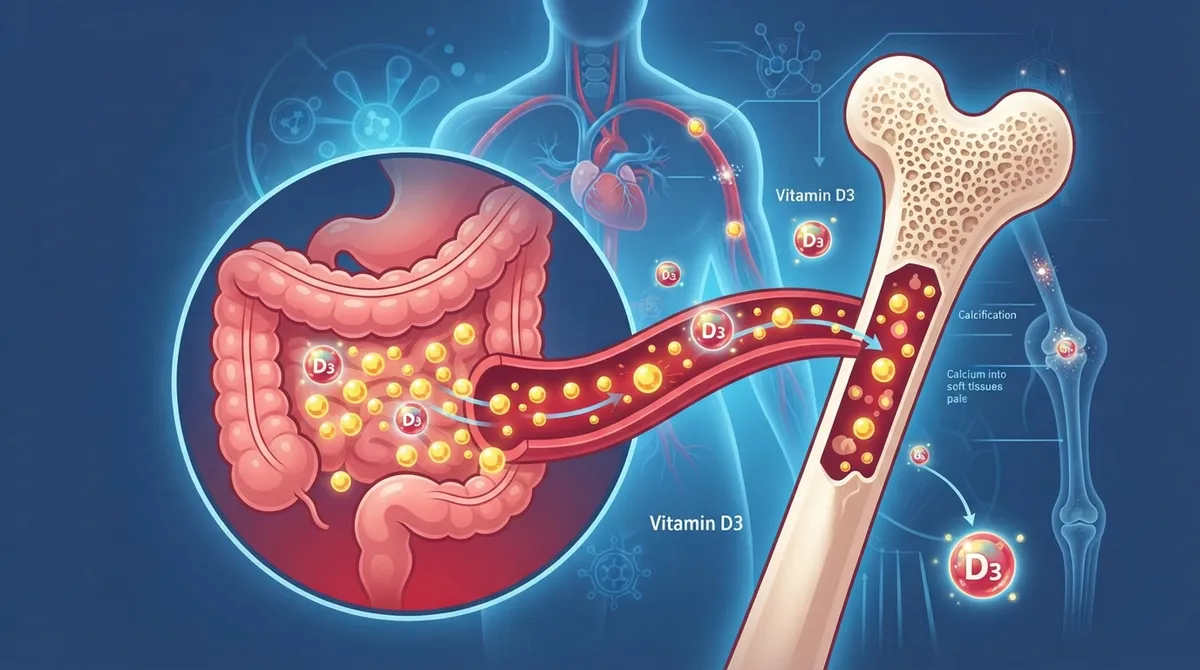
What Vitamin D3 and Vitamin K2 Actually Do
Vitamin D3, also called cholecalciferol, helps your body absorb calcium from food. It also supports bone mineralization. Your skin makes vitamin D3 when it is exposed to sunlight, and you also get it from fatty fish, fortified foods, and supplements.
Vitamin K plays a different role. It helps your blood clot. It also activates proteins that take part in bone metabolism. Vitamin K2 is one form of vitamin K, and it is commonly sold as menaquinone-7 (MK-7) or menaquinone-4 (MK-4).
Because the two nutrients work in different parts of the same process, makers often combine them. There is a sound biological reason for this idea. But a good reason on paper does not prove better health results in real people.
Why the Pairing Makes Sense on Paper
- Vitamin D3 helps move calcium into the body.
- Vitamin K helps activate proteins tied to bone and calcium handling.
- Both nutrients touch the same bone-building system from different angles.
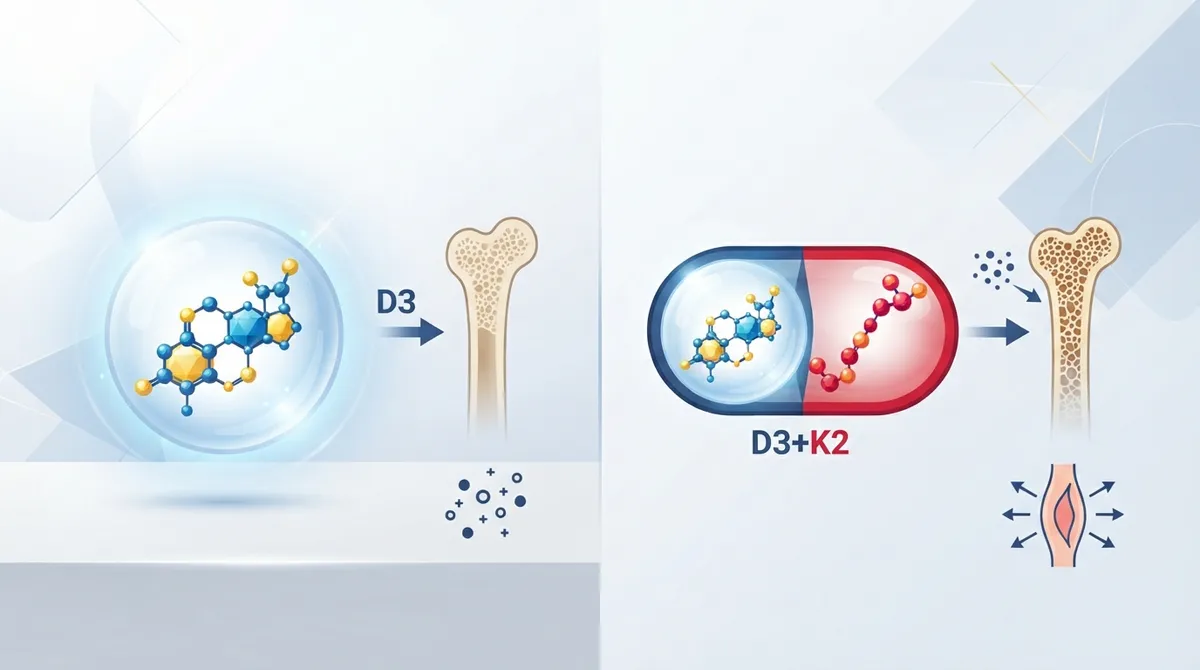
Vitamin D3 Alone vs. D3 With K2: A Side-by-Side Look
The table below compares the two choices. It reflects the current state of the evidence, not marketing claims.
|
Factor |
Vitamin D3 Alone |
Vitamin D3 With K2 |
|---|---|---|
|
Main role |
Calcium absorption and bone mineralization |
Calcium absorption plus support for proteins tied to bone metabolism |
|
Proven for deficiency |
Yes, when a deficiency is diagnosed |
D3 part helps; added K2 benefit is not established |
|
Fracture prevention |
Mixed evidence in the general population |
Not conclusively shown |
|
Artery calcification claims |
Not a proven benefit |
Not a proven benefit |
|
Warfarin interaction |
No direct effect |
Yes, K2 can change how warfarin works |
|
Cost |
Usually lower |
Usually higher |
What the Evidence Really Says About the Combination
Many labels say that D3 with K2 directs calcium into your bones and keeps it out of your arteries. That is a strong claim. The current research does not back it up for the general population.
Studies have not conclusively shown that taking both vitamins together prevents fractures, osteoporosis, heart disease, or hardening of the arteries. The idea is appealing, and some early findings are interesting. Still, a product should not be presented as proven to steer calcium to the right places.
This does not mean the combination is harmful for most people. It means you should not expect guaranteed results. Think of it as a possible extra, not a proven treatment.
How Much Vitamin D3 Do You Need?
Dose matters. More is not always better, especially with vitamin D. Here are the key numbers from the NIH Office of Dietary Supplements.
- Adults through age 70: The recommended dietary allowance is 600 IU (15 mcg) per day.
- Adults over age 70: The recommended amount rises to 800 IU (20 mcg) per day.
- Upper limit: The tolerable upper intake level for adults is 4,000 IU (100 mcg) per day from all sources.
- Higher doses: A clinician may prescribe more for a short time if you have a diagnosed deficiency.
Remember that the upper limit counts every source. That includes multivitamins, fortified foods, and calcium products that contain vitamin D. It is easy to overshoot if you stack several supplements.
How Much Vitamin K Do You Need?
Vitamin K intake is measured as total vitamin K, not just K2. For adults, the adequate intake is 90 mcg per day for women and 120 mcg per day for men. These are not treatment doses for K2 supplements. They are general targets, and many people reach them through leafy greens, vegetable oils, and fermented foods.
No tolerable upper intake level has been set for vitamin K. Even so, that does not mean any amount is safe for everyone. Your medicines and health history still matter.
Blood Tests: What Your Vitamin D Level Means
A simple blood test measures 25-hydroxyvitamin D. This number shows your vitamin D status. According to the NIH, the ranges look like this:
- At least 20 ng/mL (50 nmol/L): Sufficient for most people.
- Below 12 ng/mL (30 nmol/L): Indicates a risk of deficiency.
- Above 50 ng/mL (125 nmol/L): May be linked to harmful effects.
National professional groups do not recommend routine vitamin D screening for everyone. Testing is usually guided by your health situation. For example, a clinician may check your level if you have bone problems, kidney disease, limited sun exposure, or a condition that affects absorption.
The Risks: Too Much Vitamin D and the Warfarin Warning
Vitamin D Excess
Too much vitamin D can raise calcium in the blood, a problem called hypercalcemia. Signs can include nausea, weakness, extreme thirst, and frequent urination. Over time, it can lead to kidney stones, kidney failure, and abnormal heart rhythms. Avoid long-term, high-dose use unless a clinician is supervising you, especially if you also take calcium.
Vitamin K2 and Blood Thinners
This is the most important safety point. Vitamin K can strongly change how warfarin and similar vitamin K-antagonist medicines work. If you take one of these drugs, talk to your prescriber before you start, stop, or change a K2 supplement. You should also keep your vitamin K intake steady from day to day. Your care team may need to adjust how often they check your blood clotting.
Who Should Be Careful With These Supplements
Some people should get medical advice before taking D3 with K2. These include people who:
- Take warfarin or another blood thinner
- Have kidney disease or a history of kidney stones
- Have a calcium disorder or high blood calcium
- Are pregnant or breastfeeding
- Already take other vitamin D or calcium products
A short medication and supplement review can prevent problems. At InCare, our team can look at your full health picture through primary care and talk through whether a supplement makes sense for you.
Choosing Between D3 Alone and D3 With K2
Use these steps to decide with your clinician.
- Name your goal. Are you correcting a deficiency, supporting bone health, or following a general wellness plan?
- Check your diet. Food may already give you enough vitamin K and some vitamin D.
- Review your medicines. Blood thinners are the biggest concern with K2.
- Consider a blood test. A 25-hydroxyvitamin D result can show whether you truly need a supplement.
- Pick a sensible dose. Stay within recommended limits unless a clinician advises otherwise.
If you have a confirmed vitamin D deficiency and no blood thinner, vitamin D3 alone is often the simplest path. If you want to add K2, ask first. Neither option replaces an evaluation or treatment for osteoporosis or heart disease.
How to Take D3 and K2 for Best Absorption
Both vitamins are fat-soluble. That means your body absorbs them better with a meal that contains some fat. Take your supplement with breakfast or dinner rather than on an empty stomach. Taking it at the same time each day also helps you build a steady habit.
How a Primary Care Visit Can Help
Supplements work best as part of a bigger plan. A thorough visit can look at your diet, your sun exposure, your medicines, and your risk for bone loss. Our annual wellness visit is a good place to start, and our lab services can check your vitamin D level when it is clinically useful.
For people who want a deeper look, InCare also offers DNA gene testing and IV hydration and vitamin drips as part of whole-body wellness care. Our approach is to match each service to your needs rather than to sell a one-size-fits-all product. You can also follow our updates on Instagram, Facebook, and TikTok for practical health tips.
With locations in Tampa and Riverview, Florida, plus virtual visits, our clinic makes it easy to fit care into a busy week. Patients can read InCare reviews on Google to see what others say about their experience.
The Bottom Line
Vitamin D3 and vitamin K2 each have a clear job in the body. Together, they make sense in theory. But the proof that the pair prevents fractures, heart disease, or artery calcification is not strong enough to promise those results. Vitamin D3 alone remains the proven choice for correcting a deficiency, while K2 needs extra care if you take warfarin or a similar medicine.
The smartest move is to test, review, and personalize. Do not guess at doses or stack products without guidance. If you want a clear answer for your own body, book an appointment with InCare today or contact our team with your questions.
FAQs
Q: What are the benefits of taking vitamin D3 with vitamin K2?
A: Vitamin D3 supports calcium absorption and bone mineralization, while vitamin K2 helps activate proteins involved in bone metabolism. The two nutrients have complementary roles. However, current research does not prove that the combination prevents fractures or heart disease in the general population.
Q: Can I take vitamin D3 and K2 with warfarin or other blood thinners?
A: Use caution. Vitamin K can strongly change how warfarin and similar anticoagulants work. Speak with your prescriber before starting, stopping, or changing a K2 supplement, and keep your vitamin K intake consistent.
Q: What dose of vitamin D3 is safe?
A: Adults need 600 IU daily through age 70 and 800 IU after age 70. The upper limit is 4,000 IU per day from all sources. A clinician may prescribe higher short-term doses if you have a diagnosed deficiency.
Q: Should I take vitamin D3 and K2 with food?
A: Yes. Both are fat-soluble vitamins, so they absorb better with a meal that contains some fat. Taking them at the same time each day also helps you stay consistent.
Q: Do I need a blood test before taking vitamin D3 with K2?
A: A test is not required for everyone, and routine screening is not recommended for the general population. A 25-hydroxyvitamin D test can be helpful if you have risk factors or symptoms. A level of at least 20 ng/mL is sufficient for most people, while below 12 ng/mL signals deficiency risk.


