

Key Takeaways
- Vitamin D is well-proven for preventing deficiency and supporting bone strength, while evidence that adding K2 improves heart or bone outcomes beyond vitamin D alone remains limited.
- Anyone taking warfarin or another vitamin K antagonist should not start, stop, or change a K2 supplement without first consulting their anticoagulation clinician.
- Most adults need 600 IU (15 mcg) of vitamin D daily through age 70 and 800 IU (20 mcg) after 70; the upper limit is 4,000 IU daily from all sources unless a clinician directs otherwise.
- Routine vitamin D blood testing is not recommended for healthy adults without symptoms, but testing is useful with bone disease, limited sun exposure, or digestive conditions that affect absorption.
- Both vitamins are fat-soluble, so take the supplement with a meal containing fat, and count vitamin D from multivitamins and fortified foods to avoid doubling up.
- Choose products with third-party testing that list the exact K2 form (MK-4 or MK-7) and the dose of each vitamin, since supplements are not reviewed by the FDA like medicines.
Walk into any supplement aisle in 2026 and you will see bottles labeled "vitamin D with K2." The pitch is simple. Vitamin D helps your body absorb calcium. Vitamin K2 helps guide that calcium to the right places. Together, they promise stronger bones and a healthier heart.
But what does the science actually say? And does everyone need this combination? The honest answer is more nuanced than most labels suggest. The reasoning behind pairing these nutrients is sound. Proof that the combined pill improves health outcomes is still limited.
This guide explains how vitamin D with K2 works, who may benefit, how much is safe, and what to watch for. It also covers an important warning for anyone who takes blood thinners. Whether you are a busy parent, a wellness-minded professional, or simply curious, you will find clear, practical answers below.

What Is Vitamin D With K2?
Vitamin D with K2 is a dietary supplement that combines two fat-soluble vitamins in one product. Most formulas use vitamin D3 (cholecalciferol) paired with a form of vitamin K2 called menaquinone.
These are two distinct nutrients with different jobs. They are often sold together because they both touch calcium and bone metabolism.
The Role of Vitamin D
Vitamin D supports calcium and phosphorus absorption in the gut. It also helps with bone mineralization. Without enough vitamin D, bones can become soft or weak over time.
The Role of Vitamin K2
Vitamin K is needed to activate certain proteins in the body. Some of these proteins help with blood clotting. Others take part in bone metabolism. K2 is the form found in fermented foods and some animal products.
Not All K2 Is the Same
K2 refers to a group of compounds called menaquinones. The two most common in supplements are MK-4 and MK-7. Research on one form or dose should not be assumed to apply to another. This is one reason labels can be confusing.
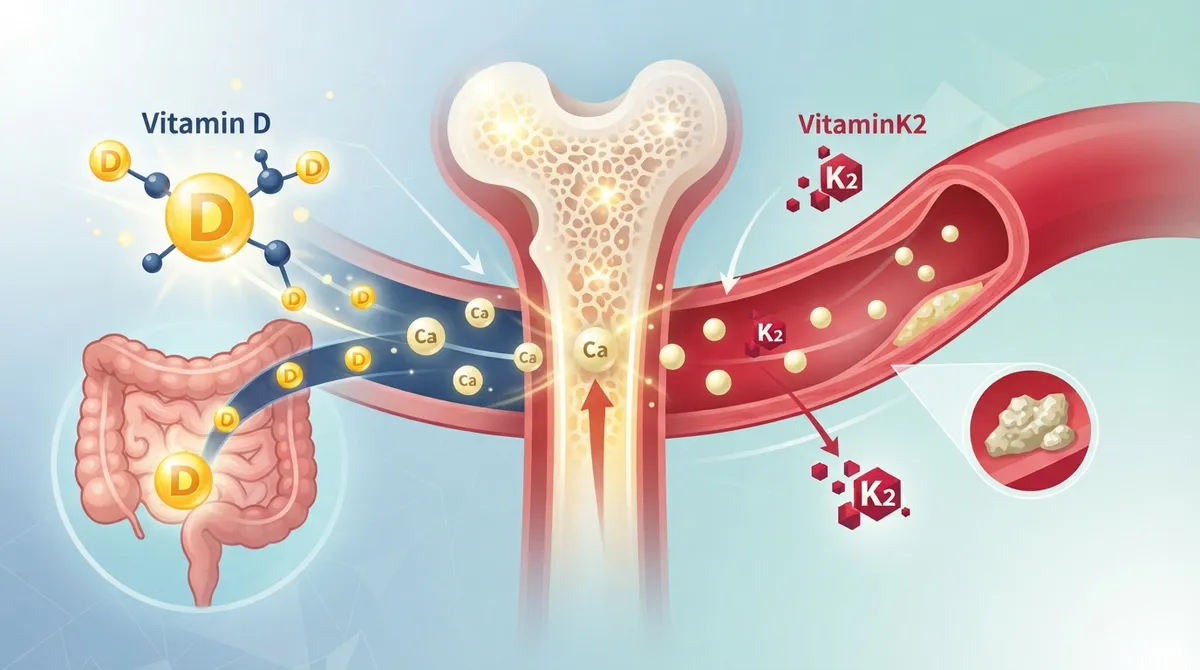
Why Are These Two Vitamins Paired Together?
The idea rests on biology. Vitamin D raises calcium absorption. K2 helps activate proteins that handle calcium once it is in the body. The theory is that the pair works as a team: D brings calcium in, and K2 helps direct it toward bone.
This logic is reasonable. However, a good biological rationale does not prove a clinical benefit. Current evidence does not show that adding K2 is necessary for everyone who takes vitamin D. It also does not show that the combination prevents heart disease or artery calcification.
That distinction matters. Marketing often runs ahead of the research. A balanced view helps you decide if the product fits your needs.
Potential Benefits: What the Evidence Supports
Let us separate what is established from what is still being studied.
Well-Established Benefits
- Vitamin D for bone health: Vitamin D is proven for preventing and treating deficiency. It also supports bone strength.
- Vitamin K for clotting: Vitamin K is essential for normal blood clotting.
Claims That Are Not Yet Proven
- Preventing arterial calcification: Some people believe K2 keeps calcium out of the arteries. This is not an established clinical benefit.
- Preventing heart disease: The combined supplement has not been shown to replace standard cardiovascular care.
- Treating osteoporosis alone: Studies of combined supplements are not strong enough to replace standard osteoporosis care.
In short, vitamin D has solid proof behind it. The K2 add-on is promising but unproven as a routine need.
How Much Vitamin D and K2 Do You Need?
Dose depends on age, diet, sun exposure, and health history. Here are the general guidelines from the National Academies and the NIH Office of Dietary Supplements.
|
Nutrient |
Group |
Recommended Amount |
|---|---|---|
|
Vitamin D |
Adults through age 70 |
600 IU (15 mcg) daily |
|
Vitamin D |
Adults over 70 |
800 IU (20 mcg) daily |
|
Vitamin D |
Upper limit (adults) |
4,000 IU (100 mcg) daily from all sources |
|
Vitamin K |
Adult men |
120 mcg daily (Adequate Intake) |
|
Vitamin K |
Adult women |
90 mcg daily (Adequate Intake) |
The 4,000 IU upper limit applies unless a clinician directs a higher dose for treatment. Vitamin K has no established upper limit. Even so, that does not mean any amount is right for every person.
Many people also get vitamin D from sunlight and food. Fatty fish, fortified milk, and eggs all contribute. Check your supplement label so you do not double up with a multivitamin.
Do You Need a Blood Test First?
This is a common question. The answer is: it depends on your situation.
A blood test measures 25-hydroxyvitamin D. According to the NIH, a level below 12 ng/mL (30 nmol/L) is linked with deficiency risk. A level of 20 ng/mL (50 nmol/L) or higher is enough for most people.
The U.S. Preventive Services Task Force says there is not enough evidence to recommend for or against screening healthy adults with no symptoms. So routine testing for everyone is not advised. Testing makes more sense when there are clinical reasons. These may include bone disease, limited sun exposure, certain digestive conditions, or a history of low levels.
A primary care visit is the best place to sort this out. Your doctor can review your history, order the right labs, and suggest a dose that fits you. At InCare primary care, this kind of personalized review is part of whole-body prevention.
Safety: Risks and Side Effects
Supplements feel harmless because they are sold without a prescription. But more is not always better.
Too Much Vitamin D
Excess vitamin D can raise calcium in the blood. This is called hypercalcemia. It can also raise calcium in the urine. Over time, this may lead to kidney stones or kidney injury.
The NIH notes that blood levels above 50 ng/mL (125 nmol/L) may be linked to harm. Very high levels, usually above 150 ng/mL (375 nmol/L), are tied to toxicity. Risk goes up with very high supplement doses. Some medical conditions and medicines that change calcium handling can also raise risk. High-dose or long-term use should be supervised by a clinician.
Vitamin K2 and Blood Thinners
This is the most important safety point. Vitamin K can strongly interfere with warfarin and similar medicines called vitamin K antagonists.
If you take one of these drugs, do not start, stop, or change a K2 supplement without talking to your anticoagulation clinician. Steady vitamin K intake and regular INR monitoring are key to staying safe.
Quality Matters
Supplements are not reviewed by the FDA the way medicines are. Look for products tested by an independent lab. Check that the label lists the exact form of K2 and the dose of each vitamin.
Who Might Consider Vitamin D With K2?
This combination is not for everyone. It may be worth discussing with your doctor if you:
- Have confirmed low vitamin D levels
- Have a higher risk of bone loss, such as after menopause
- Get little sun exposure or eat few vitamin D foods
- Have a digestive condition that limits nutrient absorption
- Want a single product instead of two separate pills
It is not a good fit if you take warfarin unless your care team approves. It also may not be needed if your vitamin D is already in a healthy range and your diet is balanced.
Tips for Taking Vitamin D With K2 Safely
If you and your doctor decide to try it, follow these steps:
- Review all medications first. Share every prescription, over-the-counter drug, and supplement with your clinician.
- Confirm your starting point. Get a vitamin D blood test if your doctor recommends one.
- Pick a quality product. Choose a brand with third-party testing and clear labeling.
- Take it with a meal that has fat. Both vitamins are fat-soluble, so food helps absorption.
- Stay within recommended limits. Count vitamin D from all sources, including multivitamins.
- Recheck levels when advised. Follow-up testing helps you avoid taking too much.
Food First: Natural Sources
Supplements fill gaps, but food is a strong foundation. You can boost both nutrients through your plate.
- Vitamin D: Salmon, trout, tuna, egg yolks, and fortified milk or cereal
- Vitamin K2: Natto, aged cheeses, egg yolks, and some fermented foods
- Vitamin K1 (leafy greens): Spinach, kale, and broccoli also contribute to total vitamin K intake
If you take a blood thinner, keep your leafy green intake steady from week to week. Sudden changes can affect how your medicine works.
How Primary Care Can Help You Decide
Supplement choices are personal. A one-size-fits-all pill rarely matches your real needs. A primary care team can look at the full picture, including your age, diet, labs, bone health, and medications.
For busy families, young professionals, and wellness seekers, this guidance saves time and money. It also reduces the risk of taking something you do not need. InCare offers comprehensive primary care, preventive screenings, and advanced wellness options at its Tampa and Riverview locations. The team can also connect nutrition and supplements with other goals, such as weight loss and DNA gene testing, for a more personalized plan.
With a 4.8 out of 5 rating on Google from hundreds of patients, InCare has built trust through friendly, thorough care. You can read InCare reviews on Google to see what patients say. You can also follow the clinic's wellness tips on Instagram, TikTok, and Facebook.
The Bottom Line
Vitamin D with K2 is a popular supplement with a sensible idea behind it. Vitamin D is well proven for bone health and deficiency. K2 plays a real role in how the body uses calcium. Still, the evidence does not yet show that the combo prevents heart disease or is needed by everyone.
The smartest path is to start with your own data. Know your vitamin D level when testing is appropriate. Stay within safe dose limits. Review your medications, especially if you take warfarin. And choose a quality product.
Ready for a personalized plan? Our team can review your health history, order the right tests, and guide your supplement choices. Book your appointment with InCare today, or contact our team with any questions.
FAQs
Q: What are the benefits of taking vitamin D3 with K2?
A: Vitamin D3 supports calcium absorption and bone health, and vitamin K2 helps activate proteins involved in bone metabolism. The pairing makes biological sense. However, current evidence does not prove that the combination improves outcomes beyond what vitamin D provides alone.
Q: Can vitamin D with K2 prevent heart disease or arterial calcification?
A: No. Claims that K2 prevents artery calcification or heart disease are not established as routine clinical benefits. The combination should not replace standard cardiovascular or osteoporosis care.
Q: Can I take vitamin K2 with warfarin or another blood thinner?
A: Not without medical guidance. Vitamin K can strongly interfere with warfarin and similar medicines. Talk to your anticoagulation clinician before starting, stopping, or changing any K2 supplement.
Q: What dose of vitamin D should I take daily?
A: Most adults need 600 IU (15 mcg) daily through age 70 and 800 IU (20 mcg) after age 70. The upper limit is 4,000 IU (100 mcg) daily from all sources unless a clinician directs otherwise. Your best dose depends on your lab results and health history.
Q: Do I need a blood test before taking vitamin D supplements?
A: Routine testing is not recommended for healthy adults without symptoms. A test may be helpful if you have bone concerns, limited sun exposure, or absorption problems. Your primary care doctor can decide if testing fits your situation.


