
Key Takeaways
- Confirm low testosterone with two separate early-morning fasting blood tests before starting treatment, since a single low result is not enough to diagnose deficiency.
- Ask for a full workup to find the cause of low testosterone, because symptoms overlap with sleep apnea, thyroid disease, depression, and diabetes.
- Make sure baseline safety checks are done before starting: hemoglobin and hematocrit, plus a PSA test for men over 40.
- Discuss fertility before any prescription is written, since testosterone therapy can suppress sperm production and is generally inappropriate for men wanting children soon.
- Expect ongoing monitoring of blood pressure, blood counts, and symptoms, since the 2025 FDA labeling update made blood pressure tracking a bigger part of safe care.
- Treat TRT as ongoing medical care, not a one-time purchase, and be wary of any provider that skips testing, safety checks, or follow-up.
Low energy, poor sleep, a flat mood, and a drop in drive can make anyone ask whether testosterone is the cause. If that sounds familiar, you may be wondering how to get testosterone replacement therapy and where to start. The answer is simpler than many people think, but the path you choose matters.
In 2026, men can seek care through a primary care clinic or through an online-only service. Both promise convenience. They differ in testing, safety checks, follow-up, and how well they treat the whole person. Testosterone replacement therapy (TRT) is a prescription treatment for diagnosed testosterone deficiency. It is not a general anti-aging tool.
This guide compares the two main routes side by side. You will learn how the process works, what tests are required, what the latest FDA labeling says, and how to pick the right option for your health and schedule.

What Testosterone Replacement Therapy Is (and Is Not)
TRT is a medical treatment for adults who have symptoms of low testosterone and repeatedly low blood levels. The Endocrine Society recommends confirming the diagnosis with a repeat morning, fasting testosterone test. A single low result is not enough on its own.
TRT is also not meant for age-related decline in men who have no related medical condition. FDA labeling still limits use in that case. So the goal is to find out whether a true deficiency exists and what is causing it.
Common symptoms that lead people to ask about TRT include:
- Low sex drive or erectile changes
- Ongoing fatigue and low motivation
- Loss of muscle mass or strength
- Increased body fat, especially around the waist
- Low mood, irritability, or poor focus
- Poor sleep quality
These symptoms overlap with many other problems, such as sleep apnea, thyroid disease, depression, and diabetes. That is why a careful workup comes first.
Two Paths to TRT: A Quick Overview
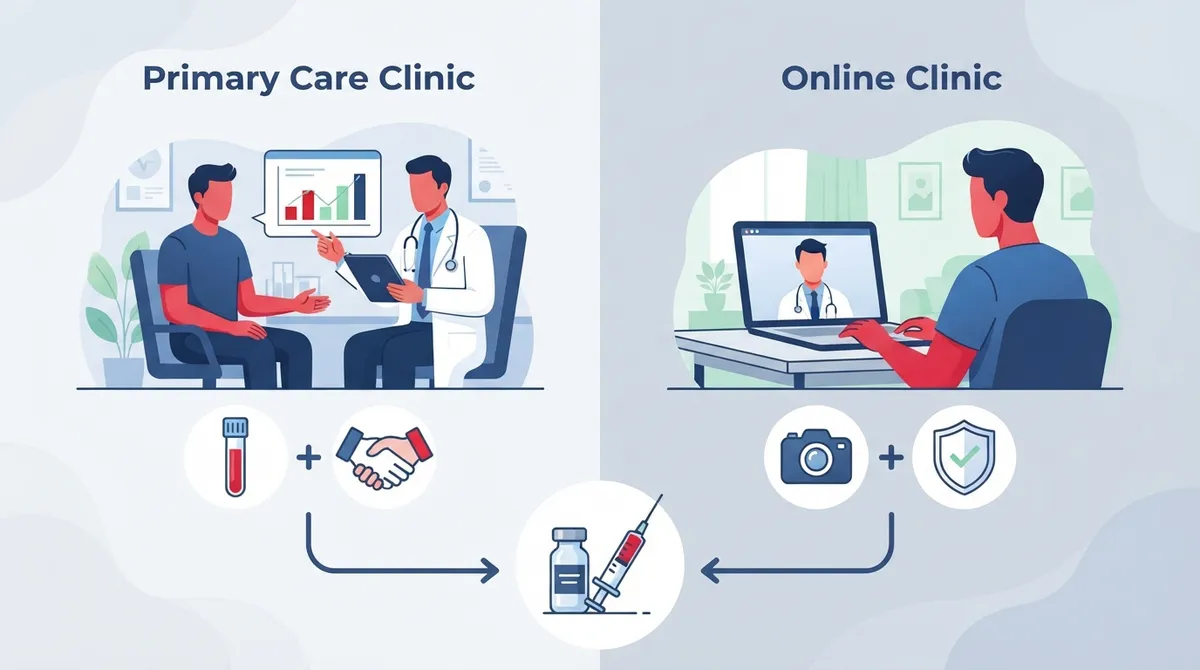
Most people choose between two routes. The first is a primary care or wellness clinic that sees you in person or by video visit. The second is an online-only telehealth service that focuses on hormone prescriptions.
Here is how the two compare at a glance.
|
Factor |
Primary Care & Wellness Clinic |
Online-Only Hormone Service |
|---|---|---|
|
Medical history review |
Full review with a physician who knows your record |
Often a short intake form |
|
Lab testing |
Repeat morning labs plus safety panels |
Varies; may rely on mail-in kits |
|
Cause of low testosterone |
Investigated as part of the visit |
Often not explored in depth |
|
Other health conditions |
Managed in the same practice |
Usually not addressed |
|
Follow-up and monitoring |
Coordinated with your full care team |
Limited to the hormone plan |
|
Fertility discussion |
Built into the visit |
May be brief |
|
Convenience |
Same-day and virtual options at many clinics |
Very high |
Convenience is the main draw of online services. Depth of care is the main draw of a primary care clinic. For a treatment that affects blood counts, the prostate, fertility, and blood pressure, depth tends to matter more.
Step-by-Step: How to Get Testosterone Replacement Therapy
Whichever route you pick, the right process follows the same medical steps. Use this list to judge any provider.
- Book an evaluation. Share your symptoms, medical history, medications, sleep habits, and goals. A primary care doctor can begin this evaluation and order the tests.
- Complete a physical exam. Your clinician checks weight, blood pressure, and signs that point to hormone problems.
- Get repeat morning blood tests. The American Urological Association (AUA) recommends two early-morning total testosterone measurements on separate occasions before diagnosing deficiency.
- Look for the cause. Additional tests may be ordered to find out why levels are low and whether treatment is a good fit.
- Complete baseline safety checks. These commonly include hemoglobin and hematocrit. The AUA also recommends a PSA test before treatment in men over 40.
- Discuss fertility. This step must happen before any prescription is written.
- Choose a treatment form and start. You and your clinician select a product that fits your health and lifestyle.
- Follow up and monitor. Symptoms, hormone levels, side effects, and safety labs are rechecked over time.
If a provider skips steps three through six, treat that as a red flag. Fast approvals may feel convenient, but they can miss problems that matter.
Why Testing Standards Matter
Testosterone levels swing during the day. They are usually highest in the early morning. That is why guidelines call for morning samples and a repeat test.
A proper workup protects you in two ways. It prevents treatment of men who do not have true deficiency. It also helps find other conditions that mimic low testosterone, such as sleep apnea or diabetes. A clinic that offers primary care alongside hormone care can look at all of these factors in one place.
In-house lab testing also speeds things up. You can learn more about the tradeoffs in our guide on in-house vs. external lab testing services.
Fertility: The Question You Must Not Skip
Testosterone therapy can suppress sperm production. For men who want children now or in the near future, TRT is generally not appropriate without specialist guidance. The AUA recommends a reproductive-health evaluation before treatment for men interested in fertility.
A primary care clinic can raise this topic early and refer you to a urologist or endocrinologist if needed. Referral may also make sense when the cause of low testosterone is unclear or when other conditions complicate care. Some online services treat this as a quick checkbox. In person, it becomes a real conversation.
If you are curious about natural options that may support hormone health, read our article on how to support healthy testosterone production at 40+.
Treatment Forms Compared
If TRT is prescribed, testosterone comes in several forms. The right one depends on clinical factors, preference, cost, and the product's specific instructions.
|
Form |
How It Is Used |
Points to Consider |
|---|---|---|
|
Injections |
Given on a set schedule |
Levels can rise and fall between doses; some prefer a clinic setting |
|
Gels |
Applied to the skin daily |
Convenient, but skin contact can transfer the product to others |
|
Patches |
Worn on the skin |
Steady delivery; skin irritation can occur |
|
Oral products |
Taken by mouth |
Each product has its own instructions and safety notes |
No single form is best for everyone. A good clinician explains the options, answers your questions, and adjusts the plan if it is not working. To see how a supervised approach looks in practice, explore physician-supervised testosterone injections.
What the 2025 FDA Update Means for You
In 2025, the FDA announced class-wide labeling changes for testosterone products. The agency acted after the TRAVERSE trial and postmarket blood-pressure studies.
Here is what changed:
- The FDA removed the class-wide boxed-warning language about increased adverse cardiovascular outcomes.
- Completed studies confirmed that testosterone products, as a class, can raise blood pressure, so warnings about this were required or added.
- The limitation of use for age-related low testosterone without an associated medical condition remains in place.
This update does not make TRT risk-free. It makes blood pressure monitoring a bigger part of safe care. A clinic that already manages hypertension can track this for you. Our guide to blood pressure management in 2026 explains why it matters.
Risks and Side Effects to Discuss
Every treatment has tradeoffs. Before you start TRT, your clinician should review these points with you:
- Higher red blood cell counts, which is why hemoglobin and hematocrit are checked
- Possible rise in blood pressure
- Reduced sperm production and fertility
- Prostate monitoring, including PSA testing in men over 40
- Skin reactions or injection-site discomfort, depending on the product
- Possible worsening of sleep apnea in some people
Monitoring is what keeps these risks manageable. Ask any provider how often they will recheck your labs and symptoms. A clear answer is a good sign. A vague one is not.
Primary Care vs. Online Clinic: Which Wins?
Online services win on speed and privacy. For a busy professional or a young parent with little free time, that appeal is real. But TRT is not a one-time purchase. It is an ongoing medical treatment that needs labs, safety checks, and adjustments.
A primary care and wellness clinic wins on depth. Your doctor sees the full picture, including weight, sleep, blood pressure, blood sugar, and mental health. Low testosterone often travels with other conditions. Treating only the hormone can miss the bigger story.
Many modern clinics now close the convenience gap. Virtual visits, same-day appointments, and in-house labs bring the best of both worlds. If you prefer to shop around for a physician, our article on finding the right internal medicine doctor offers helpful tips.
Who Should Lean Toward Primary Care
- Men with several symptoms or other chronic conditions
- Men who may want children in the future
- Men over 40 who need PSA and blood count monitoring
- Anyone who wants one team to manage all of their health
Who Might Consider Online Care First
- Men who live far from a clinic and cannot travel
- Patients who already have a full workup and only need ongoing follow-up through a licensed provider
Even then, the best online care should require proper testing and monitoring. If it does not, a clinic visit is the safer choice.
How InCare Approaches Testosterone Care
InCare is a personalized primary care and wellness clinic serving Tampa and Riverview, Florida. The practice combines medical expertise with advanced technology and focuses on prevention and whole-body health. That approach fits TRT well, because hormone care works best alongside screening, metabolic insight, and regular follow-up.
Patients can learn the basics in our overview of testosterone replacement therapy at InCare. Those in the Tampa area can also review our page on the Tampa testosterone clinic, and Riverview residents can see our Riverview testosterone clinic information. You can also meet the providers who guide care.
Patients tell us they value the friendly staff and the time their physicians take. You can read what people say and see InCare reviews on Google. We also share health tips on Instagram, Facebook, and TikTok.
Questions to Ask Any TRT Provider
Use these questions to compare clinics or online services before you commit:
- Will you order two early-morning testosterone tests?
- How will you look for the cause of my low levels?
- Do you check hemoglobin, hematocrit, and PSA before treatment?
- How will you handle fertility questions?
- How often will you monitor my labs, blood pressure, and symptoms?
- Who do I contact if I have side effects?
- What does the full plan cost over time, including labs?
Clear, confident answers show a provider who takes safety seriously.
Take the Next Step Toward Safe Testosterone Care
Getting TRT the right way means a real evaluation, repeat morning labs, honest talk about fertility and risks, and steady follow-up. A primary care and wellness clinic delivers all of that under one roof and looks at your whole health, not just one number.
If you are ready to find out whether low testosterone is behind your symptoms, book your evaluation at InCare today. Prefer to talk first? Contact our team with your questions, and we will help you choose the best next step.
FAQs
Q: Can my primary care doctor prescribe testosterone replacement therapy?
A: Yes. A primary care clinician can start the evaluation, order testing, and prescribe TRT when it is medically appropriate. Referral to an endocrinologist or urologist may be advised if the cause is unclear, fertility is a priority, or other conditions complicate care.
Q: What tests are needed before starting testosterone therapy?
A: Most guidelines call for two early-morning total testosterone tests on separate occasions. Baseline safety checks commonly include hemoglobin and hematocrit, and the American Urological Association recommends PSA testing before treatment in men over 40.
Q: Can testosterone replacement therapy affect fertility?
A: Yes. Exogenous testosterone can suppress sperm production, so TRT is generally not appropriate for men seeking current or near-term fertility without specialist guidance. Discuss your family plans with your clinician before you begin.
Q: How often are blood tests and follow-up visits needed on TRT?
A: Follow-up is an ongoing part of treatment. Your clinician rechecks symptoms, testosterone levels, side effects, and safety labs on a schedule tailored to you, including blood pressure monitoring in line with updated FDA labeling.
Q: Is testosterone replacement therapy meant for normal aging?
A: No. TRT is intended for adults with symptoms and repeatedly low testosterone levels from a diagnosed deficiency. FDA labeling continues to limit use for age-related low testosterone without an associated medical condition.


