
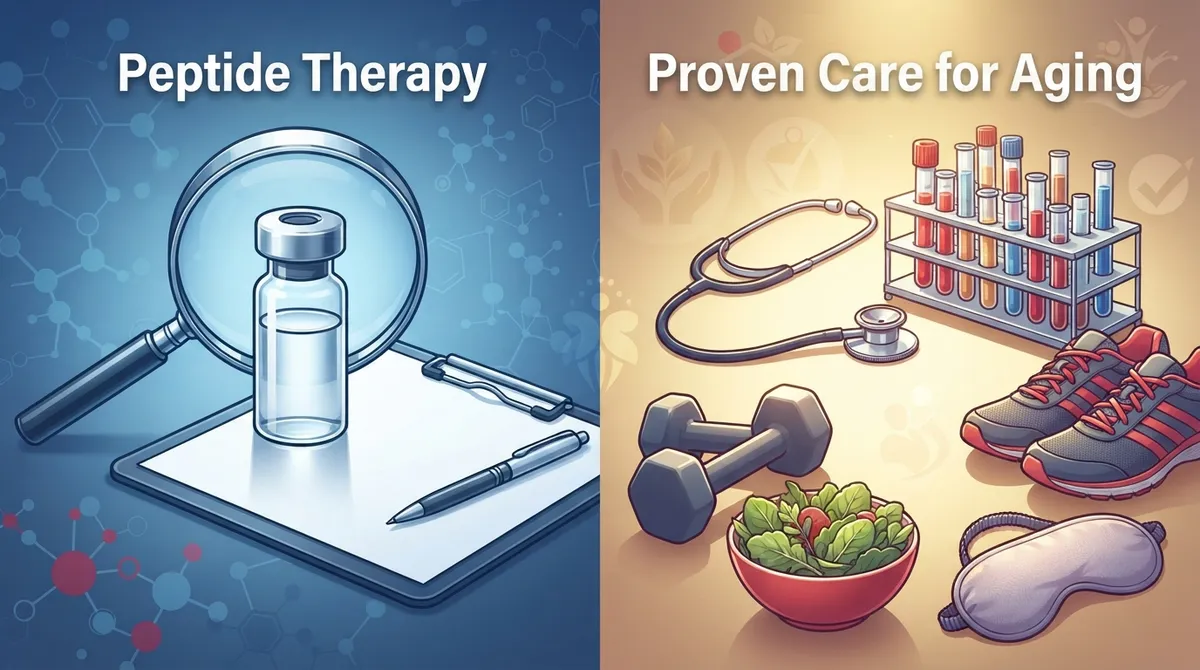
Key Takeaways
- Peptide therapy is not one standard treatment; each compound has its own evidence, FDA status, and risks, so claims about 'peptide therapy' as a whole should be questioned.
- Popular wellness peptides like BPC-157, TB-500, CJC-1295, and ipamorelin are not FDA-approved for anti-aging, and most supporting data come from animal or lab studies.
- Before starting any peptide, ask for the exact drug name, dose, route, FDA status for your use, human evidence, the prescribing clinician, the supplying pharmacy, and how side effects are tracked.
- Evidence-backed aging care starts with a physician baseline: history, medication review, labs, preventive screening, strength training, aerobic exercise, sleep, and nutrition.
If you search for a clinic to recommend peptide therapy for aging in Tampa, you will find bold promises. Many ads say peptides can turn back the clock. The science is more careful than the marketing. Peptide therapy is not one treatment. It is a broad label that covers many different compounds, and each has its own rules, evidence, and risks.
This guide compares two paths for healthy aging in 2026. The first is peptide therapy, as it is often sold in wellness clinics. The second is a physician-led, evidence-first plan built on primary care. If you are a busy professional, a health-conscious parent, or a wellness seeker who likes new technology, this comparison will help you decide with confidence.
At InCare, we believe the best aging plan starts with data about your own body. We also believe in honest talk about what is proven and what is not. Let's look at both options side by side.

What Peptide Therapy Actually Means
Peptides are short chains of amino acids. Your body makes thousands of them. Some act as hormones, like insulin. Others help cells talk to each other. Because they are natural messengers, they sound like a perfect anti-aging tool.
The problem is the word "peptide therapy." It is not one standard treatment. Peptides differ in structure, how you take them, legal status, and the quality of research behind them. An FDA approval applies to one specific product for one specific use. It does not cover the whole category.
For a deeper primer, read our guide on what peptides are and how they relate to longevity.

The Regulatory Reality for Aging Claims
Some peptide-based medicines are FDA-approved for clear medical needs. Examples include certain drugs for diabetes and weight management. That approval does not mean they reverse aging. It also does not mean they are approved for general wellness or longevity.
Popular wellness compounds are a different story. BPC-157, TB-500, CJC-1295, and ipamorelin are not FDA-approved for anti-aging. Much of the support for them comes from lab and animal studies. High-quality human trials are limited or missing, and long-term safety data are thin.
The FDA has also flagged safety concerns about certain bulk substances proposed for compounding. Its listed concerns include:
- Peptide impurities and product contamination
- Difficulty identifying the exact active ingredient
- Possible immune reactions
- Limited safety information for some routes of use
Compounded drugs are not FDA-approved. They do not get the same pre-market review for safety, effectiveness, and quality. Rules also change, so always check the current FDA compounding page before you decide.
What the Research Shows So Far
Recent reviews paint a measured picture. A 2025 systematic review of BPC-157 in orthopedic and sports-medicine settings included 36 studies. Of those, 35 were preclinical and only one was clinical. The authors called the evidence low-level and noted that established human safety data were missing.
A separate 2025 review of anti-aging peptides reached a similar view. Clinical evidence for many experimental peptides remains limited. Long-term safety data are lacking, especially for older adults.
This does not mean peptide science is useless. Research is active, and some findings are interesting. It means patients deserve honest language. A clinic that promises to reverse aging is selling hope, not proof.
Two Paths Compared: Peptide-First vs. Evidence-First Care
The table below compares a typical peptide-first wellness approach with a primary care, evidence-first plan.
|
Factor |
Peptide-First Approach |
Evidence-First Primary Care |
|---|---|---|
|
Starting point |
Often a product or protocol |
Medical history, exam, labs, and your goals |
|
Evidence for anti-aging |
Limited human data for most compounds |
Strong data for screening, exercise, sleep, and nutrition |
|
FDA status |
Many popular compounds not approved for aging |
Standard, approved care and guideline-based screening |
|
Safety monitoring |
Varies widely by clinic and pharmacy |
Ongoing follow-up with one accountable physician |
|
Product quality |
Can vary, especially with poorly sourced products |
Regulated medicines and accredited labs |
|
Claims |
Can be broad or overstated |
Measured, with uncertainty stated plainly |
The takeaway is simple. Evidence-first care gives you a safer foundation. If peptides are ever part of your plan, they should sit on top of that foundation, not replace it.
The Risks Worth Knowing
Risks depend on the exact product and how it is given. Reported or plausible concerns include:
- Injection-site reactions such as redness, pain, or swelling
- Allergic or immune responses
- Dosing errors or contamination from poorly sourced products
- Side effects that are specific to a single compound
Please avoid self-injection. Also avoid any product sold as a "research chemical." These products are not meant for human use, and you have no assurance of what is inside the vial. Talk with a licensed clinician first.
How to Evaluate Any Peptide Clinic in Tampa
Marketing terms like "medical grade" do not prove approval or results. Use this checklist to protect yourself.
- Ask for the exact drug name. Get the compound, the dose, and the route of use in writing.
- Ask about FDA status. Is it approved for this specific use, or is it compounded?
- Ask for the human evidence. Request studies in people, not only in animals or cells.
- Ask who prescribes it. Confirm the clinician is licensed and will see you for follow-up.
- Ask which pharmacy supplies it. Confirm how product quality is checked.
- Ask how side effects are tracked. A good clinic has a clear monitoring plan.
Our article on choosing a peptide therapy provider in Tampa Bay goes deeper on these questions. You can also review our peptide therapy safety guide for Tampa patients.
What Evidence-First Aging Care Looks Like
Healthy aging is built from habits and screening that have decades of support. A strong plan often includes the following parts.
A Full Baseline Assessment
Your visit should start with your story. That means your history, your medicines, your supplements, and your goals. Then comes an exam and labs. Our guide on what happens during an annual wellness visit shows what to expect.
Preventive Screening
Finding problems early matters more than almost any supplement. Age-appropriate cancer screening, blood pressure checks, and metabolic labs all play a role. Our primary care team manages these steps in one place.
Personalized Data and Testing
Modern tools can show how your body really works. DNA gene testing can offer insight into health tendencies. Body composition analysis tracks muscle and fat over time. Metabolic breath analysis measures how efficiently you burn fuel. These tools turn guesswork into a plan.
Core Lifestyle Pillars
- Strength training to protect muscle as you age
- Regular aerobic exercise for heart and brain health
- Consistent sleep and stress management
- Protein-aware, balanced nutrition
- Medication and supplement review to avoid harmful overlap
If you want a closer look at how doctors think about long life, see why longevity medicine starts with primary care.
How a Primary Care Doctor Evaluates Aging Concerns
Fatigue, muscle loss, poor sleep, and brain fog are often blamed on "just getting older." They can have treatable causes. A careful physician looks for them first. Possible causes include thyroid problems, low vitamin levels, sleep apnea, anemia, blood sugar changes, medicine side effects, and low mood.
When a cause is found, treatment can be direct and effective. When none is found, your doctor can still help you build habits that support energy and strength. This step-by-step thinking is what separates real medicine from a quick-fix sales pitch.
Where Peptides Might Fit, If at All
Some peptide-based medicines are real, approved tools for specific conditions. A physician may discuss them if you meet the medical criteria. Our resources on medical weight loss explain how approved options are used with monitoring.
For other peptides, a careful clinician will share what is known and what is not. They will explain the lack of long-term data. They will also check your history and offer proven alternatives. You can read our view on peptide therapy for anti-aging and on peptides in Tampa. The guiding rule is clear: your safety and informed consent come first.
The Verdict: Which Path Wins?
For most people, the evidence-first path wins. It is safer, better supported, and built around you. Peptide therapy may have a role in select cases, but only with transparency, a licensed prescriber, quality-checked products, and follow-up care.
This approach fits different readers well:
- Tech-savvy professionals get data-driven testing and clear tracking.
- Busy families get one trusted team for screening and prevention.
- High-income wellness seekers get advanced diagnostics without hype.
- Younger adults and women building a first care relationship get a strong prevention base early.
Patients trust InCare for this balance. You can read what others say in our patient testimonials, or read InCare reviews on Google. Our Tampa location is near downtown, and our providers take time to explain your options. You can also follow our health tips on Instagram, TikTok, and Facebook.
Take the Next Step
Aging well does not need a miracle. It needs a clear plan, good data, and a doctor who tells you the truth. If you are considering peptides, start with a conversation about your goals and your health history.
Ready to build a smart, safe aging plan? Book your appointment with InCare today, or contact our team with questions. We serve patients across Tampa and Riverview, and we are glad to help you take the first step.
FAQs
Q: Does peptide therapy reverse aging or extend lifespan?
A: No peptide therapy has been proven to reverse aging or extend human lifespan. Reviews published in 2025 describe the clinical evidence for many anti-aging peptides as limited, with little long-term safety data in older adults.
Q: Are BPC-157, CJC-1295, or ipamorelin FDA-approved for anti-aging?
A: No. BPC-157, TB-500, CJC-1295, and ipamorelin are not FDA-approved for anti-aging uses. The FDA has also listed safety concerns for some of these substances in compounding, so check its current guidance before considering them.
Q: What questions should I ask before starting peptide therapy in Tampa?
A: Ask for the exact drug, its FDA status for your use, and the human studies behind the claim. Also ask who prescribes it, which pharmacy supplies it, and how product quality and side effects are monitored.
Q: What are evidence-based alternatives for healthy aging?
A: Strong options include preventive screening, strength and aerobic exercise, quality sleep, balanced nutrition, and medication review. A primary care physician can tailor these steps to your history and goals.
Q: How should a doctor evaluate fatigue or muscle loss that is blamed on aging?
A: A physician should review your history, medicines, and symptoms, then perform an exam and order appropriate labs. This helps find treatable causes such as thyroid issues, sleep apnea, anemia, or nutrient deficiencies before any other therapy is considered.