

Key Takeaways
- There is no established evidence-based protocol showing that popular wellness peptides improve weight loss, protect muscle, or are safe when added to GLP-1 medicines like semaglutide or tirzepatide.
- Compounded drugs are not FDA-approved or reviewed for safety, quality, or effectiveness before marketing, and the FDA has reported dosing errors with compounded injectable semaglutide, some causing hospitalization.
- Before adding any peptide, name every ingredient with its dose and source, check whether it is FDA-approved, compounded, or labeled for research use only, and ask for human studies of that exact combination with a GLP-1.
- Combining agents that affect appetite, digestion, glucose, or fluid balance can add side effects and make it hard to tell which product caused a symptom, so clinician review of your full medication list is essential.
Social media is full of claims about "peptide stacks" that supposedly boost GLP-1 weight loss, protect muscle, and speed recovery. If you are taking semaglutide or tirzepatide, you may be wondering how peptide stacks work with GLP-1 medications and whether adding one is smart. The honest answer is more careful than the marketing suggests.
"Peptide stack" is a marketing term, not a medical treatment. It usually means combining several peptide products at once. The ingredients, doses, and quality vary widely, and there is no established evidence-based protocol showing that popular wellness peptides improve results when added to a GLP-1 medicine.
This guide shows you how to evaluate a stack step by step, using your primary-care team as a safety partner. You will learn what GLP-1 medicines do, where the evidence stops, which risks matter most, and which questions to ask before you add anything. InCare's clinicians in Tampa and Riverview use this same approach with patients every day.

What Is a Peptide Stack?
Peptides are short chains of amino acids. Some are approved medicines. Semaglutide, liraglutide, and tirzepatide are all peptide-based drugs. That is where confusion starts: "peptide" describes a chemical category, not a level of proof.
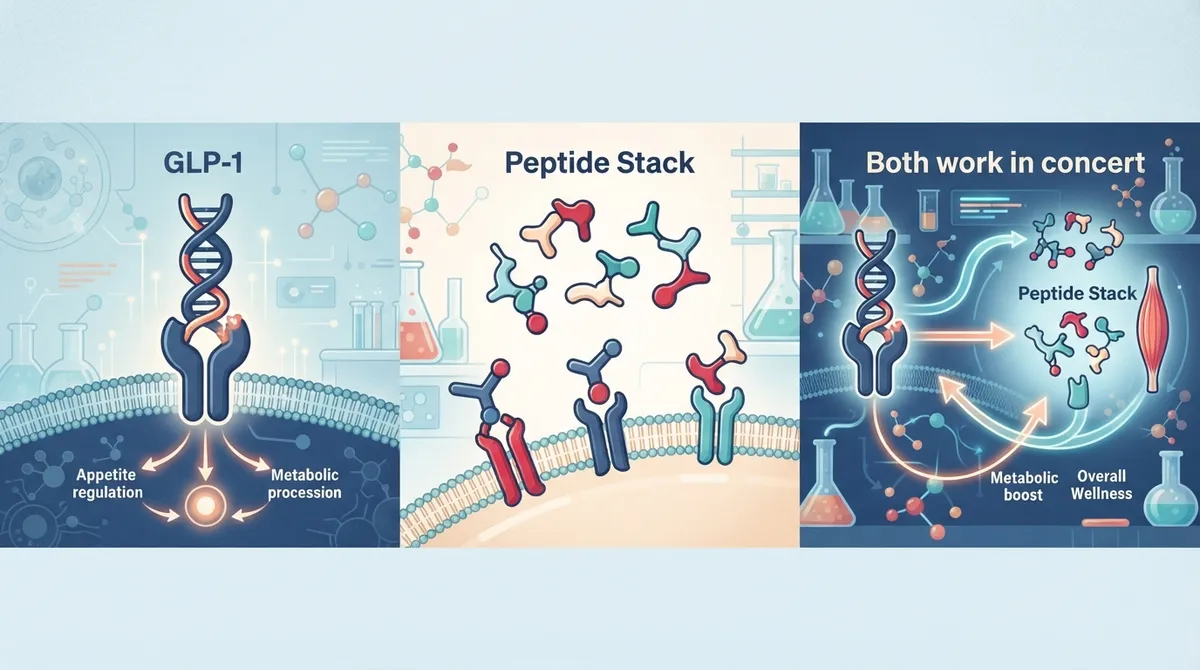
A "stack" is a casual label for taking more than one product together. A stack might pair a GLP-1 medicine with other peptides sold for healing, fat loss, or anti-aging. Each product has its own regulatory status and evidence base. Combining them does not create a validated treatment.
Approved Medicines vs. Marketed Stacks
|
Feature |
FDA-Approved GLP-1 Medicine |
Typical Marketed "Peptide Stack" |
|---|---|---|
|
Safety and quality review |
Reviewed by FDA before marketing |
Often none, or varies by product |
|
Standard dosing |
Defined in product labeling |
Varies by seller or source |
|
Evidence for the combination |
Studied in clinical trials |
Usually no combination trials |
|
Clinical oversight |
Prescribed with monitoring |
Often self-directed |
How GLP-1 Medications Actually Work
To judge any add-on, start with what the base medicine does. GLP-1 medicines such as semaglutide and liraglutide, and the dual GIP/GLP-1 medicine tirzepatide, act on appetite and blood sugar pathways. They help you feel full sooner, slow stomach emptying, and support glucose control.
These drugs are prescribed for specific indications and should follow the product labeling and clinician guidance. The World Health Organization's 2025 guideline conditionally recommended GLP-1 therapies as a long-term option for adults living with obesity. It also recommended behavioral support alongside treatment, and it noted uncertainty around long-term data and access.
That is the evidence foundation. Anything added on top needs its own proof. You can learn more in our guide on how GLP-1 medications transform weight loss in 2026.
How to Evaluate a Peptide Stack Step by Step
Use this checklist before adding any peptide to a GLP-1 plan.
- Name every ingredient. Write down each peptide, its dose, and its source. If a seller cannot give you this, stop there.
- Check the regulatory status. Ask whether each product is FDA-approved, compounded, or sold as "research use only."
- Look for human evidence. Ask whether the specific combination has been studied in people, not just in animals or cells.
- Review your medication list. Your clinician should check for overlapping effects on appetite, digestion, glucose, or fluids.
- Set a measurable goal. Decide what you want the add-on to change, such as strength, recovery, or lab values, and how you will track it.
- Plan follow-up. Schedule check-ins so side effects are caught early.
If a product fails step two or step three, the safest choice is usually to wait. Our article on FDA-approved vs. compounded peptides explains the differences in more detail.
What the Evidence Does and Does Not Show
There is no established evidence-based protocol showing that commonly marketed wellness peptides improve weight loss, preserve muscle, or are safe when added to a GLP-1 medicine. Evidence for approved medicines and studied combinations should not be stretched to cover unapproved stacks.
Research on combination obesity treatments is active, but it focuses on defined drug pairings tested under controlled conditions. That is very different from mixing separate products bought from different sources. If you want a deeper look at one popular peptide, see what wellness patients should know about BPC-157.
Common Claims and How to Test Them
- "It protects muscle on GLP-1s." Ask for human trial data. Strength training, protein intake, and body composition tracking have far stronger support. A body composition analysis can show whether you are losing fat or lean mass.
- "It boosts weight loss." Ask which study measured this in people who were also taking a GLP-1 medicine.
- "It reduces side effects." Ask how this was measured, and whether it could instead mask a warning sign.
Risks of Combining Peptides With GLP-1 Medications
Combining agents that affect appetite, digestion, glucose, or fluid balance can add side effects. It can also make it hard to tell which product caused a symptom. GLP-1 medicines commonly cause stomach and bowel effects, and a second product may blur the picture.
Quality and dosing add another layer of risk. The FDA states that compounded drugs are not FDA-approved and are not reviewed for safety, effectiveness, or quality before marketing. The agency advises that compounding should generally be reserved for cases where a patient's medical need cannot be met by an approved drug.
Dosing Errors and Unapproved Forms
The FDA has reported dosing errors with compounded injectable semaglutide. These involved mistakes measuring doses from multidose vials and confusion about concentrations or units. Some errors led to adverse events, including hospitalization.
The agency also warns against unapproved semaglutide salt forms, such as semaglutide sodium or acetate. These are not the same active ingredient as approved semaglutide products. As of July 31, 2025, the FDA had received 605 adverse event reports tied to compounded semaglutide and 545 tied to compounded tirzepatide. These are reports, not proof of cause, and reporting may be incomplete. Still, they show why oversight matters.
Compounding policies change over time. The FDA declared the national semaglutide shortage resolved on February 21, 2025, so always check current agency guidance. For related context, read our guide on compounded semaglutide facts, risks, and options.
How a Primary-Care Approach Works
A safe plan starts with you, not with a product. At InCare, the process follows a clear order.
- Review your diagnosis and goals. Your clinician confirms why a GLP-1 medicine is appropriate and what you want to achieve.
- Check contraindications and your medication list. This includes supplements and anything bought online.
- Start with approved options. Approved treatments come first because their safety and quality are reviewed.
- Evaluate any second product. If you ask about a peptide, your clinician looks at its evidence, regulatory status, and additive risks.
- Monitor and adjust. Follow-up visits track weight, labs, symptoms, and body composition.
InCare's medical weight loss program pairs physician oversight with tools such as metabolic breath analysis and 3D body scanning, so decisions rest on your data rather than trends. Patients across Tampa and Riverview can also explore peptide therapy at InCare with clinicians who explain the evidence honestly. You can meet the InCare providers and see what other patients say by reading InCare reviews on Google.
Questions to Ask Before Adding a Peptide
- Is this product FDA-approved, compounded, or labeled for research only?
- Who manufactures it, and can I see third-party testing?
- What human studies support using it with a GLP-1 medicine?
- What side effects could overlap with my current medication?
- How will we measure whether it works, and when will we stop if it does not?
A trustworthy clinician welcomes these questions. If a seller dodges them, treat that as a warning sign.
When to Seek Medical Attention
Stomach upset is common with GLP-1 medicines, but some symptoms need prompt assessment. Contact your clinician if you have severe or persistent vomiting, severe abdominal pain, signs of dehydration, an allergic reaction, or any symptom that worsens after you add a new product. Do not wait to see if it passes.
For sudden or severe symptoms, our urgent care team can help. Staying hydrated also matters while on these medications, and options like IV hydration may be discussed when appropriate. Keep a written log of every product you take, including doses and start dates. This simple record helps your clinician find the cause of a problem much faster.
Build Your Plan on Proven Ground
Peptide stacks are not a shortcut that has been proven to improve GLP-1 results. The safest route is to master the basics first: an approved medication, protein, strength training, sleep, and regular monitoring. If you still want to explore an add-on, bring it to a clinician who will review the evidence with you.
For more on proven strategies, see our guide to choosing the best injection for weight loss in 2026 and our overview of weight loss injection costs. You can also follow our health tips on Instagram, Facebook, and TikTok.
Ready for a plan built around your goals and your safety? Book your visit with InCare today, or contact our team with questions about GLP-1 care and peptide safety.
FAQs
Q: What does "peptide stack" mean when taking a GLP-1 medication?
A: A peptide stack is a marketing term for taking several peptide products together. It is not a standardized medical treatment, and the ingredients, doses, and quality vary widely. There is no established evidence-based protocol for adding these products to a GLP-1 medicine.
Q: Are peptide stacks proven to improve GLP-1 weight-loss results?
A: No. Evidence for approved GLP-1 medicines and studied drug combinations should not be applied to unapproved peptide stacks. Any claim of added weight loss or muscle protection should be backed by human trials involving that exact combination.
Q: Are compounded peptides or compounded semaglutide FDA-approved?
A: No. Compounded drugs are not FDA-approved and are not reviewed by the FDA for safety, effectiveness, or quality before marketing. The FDA has also reported dosing errors with compounded injectable semaglutide and warns against unapproved salt forms of the drug.
Q: What should I ask my primary-care clinician before adding a peptide?
A: Ask whether the product is FDA-approved, what human evidence supports it alongside your GLP-1 medicine, and what side effects could overlap. Also ask how progress will be measured and when follow-up will occur.
Q: What symptoms while taking a GLP-1 medication should prompt medical attention?
A: Seek prompt care for severe or persistent vomiting, severe abdominal pain, signs of dehydration, or an allergic reaction. Contact your clinician as well if symptoms worsen after you start any new product.