

Key Takeaways
- Vitamin D3 and K2 combination lacks strong evidence for preventing fractures, osteoporosis, or heart disease despite popular marketing claims; current research is too limited to recommend the pairing for these conditions.
- Vitamin K2 can dangerously interact with warfarin and blood thinners by altering drug effectiveness; never start K2 supplements without explicit prescriber approval if taking anticoagulants.
- Most healthy adults under 75 don't need routine vitamin D testing or supplementation above recommended intake (600 IU daily through age 70, 800 IU after); only specific risk groups benefit from screening.
- Vitamin D toxicity occurs at very high levels (above 150 ng/mL) and stacks up quickly when combining supplements with multivitamins and fortified foods; calculate total intake from all sources before supplementing.
- Food-first approach is more effective than supplements for bone and heart health: eat fatty fish 2-3 times weekly, include leafy greens, do weight-bearing exercise, and manage blood pressure rather than relying on one pill.
- Quality varies widely in unregulated supplement market; choose products with third-party testing, clear D3 dose under 4,000 IU, documented K2 form (MK-4 or MK-7), and take with fat-containing meals for absorption.
Few supplements get as much attention as the vitamin d3 & k2 supplement. Labels promise stronger bones, healthier arteries, and better aging. It is easy to see the appeal, especially if you are a busy parent, a wellness-minded professional, or someone who wants to stay ahead of health problems before they start.
But a popular product is not always the right product for you. The science behind each vitamin is sound. The proof that taking them together prevents fractures or heart disease is much weaker. This guide shows you how to sort fact from marketing, check your own needs, stay safe with medications, and choose a product wisely in 2026. You will also learn when a simple conversation with a primary care provider can save you money and guesswork.
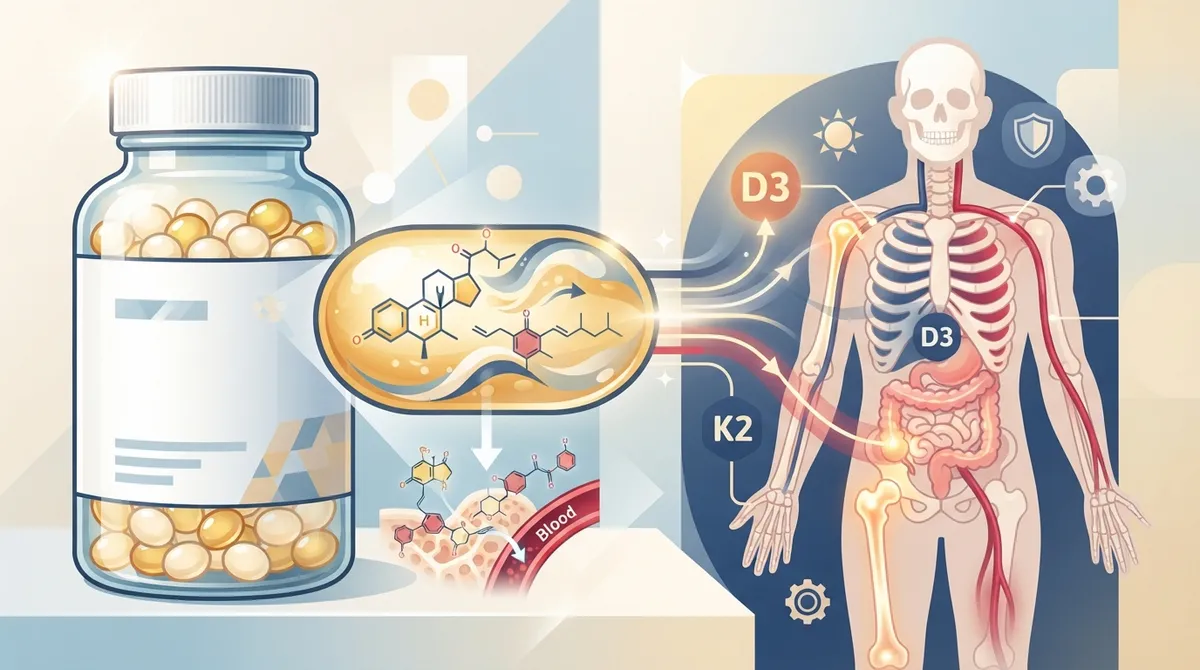
What a Vitamin D3 & K2 Supplement Actually Is
A vitamin d3 & k2 supplement combines two fat-soluble vitamins in one capsule, softgel, or drop. Each plays a separate role in the body.
What Vitamin D3 Does
Vitamin D3 (cholecalciferol) helps your body absorb calcium. It supports bone mineralization and muscle function. Your skin makes it from sunlight, and you also get small amounts from fatty fish, egg yolks, and fortified foods.
What Vitamin K2 Does
Vitamin K helps activate proteins involved in blood clotting and bone metabolism. K2 is one form of vitamin K. Other forms are found in leafy greens and some fermented foods.
Why They Are Sold Together
The idea is simple. Vitamin D supports the production of certain proteins. Vitamin K helps activate them. Together, they are said to guide calcium into bones and away from soft tissue. This is a reasonable biological theory. However, a theory is not proof that the pairing prevents fractures, osteoporosis, or artery calcification.
What the Evidence Says in 2026
Honest answers matter here. Current reviews note that trials on D3 plus K2 are limited. They are not strong enough to recommend the combination for osteoporosis prevention or treatment. The same is true for heart disease and arterial calcification.
This does not mean the combination is harmful or useless. It means the claims on many labels run ahead of the research. A supplement should never replace indicated osteoporosis care, a balanced diet, or prescribed treatment.
The Endocrine Society's 2024 guideline also supports a measured approach. It advises against routine vitamin D testing or extra supplementation above recommended intake for generally healthy adults under 75. It does identify certain groups who may benefit from empiric supplementation. Decisions should be individual, not based on one universal target.
How to Check Whether You Need Vitamin D at All
Before you buy anything, ask a basic question: do you have a reason to think your vitamin D is low? Follow these steps.
- Review your risk factors. Limited sun exposure, darker skin, older age, obesity, and certain digestive or kidney conditions can all lower vitamin D status.
- Look at your diet. Count how often you eat fatty fish, fortified milk or cereal, and eggs.
- Check your medication list. Some medicines affect vitamin D or vitamin K, so a full list helps your clinician.
- Ask about a blood test. A 25-hydroxyvitamin D test shows your current level. Your provider can tell you if testing makes sense for you.
- Interpret results in context. The number matters, but so do your age, health history, and symptoms.
A primary care visit is the easiest place to do all five steps at once. At InCare, our team can review your history, order labs, and build a plan around your goals. You can learn more about our primary care services or see what happens during an annual wellness visit.
Know the Numbers: Doses and Blood Levels
Numbers help you stay in a safe range. These figures come from the U.S. National Academies and the NIH Office of Dietary Supplements.
|
Measure |
Value |
|---|---|
|
Vitamin D daily recommendation, adults through age 70 |
600 IU (15 mcg) |
|
Vitamin D daily recommendation, adults over 70 |
800 IU (20 mcg) |
|
Adult upper intake limit (all sources) |
4,000 IU (100 mcg) per day |
|
Blood level linked to deficiency risk |
Below 12 ng/mL (30 nmol/L) |
|
Blood level sufficient for most people |
20 ng/mL (50 nmol/L) or higher |
|
Level that may bring adverse effects |
Above 50 ng/mL (125 nmol/L) |
|
Level linked to toxicity |
Above 150 ng/mL (375 nmol/L) |
Note that these are general guides. The 4,000 IU upper limit applies unless a clinician directs otherwise. Your provider may use a different target based on your health.
There is also no universal K2 dose proven to prevent heart disease or osteoporosis. That is why label claims about "optimal" K2 amounts deserve caution.
The Most Important Safety Check: Blood Thinners
This is the section to read twice. Vitamin K can seriously interact with warfarin and similar vitamin K-antagonist anticoagulants. Warfarin works by blocking vitamin K. Changing your vitamin K intake can change how well the drug works.
If you take one of these medicines, follow these rules:
- Talk to your prescriber before starting, stopping, or changing any K2 supplement.
- Keep your vitamin K intake steady from day to day, including food sources.
- Do not add a combined D3 and K2 product on your own.
- Tell every provider about every supplement you take.
Even if you do not take warfarin, share your supplement list with your care team. A short conversation can prevent a serious problem. If you manage several prescriptions, these prescription management tips can help you stay organized.
Risks of Taking Too Much Vitamin D
More is not better. Because vitamin D is fat-soluble, the body stores it. Very high intake can raise blood calcium, a condition called hypercalcemia. Symptoms can include nausea, weakness, frequent urination, and confusion. Toxicity is most often linked to high-dose supplements, not sunlight or food.
Many people also take a multivitamin, a calcium product, and a D3 and K2 supplement at the same time. These can stack up. Add up vitamin D from every source before you decide on a dose. If you are unsure, bring all your bottles to your appointment.
Who May Benefit From a Vitamin D3 & K2 Supplement
Some groups are more likely to benefit from a vitamin D supplement. A clinician can help you decide if you belong to one of them.
- Older adults who spend little time outdoors and face higher bone health concerns.
- People with confirmed low vitamin D on a blood test.
- People with limited sun exposure, such as those who work indoors or cover most of their skin outdoors.
- People with conditions that affect absorption, including some digestive disorders.
- People with higher bone loss risk who are working with a provider on a full bone health plan.
If you are young, healthy, and eat a varied diet, you may not need a combined product at all. A simple vitamin D check, and a food-first plan, may be enough. For women in their 20s and 30s who have never had a full wellness workup, a baseline visit is a smart first step. Learn why preventive care pays off over time.
How to Choose a Quality Product
The supplement market is loosely regulated. Quality varies a lot. Use this checklist when you shop.
- Check the vitamin D form. Look for D3 (cholecalciferol) and a clear dose in IU or mcg.
- Check the K2 form and dose. Labels may list MK-4 or MK-7. Make sure the amount is clearly stated.
- Look for third-party testing. Seals from independent testing groups suggest the product contains what the label says.
- Avoid mega-doses. Stay well under the 4,000 IU upper limit unless your provider says otherwise.
- Read the full ingredient list. Watch for added calcium, fillers, or allergens.
- Ignore miracle claims. Phrases like "clears arteries" or "reverses osteoporosis" are red flags.
- Take it with food that has fat. Fat-soluble vitamins absorb better with a meal.
Food-First Ways to Support Bone and Heart Health
Supplements are only one tool. Daily habits matter just as much. Consider these steps:
- Eat fatty fish such as salmon or sardines a few times a week.
- Include leafy greens, which are a source of vitamin K.
- Choose fortified foods if your diet is low in vitamin D.
- Do weight-bearing and strength exercise to support bone density.
- Avoid smoking and limit alcohol.
- Keep up with blood pressure and cholesterol checks.
If you want a deeper look at your overall health, advanced tools can help. InCare offers services such as body composition analysis and DNA gene testing to give you personalized insight. Some patients also explore IV hydration and vitamin drips as part of a broader wellness plan, always with provider guidance.
When to Talk to a Provider First
Make an appointment before starting a vitamin d3 & k2 supplement if any of these apply to you:
- You take warfarin or another anticoagulant.
- You have kidney disease, a history of kidney stones, or high blood calcium.
- You are pregnant or breastfeeding.
- You take several prescriptions or other supplements.
- You have been told you have osteoporosis or low bone density.
- You are giving supplements to a child.
A personalized plan is safer than a guess. Busy families can also find help through family primary care, where one team looks after everyone's needs. If you like to compare options, see what our patients say on Facebook, follow our wellness tips on Instagram, or watch short health videos on TikTok. You can also read InCare reviews on Google from patients in Tampa and Riverview.
A Simple Decision Path
Use this quick path to decide your next move.
- Start with a conversation about your risk factors and diet.
- Get a vitamin D blood test if your provider recommends it.
- Review all medications, especially blood thinners.
- If a supplement is advised, choose a tested product with a modest, clear dose.
- Recheck your levels and goals as your provider suggests.
This approach protects your health and your budget. It also keeps you from relying on one pill to do the work of a whole lifestyle.
Conclusion
A vitamin d3 & k2 supplement can be a reasonable choice for some people, especially those with low vitamin D or higher bone health risk. But it is not a cure-all. The proof that the pair prevents fractures, osteoporosis, or heart disease is still limited, and the combination can be risky for anyone on warfarin. The best path is personal: check your levels, review your medicines, and pick a quality product only if it fits your needs.
If you want clear answers instead of guesswork, our team at InCare is here to help. Whether you need labs, a medication review, or a full wellness plan, we will build a plan around you. Book Now to schedule your visit at our Tampa or Riverview clinic, or contact our team with any questions.
FAQs
Q: What are the benefits of taking vitamin D3 and K2 together?
A: Vitamin D3 helps your body absorb calcium, and vitamin K helps activate proteins tied to bone and blood clotting. The pairing makes biological sense, but studies have not proven it prevents fractures, osteoporosis, or arterial calcification. Talk with your provider about whether it suits you.
Q: Can I take vitamin D3 and K2 with warfarin or other blood thinners?
A: Not without your prescriber's approval. Vitamin K can change how warfarin and similar medicines work. Always check with your prescriber before starting, stopping, or changing a K2 supplement, and keep your vitamin K intake consistent.
Q: What dose of vitamin D3 and K2 should I take?
A: For most adults, the vitamin D recommendation is 600 IU daily through age 70 and 800 IU after age 70. The upper limit is 4,000 IU from all sources unless a clinician directs otherwise. No universal K2 dose has been established, so ask your provider for personal guidance.
Q: What are the risks of taking too much vitamin D?
A: Too much vitamin D can raise blood calcium and cause nausea, weakness, frequent urination, and confusion. Toxicity is linked to very high blood levels, above 150 ng/mL. Add up vitamin D from all supplements and foods before deciding on a dose.
Q: Who should consider vitamin D testing or a vitamin D supplement?
A: People with limited sun exposure, older adults, those with absorption problems, and those with higher bone loss risk may benefit. The Endocrine Society advises against routine testing in generally healthy adults under 75. A primary care provider can help you decide based on your history.


