
Key Takeaways
- Peptide timelines depend on the specific product: FDA-approved medicines like GLP-1s have trial-based timelines, while most wellness peptides lack reliable human data to set any timeline.
- For approved GLP-1 medicines such as semaglutide and tirzepatide, early appetite or blood sugar changes may appear within weeks, while measurable weight outcomes are typically judged over months.
- Wellness peptides like BPC-157, TB-500, and MOTS-c are not FDA-approved for recovery or anti-aging, and their evidence is largely preclinical, so claims of results in two weeks are unsupported.
- Compounded and online peptide products carry added risk: their identity, purity, strength, and sterility may be uncertain, and injectable peptides can trigger serious allergic reactions.
- Before starting any peptide, ask your clinician to name the exact product, its approved uses, the human studies behind it, and the realistic timeline and measurements you will track.
- Never delay proven medical care in favor of an unproven peptide, and seek prompt help for severe symptoms such as swelling, trouble breathing, or intense pain at an injection site.
If you are asking how long peptide therapy takes to work, the honest answer is that it depends. The word "peptide" covers very different products. Some are FDA-approved medicines with years of trial data. Others are wellness products with very little human research behind them.
That difference matters most when you ask about timing. A prescription GLP-1 medicine and a wellness peptide sold for recovery or anti-aging do not follow the same timeline. In some cases, no reliable timeline exists at all.
This article compares the two groups side by side. You will learn what the evidence says about how long peptide therapy takes to work for each, which signs show up first, and what to ask a licensed clinician before you start. Whether you are a busy parent, a wellness-minded professional, or someone exploring prevention for the first time, this guide gives you a realistic, safety-first picture for 2026.

Why There Is No Single Answer
Peptides are short chains of amino acids. Your body makes many of them naturally. Some peptide medicines are well studied and approved for specific conditions. Others are marketed for general wellness without that level of proof.
Timing depends on several factors:
- The specific peptide: Each product acts differently in the body.
- The condition or goal: Blood sugar, appetite, and body weight change at different speeds.
- Dose and route: Many medicines start low and rise slowly.
- The outcome you track: A lab value moves faster than a change in body composition.
- Your own health history: Response varies from person to person.
Because of this, any clinic that promises one fixed timeline for all peptides should raise a flag. A responsible answer starts by naming the exact product and the evidence behind it. To learn the basics first, see what peptides are and how they relate to longevity and wellness.
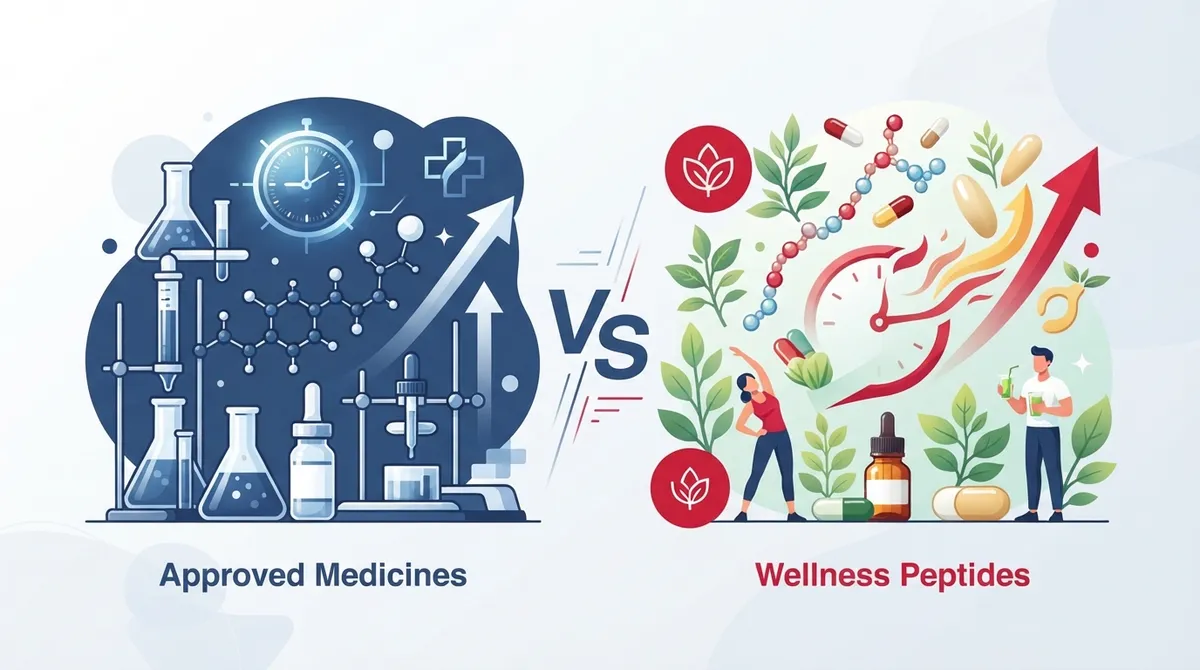
The Two Groups: Approved Medicines vs. Wellness Peptides
It helps to sort peptides into two groups before you compare timelines.
|
Feature |
FDA-Approved Peptide Medicines (e.g., GLP-1s) |
Wellness-Marketed Peptides (e.g., BPC-157, TB-500, MOTS-c) |
|---|---|---|
|
Regulatory status |
Approved for specific conditions |
Not approved for wellness, recovery, or anti-aging uses |
|
Human evidence |
Large clinical trials |
Mostly preclinical or limited |
|
Timeline guidance |
Weeks to months, based on trials |
No dependable timeline in people |
|
Dosing |
Defined by prescribing information |
Often unstandardized |
|
Main concern |
Side effects and proper monitoring |
Unknown effectiveness, quality, and safety |
This split is the key to answering the question. For the first group, you can discuss realistic windows. For the second, an honest clinician will tell you the timeline is unproven.
How Long Do Approved GLP-1 Medicines Take to Work?
GLP-1 medicines such as semaglutide and tirzepatide are among the best-studied peptide-based treatments. They are approved for specific uses, and their effects are tracked over weeks and months.
What You May Notice First
Early changes often come before visible weight change. Some people notice a smaller appetite or feel full sooner. Others see blood sugar shifts if they have a related condition. These early signs vary, and not everyone feels them right away.
When Weight Changes Are Measured
Weight outcomes are generally judged over months, not days. Doses usually increase in steps, so your body can adjust and side effects stay manageable. A slow start is normal and intended.
Clinical trials give a sense of the scale. A 2026 review reported trial durations ranging from 6 to 104 weeks. The same review noted mean weight loss with tirzepatide approaching 21% after 72 weeks in cited evidence. These are study-level results, not a prediction for any one patient. Your response may be higher or lower.
If you want a closer look at these medicines, review our guide on how long tirzepatide takes to work for weight loss and our overview of how to know when weight loss medication is working.
How Long Do Wellness Peptides Take to Work?
This is where honesty matters most. Many peptides promoted for recovery, anti-aging, or body composition are not FDA-approved for those uses. Examples include BPC-157, TB-500, and MOTS-c.
For many of these, the available evidence is largely preclinical, meaning lab or animal research. Human data is limited. Without strong human trials, no one can say with confidence how long they take to work, or whether they work at all.
You may still see confident claims online, such as "results in two weeks." Treat those with caution. A claim without human trial data is a marketing statement, not a medical timeline.
For deeper reading on individual products, see our articles on BPC-157 facts every wellness patient should know and how to understand TB-500 before you consider it.
Head-to-Head: Timeline Expectations
Here is a simple comparison of what is realistic versus what remains unknown. These are general patterns, not promises.
|
Question |
Approved GLP-1 Medicines |
Wellness Peptides |
|---|---|---|
|
Early signs |
Appetite or blood sugar changes may appear within the first weeks |
No reliably established early signs |
|
Measurable outcomes |
Typically assessed over months |
Not established in people |
|
Basis for timeline |
Clinical trials and prescribing information |
Limited human research |
|
Predictability |
Moderate, with wide individual variation |
Low to none |
|
Follow-up needed |
Regular visits and dose review |
Clinician review of product, purpose, and safety |
The takeaway is clear. If speed and predictability matter to you, approved medicines offer a more evidence-based picture. Wellness peptides cannot yet offer that.
Safety: Why the Source of Your Peptide Matters
Timing is only part of the story. Safety and quality shape every outcome.
Compounded and Online Products
Compounded medicines are not FDA-approved, even when a pharmacy prepares them under applicable conditions. FDA materials from 2024 note that injectable and other non-oral peptide products can carry a higher risk of immune reactions. These can include serious allergic reactions such as anaphylaxis.
Products labeled "research use" or sold outside regulated medical channels add more risk. Their identity, purity, strength, and sterility may be uncertain. You cannot judge these from a label alone.
What a Safe Process Looks Like
- Name the exact peptide. A clinic should tell you which product it is and what evidence supports it.
- Review your history. A clinician should check your conditions, allergies, and current medicines.
- Confirm the source. Ask where the product comes from and how it is made.
- Set clear goals. Agree on what you will measure and when you will review progress.
- Plan follow-up. Regular visits help catch side effects early.
FDA guidance can change, so always verify the current status of any specific product before you begin. You can also read our guides on FDA-approved peptides to know in 2026 and FDA-approved versus compounded peptides.
How Long Should You Try a Peptide Before Deciding?
This is a common question, and it needs a careful answer. There is no universal trial period. The right window depends on the product and your goals.
For an approved medicine, your clinician will usually set review points based on the prescribing information. Dose increases often happen in steps, so early weeks are about tolerance, not final results. Judging success too soon can lead to a wrong conclusion.
For an unproven peptide, the better question is whether to use it at all. If there is little human evidence, there is no solid basis for a trial length. In that case, a clinician may suggest proven options first.
Never delay established care in favor of an unproven product. Seek prompt medical advice for severe or unexpected symptoms, such as swelling, trouble breathing, or intense pain at an injection site.
Questions to Ask Your Primary-Care Clinician
Bring these questions to your visit. They help you move from marketing claims to real answers.
- Which exact peptide are you recommending, and is it FDA-approved for my goal?
- What human studies support it, and how long did they last?
- What timeline is realistic for me, and what will we measure?
- Where does the product come from, and who prepares it?
- What side effects should I watch for, and when should I call you?
- Are there proven options I should consider first?
A primary-care setting is a smart place to start. Your clinician can look at your whole health picture, including labs, medicines, and long-term goals. That context makes any plan safer. Learn more about why this matters in our article on peptides in primary care: what works and what is risky in 2026.
Who Benefits Most From a Doctor-Led Approach?
Different readers come to peptide therapy for different reasons. A medical team can tailor the conversation to each.
- Busy families: You need efficient, clear plans that fit a tight schedule, with weight loss support grounded in evidence.
- Tech-savvy professionals: You may want data-driven tools like body composition tracking and metabolic testing to measure real progress.
- Wellness-focused adults: You want prevention and optimization, but with clear safety guardrails.
- Young adults exploring options: You may be reading online claims and need a trusted voice to separate fact from hype.
Objective measurement makes timelines easier to judge. Tools such as body composition analysis and metabolic breath analysis give you real numbers to track instead of guessing.
Why Choose InCare for Peptide and Weight Loss Guidance
InCare is a personalized primary care and wellness clinic serving Tampa and Riverview, Florida. The team combines medical expertise with modern technology, so your plan rests on testing and evidence rather than trends. InCare holds a 4.8 out of 5 rating on Google across 359 reviews, and patients often mention the friendly staff and attentive care from Dr. Ahluwalia.
For patients exploring medical weight loss, InCare offers physician-guided weight loss programs. If you want to talk through peptide questions, you can also read about peptide therapy at InCare in Tampa and meet the providers who will guide your care. You can see what other patients say by reading InCare reviews on Google.
You can also follow InCare for health tips on Instagram, TikTok, and Facebook.
The Bottom Line
So, how long does peptide therapy take to work? For approved GLP-1 medicines, expect early signs over the first weeks and measured outcomes over months, with wide individual variation. For many wellness peptides, no dependable timeline exists because strong human evidence is missing.
The smartest path is simple. Identify the exact product, check the evidence, confirm the source, and work with a licensed clinician who will track your progress with real measurements. Avoid guaranteed timelines, and never skip proven care for an unproven product.
Ready to talk through your goals with a clinician who puts evidence first? Book your visit with InCare or contact our team to get started in Tampa or Riverview.
FAQs
Q: How long does semaglutide take to work for weight loss?
A: Some people notice a smaller appetite within the first weeks, but meaningful weight change is generally assessed over months. Doses usually rise in steps, so early weeks focus on tolerance. Individual response varies, so your clinician will set review points for you.
Q: Why do peptide treatments have different timelines?
A: Peptides are a broad group of products with different actions, doses, and goals. An approved GLP-1 medicine, for example, works very differently from a wellness peptide. Timing also depends on the outcome being measured, such as blood sugar, appetite, or body composition.
Q: Are wellness peptides such as BPC-157 FDA-approved?
A: No. BPC-157, TB-500, and MOTS-c are not FDA-approved for wellness, recovery, or anti-aging uses. Much of the available evidence is preclinical or limited, so a reliable time-to-benefit in people has not been established. Always verify current FDA guidance before considering any product.
Q: What are the risks of compounded or online peptide injections?
A: Compounded medicines are not FDA-approved, and FDA has raised concerns about quality, formulation, and immune reactions for some compounded peptides. Injectable products can cause serious allergic reactions. Products sold as "research use" may have uncertain identity, purity, strength, and sterility.
Q: How can I tell whether a peptide treatment is supported by clinical evidence?
A: Ask your clinician to name the exact peptide, its approved uses, and the human studies behind it. An FDA-approved medicine comes with prescribing information and trial data. If the proof is mostly lab or animal research, the timeline and benefit in people remain unproven.