

Key Takeaways
- FDA-approved peptide medicines follow monitoring defined in their prescribing information, while compounded or unapproved peptides lack that guidance, so product source and quality matter as much as labs.
- A safe plan includes a documented goal, baseline history and medication review, allergy check, targeted labs chosen for the specific drug, scheduled follow-up, and a clear side-effect plan.
- Follow-up is usually closer at the start and after every dose change, then spaced out once treatment is stable; any new or concerning symptom warrants prompt contact with your clinician.
- Seek urgent care for trouble breathing, throat or facial swelling, severe belly pain, chest pain, or fainting; call your clinician before the next dose for milder but persistent problems.
- Compounded peptides are not FDA-approved and are generally meant only when an approved drug cannot meet a patient-specific need, and 'research use only' peptides are not intended for human use.
- Monitoring supports safe treatment but cannot make an unproven or poorly made product safe, so a clinician should explain benefits, unknowns, and alternatives before you begin.
Peptide therapy is a hot topic in wellness circles. Many people want to know what monitoring is needed with peptide therapy before they start. The honest answer is that no single plan fits every peptide. Monitoring depends on the specific medicine, the reason for treatment, the dose, and your health history.
This matters most when you compare two very different categories: FDA-approved peptide medicines and compounded or unapproved peptide products. The first group comes with a label, trial data, and clear safety guidance. The second group often lacks all three. This article explains how monitoring differs between them, what a safe plan looks like, and when to stop and call your doctor.
If you live in the Tampa Bay area and want a clear, medically grounded answer, a primary care visit is the right first step. A clinician can review your history, explain the evidence, and build a follow-up plan that fits you.

What Monitoring Is Needed With Peptide Therapy? The Short Answer
There is no universal "peptide panel." Good monitoring is built around the drug, not the trend. In primary care, a safe plan usually covers five areas:
- A documented diagnosis and goal. You and your clinician should agree on what you want to treat and how you will measure success.
- A baseline assessment. This includes your history, current medicines, allergies, and any conditions that raise risk.
- Drug-specific labs and checks. Tests are chosen for the medicine and your health, not ordered as a generic bundle.
- Scheduled follow-up. Visits are closer together at the start and after any dose change.
- A plan for side effects. You should know which symptoms need a call and which need urgent care.
The key point is that monitoring supports safe treatment. It does not make an unproven product safe. The quality and source of the product matter just as much.
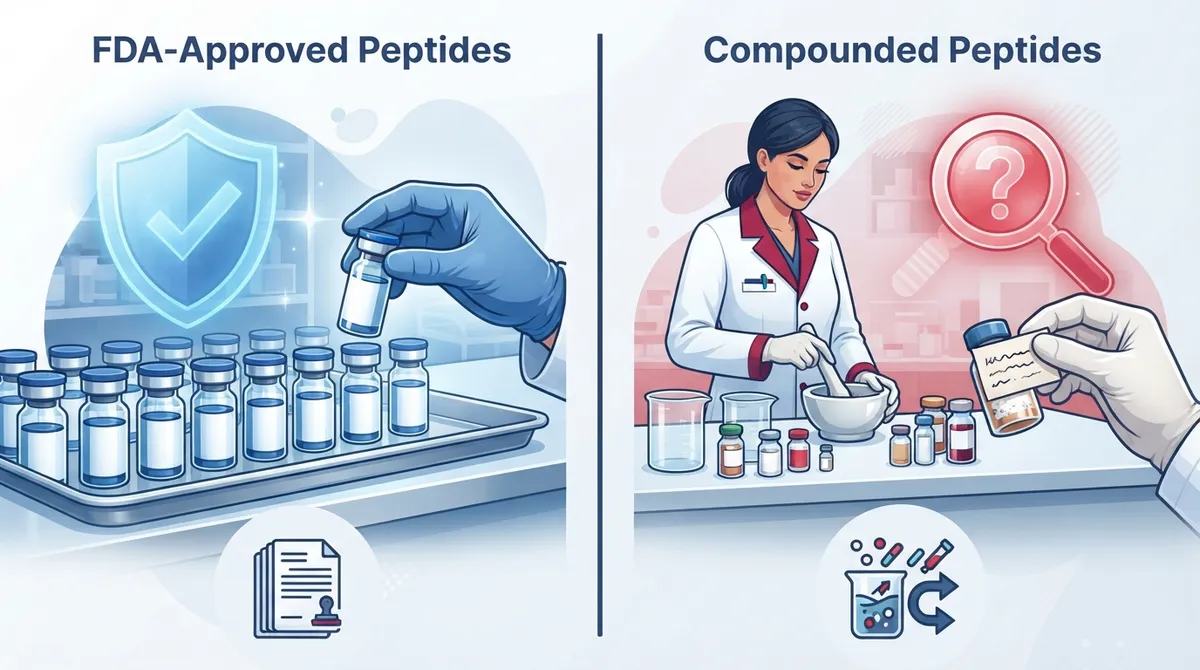
FDA-Approved Peptides vs. Compounded Peptides: A Side-by-Side View
The word "peptide" covers a wide range. Some peptide medicines are FDA-approved and widely studied. Others are made by compounding pharmacies or sold under labels like "research use only." The monitoring picture is very different for each.
|
Factor |
FDA-Approved Peptide Medicines |
Compounded or Unapproved Peptides |
|---|---|---|
|
Safety review |
Reviewed by the FDA for safety, effectiveness, and quality |
Not reviewed by the FDA before marketing |
|
Monitoring guidance |
Detailed in the prescribing information |
Often limited or unclear |
|
Human safety data |
Clinical trial data available |
Frequently limited |
|
Product quality |
Standardized manufacturing |
Can vary by source and batch |
|
Known risks |
Listed on the label |
FDA has flagged concerns for some, such as impurities and immune reactions |
|
Best use |
A defined medical condition |
Only when an approved drug cannot meet a patient-specific need |
The FDA states that compounded drugs are not FDA-approved. It also notes that compounding is generally meant for a patient-specific need when an approved drug cannot fill that need. It is not meant as a routine substitute for an approved product.
Monitoring for FDA-Approved Peptide Medicines
For approved peptide medicines, the drug label is your roadmap. It spells out who should not take the drug, how to raise the dose, what to watch for, and which labs to order. A weight-management peptide medicine, for example, has different monitoring needs than an endocrine peptide medicine. They are not interchangeable.
Depending on the medicine and the patient, a clinician may follow:
- Blood glucose or A1c
- Kidney and liver function
- Electrolytes
- Hormone levels
- Weight, blood pressure, and heart rate
- Disease-specific tests tied to the condition being treated
Follow-up should also check how well the treatment is working, whether you are taking it as directed, and how you are tolerating it. If you inject the medicine, your clinician should review your technique too. For a closer look at how these medicines behave in the body, see 9 Ways Tirzepatide Works Inside Your Body (2026) and How to Understand Semaglutide's Mechanism of Action.
Monitoring for Compounded and Unapproved Peptides
Here the picture is harder. Monitoring still matters, but it has limits. The FDA has identified potential safety concerns for several peptide substances proposed for compounding. These include immune reactions, impurities in the peptide itself, and limited human safety information. For some substances, the concern also includes effects on blood sugar or cortisol.
That means a blood test cannot catch every problem. If the product is poorly made or poorly understood, no lab panel can fully protect you. Product identity, source, and clinical reason come first.
If a clinician does discuss a compounded product, a careful plan should include:
- A written reason why an approved option does not fit your needs.
- Documentation of the exact product and where it came from.
- Informed consent that covers benefits, unknowns, and alternatives.
- A baseline exam and labs that match the known concerns.
- A set follow-up schedule with clear stopping rules.
- A process for reporting side effects or product problems.
Be cautious with anything labeled "research use only." These products are not medicines, and they are not meant for human use. Learn more in FDA-Approved vs. Compounded Peptides: Which Wins? and 5 BPC-157 Buying Mistakes That Put Your Health at Risk.
Baseline Steps Before Any Peptide Therapy Begins
Good monitoring starts before the first dose. A baseline visit gives your clinician a starting point to compare against later. It should include:
- Medical history review. Past conditions, surgeries, and family history.
- Medication and supplement list. Some products interact with each other.
- Allergy check. Peptides can trigger immune reactions in some people.
- Pregnancy and breastfeeding status, where it applies.
- Baseline symptoms. What you feel now, so changes are easy to spot.
- Targeted labs. Chosen for the medicine and your risk factors.
Your clinician should also explain the expected benefits, the unknowns, other options, and the warning signs. If a provider skips this step or rushes you, that is a red flag. Our guide 15 Questions to Ask a Peptide Therapy Clinic in Tampa can help you prepare.
How Often Should You Be Monitored?
There is no set number that applies to all peptides. Timing should match the drug and the person. In general, the pattern looks like this:
|
Stage |
What to Expect |
|
|---|---|---|
|
Starting treatment |
Closer follow-up to check tolerance and early side effects | |
|
Dose changes |
Added review after each increase or decrease | |
|
Stable treatment |
Regular visits and labs as the drug label or clinician advises | |
|
New symptoms |
Prompt evaluation, even between scheduled visits |
The value of follow-up is not only lab work. A good visit asks how you feel, whether the goal is being met, and whether the treatment still makes sense. If it is not helping, or if risks outweigh benefits, stopping is a valid choice.
Side Effects and Warning Signs to Track
Keep a simple log of how you feel. Share it at each visit. Watch for:
- Redness, swelling, or pain at the injection site
- Nausea, vomiting, or stomach pain that does not ease
- Dizziness, fainting, or a racing heartbeat
- Unusual thirst, frequent urination, or shakiness that may point to blood sugar changes
- Rash, hives, itching, or swelling of the face or lips
- Persistent fatigue, mood changes, or sleep problems
Seek urgent care right away for trouble breathing, swelling of the throat or face, severe belly pain, chest pain, or fainting. For less severe but ongoing problems, call your clinician before the next dose. For details on one commonly discussed peptide, read How to Spot BPC-157 Side Effects Before They Escalate.
If you suspect a serious reaction or a product-quality problem, it can be reported through the FDA's MedWatch program.
Which Peptide Types Need Closer Attention?
Different peptide classes carry different watch points. These are general examples, not a substitute for the drug label or your clinician's advice.
- Metabolic peptide medicines. These often involve glucose, weight, digestive symptoms, and kidney function. See Tirzepatide vs. Semaglutide: Which Wins for Weight Loss? for how these differ.
- Growth hormone-related peptides. These can affect fluid balance, blood sugar, and hormone levels. Read CJC-1295 vs Ipamorelin: Which Peptide Fits Your Goals? for more context.
- Healing and recovery peptides. Human evidence is often limited, which makes careful documentation and caution even more important. See How to Use Healing Peptides Safely for Recovery.
- Investigational peptides. Some have no proven human dose. Our article MOTS-c Dosage: Why No Safe Human Dose Is Proven Yet explains why that matters.
Why Primary Care Is the Right Home for Monitoring
Peptide therapy works best when one team sees the full picture. A primary care clinic can review your medicines, track your labs over time, and spot problems early. It can also tell you when a peptide is not the right tool.
That is the approach at InCare, a personalized primary care and wellness clinic with locations in Tampa and Riverview. Our team combines medical expertise with modern testing, including in-house lab capabilities, body composition analysis, and metabolic assessments. That helps us build a baseline and track change in a clear, measurable way. We focus on prevention and whole-body health, and we are honest about what the evidence does and does not support.
Patients often tell us they value having one clinic that handles routine care, wellness testing, and follow-up. You can see what others say about us on Visit us on Google — InCare, and you can follow our updates on Instagram, Facebook, and Tik Tok.
A Simple Monitoring Checklist You Can Bring to Your Visit
Use this list to guide the conversation with your clinician:
- What condition or goal is this peptide meant to address?
- Is the product FDA-approved, compounded, or something else?
- Where does it come from, and how is quality confirmed?
- Which baseline tests do I need?
- How often will I be seen, and what will be checked?
- Which symptoms mean I should call you, and which mean urgent care?
- What is the plan if it is not working or I have side effects?
A trustworthy clinic will welcome these questions. If you want to compare costs and structure before you commit, see What Does Monthly Peptide Therapy Cost in Tampa?
Conclusion: Choose the Safer Path First
So, what monitoring is needed with peptide therapy? It depends on the medicine. FDA-approved peptides come with clear, label-based monitoring. Compounded and unapproved peptides come with more unknowns, and monitoring cannot erase those risks. In every case, you need a clear reason for treatment, a baseline exam, targeted labs, scheduled follow-up, and a plan for side effects.
The safest first step is a conversation with a primary care clinician who knows your history. If you are considering peptide therapy in the Tampa Bay area, our team at InCare can help you weigh your options and build a plan that puts safety first. Book Now to schedule a visit, or Contact us with questions.
FAQs
Q: What tests should be done before starting peptide therapy?
A: Testing depends on the specific peptide and your health history, so there is no single standard panel. A clinician should review your history, medicines, and allergies, then order targeted labs such as glucose or A1c, kidney and liver function, electrolytes, or hormone levels when they apply.
Q: How often should a patient be monitored while taking peptide therapy?
A: Follow-up timing is individualized. Reviews are usually closer together at the start and after any dose change, then spaced out as treatment becomes stable. Any new or concerning symptom should prompt a call to your clinician right away.
Q: Is compounded peptide therapy FDA-approved or safe?
A: No. Compounded drugs are not FDA-approved, and the FDA does not review them for safety, effectiveness, or quality before they are marketed. The FDA has also flagged potential concerns for certain peptide substances, so monitoring cannot replace using a well-characterized medicine.
Q: Are "research use only" peptides safe for human use?
A: No. Products labeled "research use only" are not medicines and are not intended for human use. Their identity, purity, and safety are not confirmed, and no lab test can fully offset those unknowns.
Q: When should I stop peptide therapy or seek urgent medical care?
A: Seek urgent care for trouble breathing, swelling of the face or throat, severe abdominal pain, chest pain, or fainting. For milder but ongoing symptoms, contact your clinician before the next dose so they can decide whether to adjust or stop treatment.


