

Key Takeaways
- UnitedHealthcare Dual Complete is a Medicare Advantage D-SNP plan that combines Medicare and Medicaid coordination into one plan, covering 2.3 million members across 43 states with 98% access for full-benefit dual-eligible people.
- Dual Complete may include $0 premiums and extra benefits like dental, vision, hearing, transportation, and OTC allowances, but costs vary by plan, Medicaid category, and whether services are in-network or out-of-network.
- Choose Dual Complete if you want one coordinated plan with built-in Medicaid coordination and extra benefits; choose Original Medicare plus Medicaid if you need freedom to see any Medicare-accepting doctor without referrals.
- Before enrolling in Dual Complete, verify your doctors are in the network, review your local Evidence of Coverage and Summary of Benefits, and confirm authorization and referral requirements specific to your county.
- Dual Complete typically requires choosing a primary care provider and may require referrals for specialists, while Original Medicare allows any Medicare-accepting doctor without referrals, affecting your care access and coordination.
- Bring both your Medicare Advantage plan ID card and Medicaid information to every visit to help your doctor's office verify coverage and prevent billing surprises from authorization or eligibility issues.
If you have both Medicare and Medicaid, you have more than one way to get your health care. One popular option in 2026 is UnitedHealthcare Dual Complete. It is a Medicare Advantage plan built for people who qualify for both programs. The other main path is Original Medicare paired with Medicaid.
Both paths can work well. But they work differently, especially when it comes to primary care, preventive visits, and wellness support. Your choice affects which doctors you can see, what you pay, and how easy it is to get care.
This guide compares UnitedHealthcare Dual Complete with Original Medicare plus Medicaid. You will learn how each option works, what changes for primary care, and what to check before you decide. Plan details vary by state, county, and plan option, so always confirm the facts in your own plan documents. A strong primary care relationship makes either path work better, and that is where a practice like InCare primary care can help.

What Is UnitedHealthcare Dual Complete?
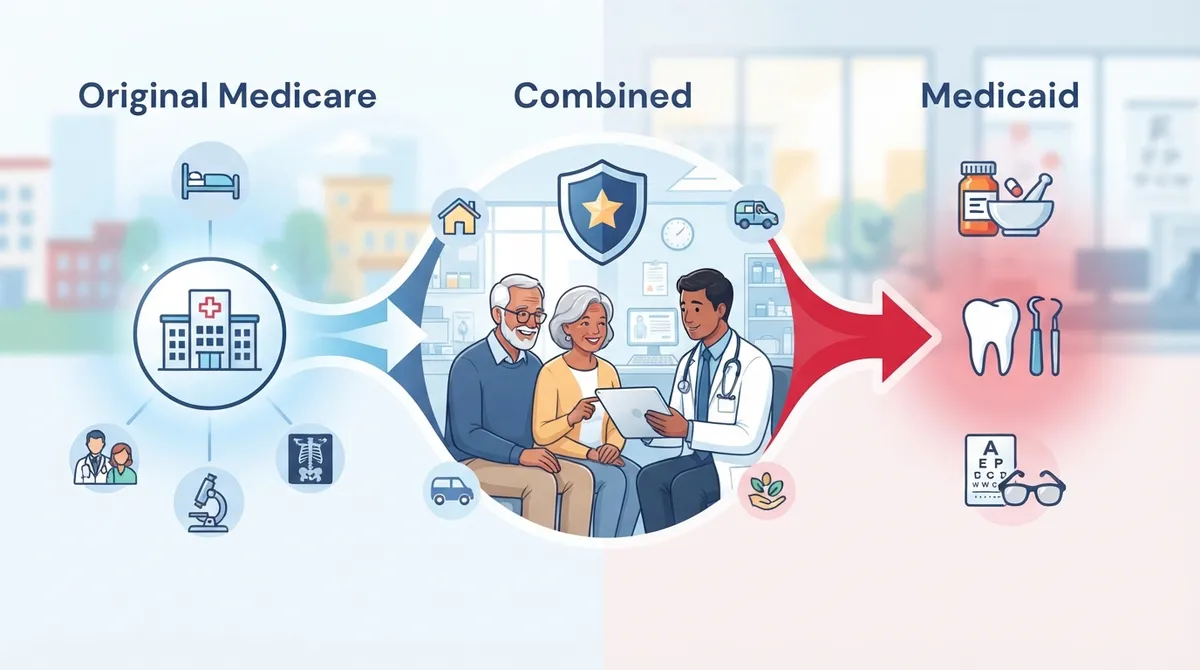
UnitedHealthcare Dual Complete is a family of Medicare Advantage plans called Dual Eligible Special Needs Plans, or D-SNPs. These plans serve people who qualify for both Medicare and Medicaid. The plan combines your Medicare coverage with help coordinating your Medicaid benefits.
It is not one single plan across the country. Benefits, eligibility categories, provider networks, and costs change by state, county, and plan option. That is why local plan documents matter so much.
Who Can Enroll?
To join a UnitedHealthcare Dual Complete plan, you generally need to meet these rules:
- Have Medicare Part A and Part B.
- Qualify for the Medicaid category that the specific plan accepts.
- Live in the plan's service area.
Some people under 65 qualify for Medicare because of a disability or other rules. They may also be eligible if they meet the other requirements.
How Common Are D-SNPs?
D-SNPs have grown quickly. A March 2026 MedPAC report notes that the share of dually eligible beneficiaries enrolled in D-SNPs rose from 14% in 2014 to 46% in 2024. The same report counted 8.7 million full-benefit and 3.4 million partial-benefit dually eligible beneficiaries in July 2024.
A 2026 Milliman analysis found that UnitedHealthcare offered D-SNPs in 43 states and the District of Columbia. It covered more than 2.3 million D-SNP members as of January 2026, about 37% of nationwide D-SNP enrollment. The analysis also found that more than 98% of full-benefit dual-eligible people had access to a D-SNP in 2026.
What Is Original Medicare Plus Medicaid?
Original Medicare is the federal program run directly by the government. Part A covers hospital care. Part B covers doctor visits and outpatient care. When you also have Medicaid, your state program may pay for some costs Medicare does not cover.
In this setup, Medicare generally pays first for Medicare-covered care. Medicaid may then cover eligible cost sharing and extra services based on your state's rules and your Medicaid category. You usually add a separate Part D plan for prescriptions.
The big difference is coordination. With Original Medicare plus Medicaid, you manage two separate programs. With a D-SNP like Dual Complete, one plan works to bring those pieces together.
Side-by-Side Comparison
The table below shows how the two paths often differ. Remember that exact features depend on your location and plan.
|
Feature |
UnitedHealthcare Dual Complete |
Original Medicare + Medicaid |
|---|---|---|
|
Plan type |
Medicare Advantage D-SNP |
Federal Medicare with state Medicaid |
|
Care coordination |
Built into the plan |
You manage it yourself |
|
Provider network |
Network rules apply |
Any provider accepting Medicare and Medicaid |
|
Referrals |
May be required, depending on the plan |
Usually not required |
|
Prescription coverage |
Often included in many versions |
Separate Part D plan |
|
Extra benefits |
May include dental, vision, hearing, and more |
Depends on your Medicaid program |
|
Authorization rules |
May apply to some services |
Fewer plan-based rules |
Primary Care and Preventive Services Compared
Primary care is the foundation of good health for both options. It is where problems get caught early and chronic conditions get managed. Here is how each path typically handles it.
Dual Complete and Primary Care
Primary care and preventive services are central benefits in Dual Complete plans. A 2025 UnitedHealthcare plan summary lists in-network preventive screenings and annual physical exams at 100% for that specific plan. This is not a universal promise across every Dual Complete plan. Check your own Summary of Benefits and Evidence of Coverage to confirm.
Many plans ask you to choose a primary care provider. Some require referrals to see specialists. In-network care is usually the smoothest path. Learn how Medicare Advantage plans work with primary care before you enroll.
Original Medicare and Primary Care
With Original Medicare, you can see any doctor who accepts Medicare and takes new patients. You usually do not need referrals. Medicare Part B covers an annual wellness visit and many preventive screenings. Medicaid may help with the costs left over.
This gives you wide choice. But you also handle more of the paperwork and coordination yourself. A good primary care doctor helps tie it all together, as explained in what Medicare covers for seniors in primary care.
Extra Benefits: What Dual Complete May Add
Many Dual Complete plan versions include Medicare Part D prescription coverage. They may also offer supplemental benefits that support daily health. Availability changes by plan and Medicaid status.
- Dental, vision, and hearing: Helpful for whole-body health.
- Over-the-counter allowances: Credits for common health items.
- Transportation: Rides to medical visits in some plans.
- Meals after a hospital or skilled nursing stay: Offered to members who qualify.
- Fitness benefits: Support for staying active.
Do not assume every benefit applies to you. Some are limited to certain members or situations. Ask for the exact list for your county.
Costs: Do Not Assume Everything Is Free
Many people hear that Dual Complete plans have $0 premiums or $0 costs. That can be true for some members and services. But it should not be assumed for everyone.
Your costs depend on your specific plan and your Medicaid category. Services that Medicaid does not cover, out-of-network care, and some prescriptions may still carry costs. Review your plan's cost details before you visit a provider.
How to Choose: A Simple 5-Step Process
- Confirm your eligibility. Verify your Medicare and Medicaid status and category with your state.
- List your doctors and prescriptions. Write down who you see and what you take.
- Check the network. Ask whether your primary care doctor is in the plan's network.
- Review the documents. Read the local Evidence of Coverage and Summary of Benefits.
- Ask about authorizations and referrals. Learn which services need approval first.
If you want a doctor who understands Medicare coverage, see 7 traits of the best Medicare provider for primary care. Also review how to find doctors accepting new patients.
Which Option Wins for Different People?
Dual Complete May Fit You If
- You want one plan to coordinate Medicare and Medicaid.
- You value extra benefits like dental and vision.
- You are comfortable using a provider network.
- You want prescription coverage built in.
Original Medicare Plus Medicaid May Fit You If
- You want the freedom to see any Medicare-accepting doctor.
- You already have doctors who may not be in a plan network.
- You prefer fewer referral and authorization steps.
- You travel often and want wide access.
There is no single winner. The better choice is the one that matches your doctors, your health needs, and your budget. Can you keep your current doctors? That question alone often decides it, so check the network first.
Tips for Busy Patients and Families
Many people using these plans are caregivers, parents, or working adults helping a loved one. Time is tight, so a few habits save effort.
- Keep your plan ID card and Medicaid information together.
- Ask your doctor's office to verify both coverages before each visit.
- Use telehealth when your plan allows it for simple visits.
- Schedule preventive screenings early in the year.
Preventive care matters most. Read how to make preventive care work for your health and learn what happens during an annual wellness visit. For a full picture of your yearly checkups, see which screenings adults should get every year.
How Primary Care Offices Verify Your Coverage
For a doctor's office, confirming both your Medicare Advantage plan and Medicaid coverage is important. Provider participation, authorization needs, referrals, and billing can differ by plan and state. UnitedHealthcare provider materials advise checking your active plan ID card and eligibility before care.
You can help by bringing your card to every visit. Tell the front desk about both your plan and your Medicaid. This prevents billing surprises later.
Where InCare Fits In
Coverage is only part of the picture. You also need a care team that listens and connects the dots. InCare is a personalized healthcare clinic in Tampa and Riverview, Florida. It blends medical expertise with modern technology to offer primary care, urgent care, and wellness services with a focus on prevention.
Patients can see the team for checkups, screenings, and ongoing care. Explore the InCare providers and view InCare locations. Before scheduling, confirm your insurance and network status with the office. You can also read reviews and see what InCare patients say on Google. For fresh updates and health tips, follow InCare on Instagram and Facebook, or watch short videos on TikTok.
Conclusion
UnitedHealthcare Dual Complete and Original Medicare plus Medicaid can both support strong health. Dual Complete offers built-in coordination, possible extra benefits, and network-based care. Original Medicare with Medicaid offers wider provider choice and fewer plan rules. Your best fit depends on your doctors, your needs, and your local plan details.
Whichever path you choose, pair it with a primary care team you trust. Preventive visits, screenings, and steady follow-up protect your health year after year. Ready to take the next step? Book your visit with InCare today, or contact our team with questions about your care.
FAQs
Q: What is UnitedHealthcare Dual Complete, and how does it work with Medicaid?
A: UnitedHealthcare Dual Complete is a Medicare Advantage Dual Eligible Special Needs Plan (D-SNP) for people who have both Medicare and Medicaid. It combines Medicare coverage with coordination of Medicaid benefits. Medicare generally pays first for Medicare-covered care, and Medicaid may cover eligible cost sharing based on your state's rules.
Q: Who is eligible for a UnitedHealthcare Dual Complete plan?
A: You generally need Medicare Part A and Part B, a Medicaid category the plan accepts, and a home in the plan's service area. Eligibility categories and service areas vary by state and county. Confirm your details with the plan or your state Medicaid office.
Q: Are primary care visits free with UnitedHealthcare Dual Complete?
A: Not always. Some plans list in-network preventive screenings and annual physicals at 100%, but this is not a universal guarantee. Your costs depend on your specific plan, your Medicaid category, and whether the provider is in the network.
Q: Can I keep my current doctors if I enroll in UnitedHealthcare Dual Complete?
A: Only if your doctors participate in the plan's network. Before enrolling, ask your doctor's office whether they accept the specific plan. Also ask whether referrals or authorizations are required for your care.


