

Key Takeaways
- Evidence that D3 with K2 prevents heart disease, fractures, or artery calcification in the general population is not conclusive; marketing claims should be read carefully.
- Vitamin K supplements can strongly interfere with warfarin and blood thinners—consult your prescriber before starting, stopping, or changing K2 dosage.
- Safe dosing: adults need 600-800 IU vitamin D daily (max 4,000 IU) and 90-120 mcg vitamin K; get baseline lab testing before supplementing to avoid toxicity.
- Test your 25-hydroxyvitamin D blood level first; levels above 150 ng/mL are linked to toxicity including kidney damage and abnormal heart rhythms.
- Take D3 and K2 with food containing fat for better absorption, and check that multivitamins or calcium products don't duplicate these nutrients.
- Prioritize natural sources like fatty fish, leafy greens, and fortified foods first; use supplements only to fill documented gaps, not as replacements for diet.
Walk into any pharmacy in 2026 and you will see shelves of supplements that pair vitamin D3 with vitamin K2. The labels promise stronger bones, a healthier heart, and better calcium use. It is easy to see why the combination is popular. But popularity is not proof, and the right choice depends on you.
This guide explains what d3 vitamin with k2 actually is, what the science says, and who may want to talk to a clinician before starting it. We will also cover safe dosing, medication risks, and how lab testing can take the guesswork out of supplements. If you are a busy parent, a wellness-minded professional, or someone new to preventive care, you will find clear answers here.
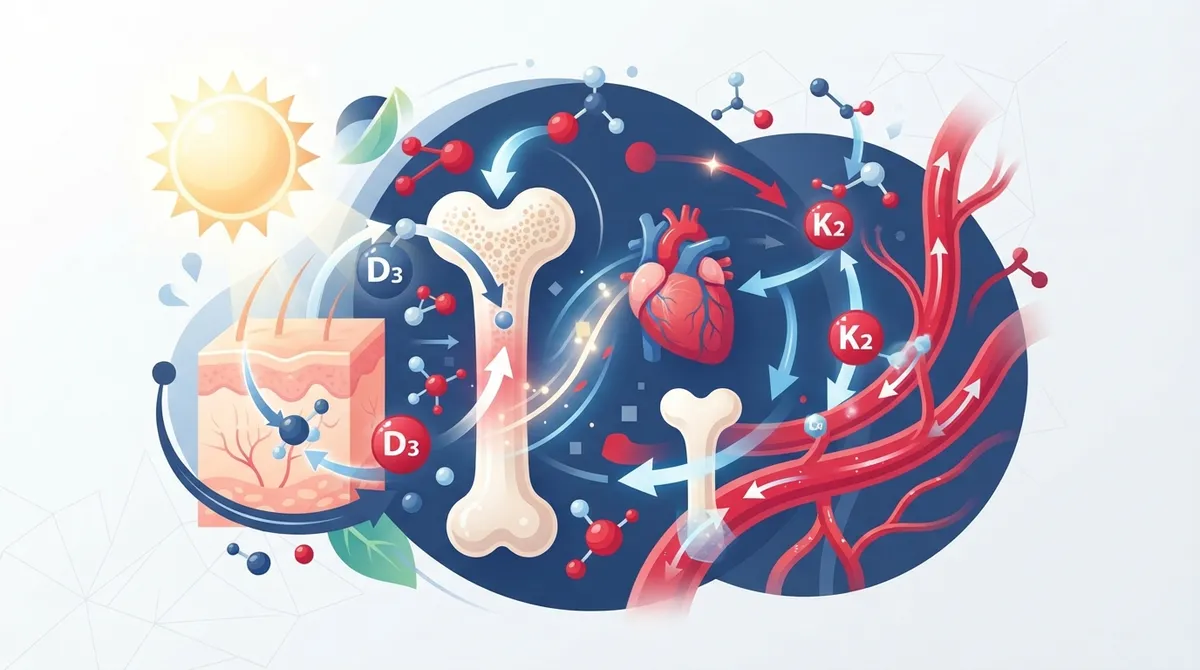
What Is D3 Vitamin With K2?
D3 vitamin with K2 is a dietary supplement that combines two nutrients with different jobs. Vitamin D3, also called cholecalciferol, helps your body absorb calcium and supports bone mineralization. Vitamin K helps activate proteins involved in blood clotting and bone metabolism.
Many products use K2 in the form of MK-7 or MK-4. Both are forms of vitamin K, but labels vary a lot. Because these nutrients play separate roles, taking them together does not automatically mean added benefit for everyone.
How the Two Vitamins Work
- Vitamin D3: Helps the gut absorb calcium and supports bone strength.
- Vitamin K2: Helps activate proteins that handle calcium in bone and blood vessels.
- Together: They are often marketed as a team for bone and heart health.
The theory is simple. D3 brings calcium into the body, and K2 may help direct it to the right places. This idea is interesting, but the research is still developing.

What Does the Evidence Really Show?
Here is the honest answer. Evidence that adding K2 to D3 prevents heart disease, artery calcification, or fractures in the general population is not conclusive. A combined supplement should not be seen as a proven treatment or prevention tool for these conditions.
That does not mean the combination is useless. Some people may benefit, especially those with low intake or specific risk factors. It means that claims on bottle labels should be read with care.
|
Claim |
What the Evidence Says |
|---|---|
|
Improves bone health |
D3 supports calcium absorption; added benefit from K2 is not firmly established for everyone |
|
Prevents fractures |
Not proven in the general population |
|
Stops calcium buildup in arteries |
Not conclusive |
|
Prevents heart disease |
Not proven |
|
Fixes vitamin D deficiency |
D3 can help, with proper dosing and oversight |
How Much Vitamin D3 and K2 Do You Need?
Dosing matters. More is not always better, and more is not always safe. The numbers below come from U.S. National Academies guidance, as summarized by the NIH Office of Dietary Supplements.
Vitamin D Targets
- Adults through age 70: 600 IU (15 mcg) per day.
- Adults over age 70: 800 IU (20 mcg) per day.
- Upper limit for adults: 4,000 IU (100 mcg) per day from all sources.
Clinicians may use higher doses for a short time to treat a true deficiency. That should only happen with proper oversight and follow-up testing.
Vitamin K Targets
The adequate intake for vitamin K is 120 mcg per day for men and 90 mcg per day for women. No upper limit has been set for vitamin K because toxicity from food or supplements is low. However, that does not remove the risk of a serious drug interaction, which we cover below.
|
Nutrient |
Typical Adult Target |
Upper Intake Level |
|---|---|---|
|
Vitamin D |
600 IU (up to age 70); 800 IU (over 70) |
4,000 IU per day |
|
Vitamin K |
120 mcg (men); 90 mcg (women) |
Not established |
Should You Test Your Vitamin D Level First?
For many people, testing is a smart first step. Vitamin D status is measured with a blood test called 25-hydroxyvitamin D, or 25(OH)D. Whether you need this test depends on your health history, diet, sun exposure, and other medicines.
The NIH notes that blood levels above 50 ng/mL (125 nmol/L) can be linked to adverse effects. Very high levels, typically above 150 ng/mL (375 nmol/L), are linked to toxicity. Testing helps you avoid both too little and too much.
This is where a primary care visit adds real value. At InCare primary care, a clinician can review your history, order the right labs, and build a plan around your needs. Our in-house approach can also make follow-up simple, which is helpful for busy schedules. You can learn more about how in-house lab testing speeds up decisions.
Risks You Should Know About
Supplements are not risk-free. Two safety issues matter most with d3 vitamin with k2.
Too Much Vitamin D
Vitamin D excess is usually caused by high-dose supplements, not sunlight. Toxicity can raise calcium in the blood and urine. In severe cases, it can lead to kidney failure, soft-tissue calcification, abnormal heart rhythms, or death. This is rare, but it is a good reason to avoid mega-doses without medical guidance.
Vitamin K and Blood Thinners
This is the most important warning. Vitamin K supplements can strongly interfere with warfarin and similar vitamin-K-antagonist blood thinners. If you take one of these medicines, talk to your prescriber before you start, stop, or change a K2 supplement. Your doctor may also ask you to keep your vitamin K intake steady from day to day.
Other Medicine Interactions
Vitamin D supplements may interact with several medicines, including:
- Orlistat, a weight loss medicine
- Steroids
- Thiazide diuretics
- Some statins
If you take any regular medicine, a medication review is wise. Our team can help with this during visits, and our guide to prescription management tips explains how to keep your list safe and current.
How to Choose a Quality Supplement
Supplement labels vary widely. Use this short checklist before you buy.
- Check the amounts. Look at the exact IU or mcg of D3 and K2 in each serving.
- Check the form of K2. Many products use MK-7 or MK-4. Know which one you are getting.
- Avoid doubling up. Many multivitamins and calcium products already contain D3 or K. Add up all sources.
- Skip "mega-dose" claims. A higher dose is not more effective, and it may not be safer.
- Look for third-party testing. Independent seals can help confirm that the label matches the bottle.
- Ask your clinician. A quick review can prevent costly mistakes.
Who May Benefit From D3 With K2?
Some groups may want to discuss this supplement with a clinician. This is not a recommendation to start, only a list of people who often ask about it.
- Adults with lab-confirmed low vitamin D
- Older adults concerned about bone health
- People with limited sun exposure or limited dietary intake
- Women thinking ahead about bone health during and after menopause
- Active adults who want to optimize nutrition with data
Bone and nutrition needs change over time. A yearly check-in is a good habit, and the annual wellness visit is a natural place to review labs and supplements together.
A Personalized Approach to Supplements
No two people have the same needs. Diet, genetics, medicines, age, and lifestyle all shape what your body requires. That is why a one-size-fits-all pill rarely fits.
InCare blends technology with medical expertise to take a whole-body view of your health. Beyond labs, we offer tools like DNA gene testing for personalized insight and body composition analysis to track progress over time. For people who want a faster way to support hydration and nutrients, our IV hydration and vitamin drips are another option to discuss with your provider.
You can also follow our updates on Instagram for wellness tips from our team. Prefer to hear from patients first? See what our InCare patients say by checking our reviews on Google, where we hold a strong 4.8 rating across hundreds of reviews. Our locations in Tampa and Riverview make it easy to get care close to home, and virtual visits are available for added convenience. See our locations for details.
Practical Tips for Safe Use
- Start with a conversation. Share your full medicine and supplement list with your clinician.
- Get baseline labs. A 25(OH)D test gives you a starting point.
- Take it with food. Vitamin D and K are fat-soluble, so a meal with some fat helps absorption.
- Stay within safe limits. Keep total vitamin D under 4,000 IU per day unless your clinician says otherwise.
- Recheck as advised. Follow-up testing shows whether your plan is working.
- Keep K intake steady if on warfarin. Do not change it without your prescriber.
Food First: Natural Sources
Supplements should fill gaps, not replace a good diet. You can get vitamin D from fatty fish, egg yolks, and fortified foods like milk and cereal. Vitamin K comes from leafy greens, while K2 is found in fermented foods and some animal products. Sun exposure also helps your body make vitamin D, though needs vary by skin tone, season, and location.
A balanced plate is a strong foundation. If your numbers still run low, a supplement plan can help close the gap.
Conclusion: Make Your Decision With Data
D3 vitamin with K2 pairs two useful nutrients, but the research does not show that the combination prevents heart disease or fractures for everyone. The smartest path is simple: know your levels, check your medicines, choose a quality product, and stay within safe doses. This matters most if you take warfarin or similar blood thinners.
Ready for a plan built around you? Our team can review your labs, medicines, and goals in one visit. Book your appointment with InCare today, or contact our team with questions. We are here to help you make confident, informed choices about your health in 2026 and beyond. You can also connect with us on Facebook and TikTok for more wellness guidance.
FAQs
Q: What are the benefits of taking vitamin D3 with K2?
A: Vitamin D3 helps your body absorb calcium and supports bone mineralization, while vitamin K supports proteins involved in bone metabolism and blood clotting. The combination is popular for bone and heart health, but evidence that it prevents fractures or heart disease in the general population is not conclusive.
Q: Can I take vitamin D3 with K2 while taking warfarin?
A: You should not start, stop, or change a K2 supplement without talking to your prescriber first. Vitamin K can substantially interfere with warfarin and similar blood thinners, so your clinician may ask you to keep your vitamin K intake consistent.
Q: What dose of vitamin D3 and K2 should I take?
A: The adult recommended intake for vitamin D is 600 IU daily through age 70 and 800 IU after age 70, with an upper limit of 4,000 IU from all sources. Vitamin K adequate intake is 120 mcg for men and 90 mcg for women. Your ideal dose depends on your labs, diet, and health conditions, so ask your clinician.
Q: Should I get my vitamin D level tested before taking a supplement?
A: Testing is often helpful because it shows whether you are low, normal, or high. A 25-hydroxyvitamin D blood test measures your status, and your clinician can decide if testing fits your health history. This helps you avoid taking too little or too much.
Q: What are the side effects or risks of vitamin D3 with K2?
A: The main risks are too much vitamin D, which can raise blood and urine calcium and, in severe cases, harm the kidneys or heart rhythm. Vitamin K can also interact with blood thinners like warfarin. Vitamin D may interact with orlistat, steroids, thiazide diuretics, and some statins.


