
Key Takeaways
- Confirm "accepting new patients" by calling the office directly, since online listings can lag and availability depends on the specific clinician, location, insurance plan, and visit type.
- Establishing a primary care home provides continuity, preventive screenings, and coordinated referrals, which walk-in visits rarely deliver for chronic conditions or long-term wellness.
- Use walk-in or urgent care for sudden, short-term problems, but never for chest pain or severe breathing trouble, which require immediate emergency care.
- If no nearby practice is open, ask about cancellation lists, other clinicians in the same organization, community health centers, or telehealth, and start your search early given primary-care shortages.
You search for a doctor, find a promising listing, and call the office. Then comes the question that stops many people cold: is the practice accepting new patients? The answer is rarely as simple as yes or no. In primary care, the phrase means a practice is currently willing to register and schedule people who are not yet established patients. But availability can depend on the clinician, the location, your insurance plan, and the type of appointment you need.
This matters more in 2026 than ever. HRSA reported that primary-care shortage areas covered about 92 million U.S. residents as of December 2025, roughly 27% of the population. For busy families, young professionals, and wellness-minded adults, finding an open panel can feel like a part-time job.
This article compares two common paths: becoming an established patient with a primary care practice that is accepting new patients, versus relying on walk-in or one-off visits. You will see how each works, what each costs in time and continuity, and which one wins for long-term health.
What Does "Accepting New Patients" Really Mean?
When a practice says it is accepting new patients, it is saying it has room on its schedule and patient roster to take on people it has not treated before. That sounds straightforward, but several factors shape the real answer.
- Clinician availability: One provider may have a full panel while another in the same office has openings.
- Insurance participation: A practice may accept new patients overall but not every insurance plan.
- Location: A health system may be open at one site and closed at another.
- Age group or visit type: Some offices limit new patients to certain age ranges or services.
Because online listings can lag behind real openings, calling the office is the most reliable way to confirm. That is one reason many people prefer a clinic with clear, current information. If you want a plain-language walkthrough of the search itself, see how to find doctors accepting new patients near you.
Path One: Becoming an Established Patient
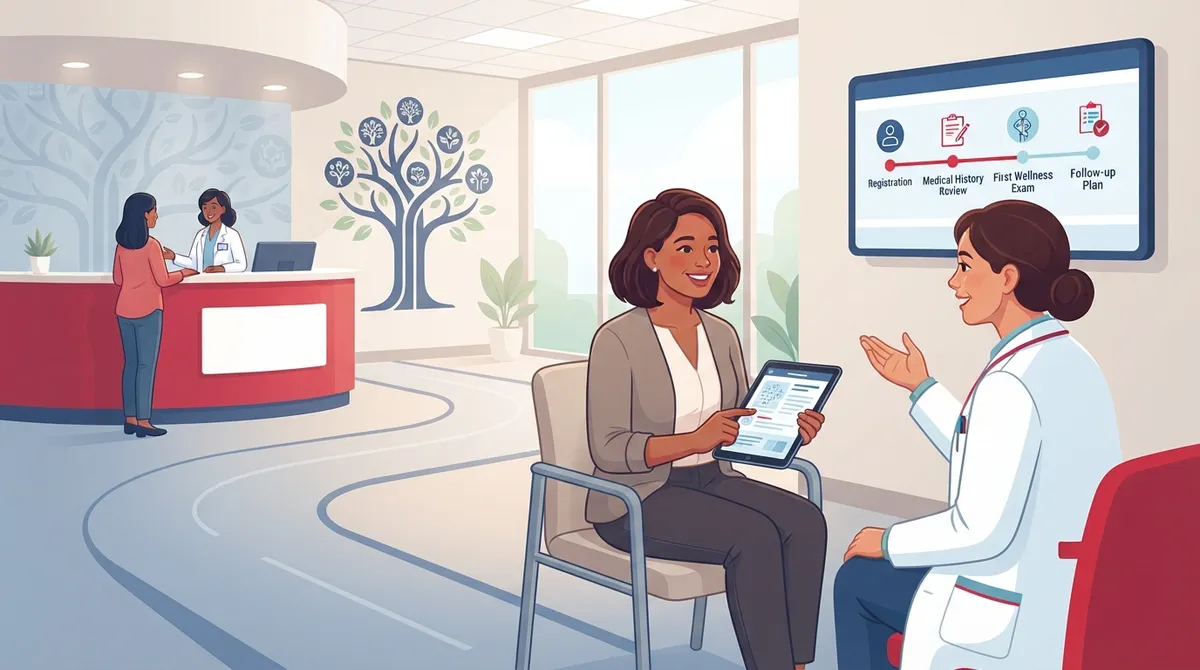
Establishing care means you register with a practice, complete a new-patient visit, and gain a home base for your health. A new-patient visit usually includes a review of your medical history, current medications, preventive-care needs, and personal goals. The exact process varies by practice, but the aim is the same: build a complete picture of you.
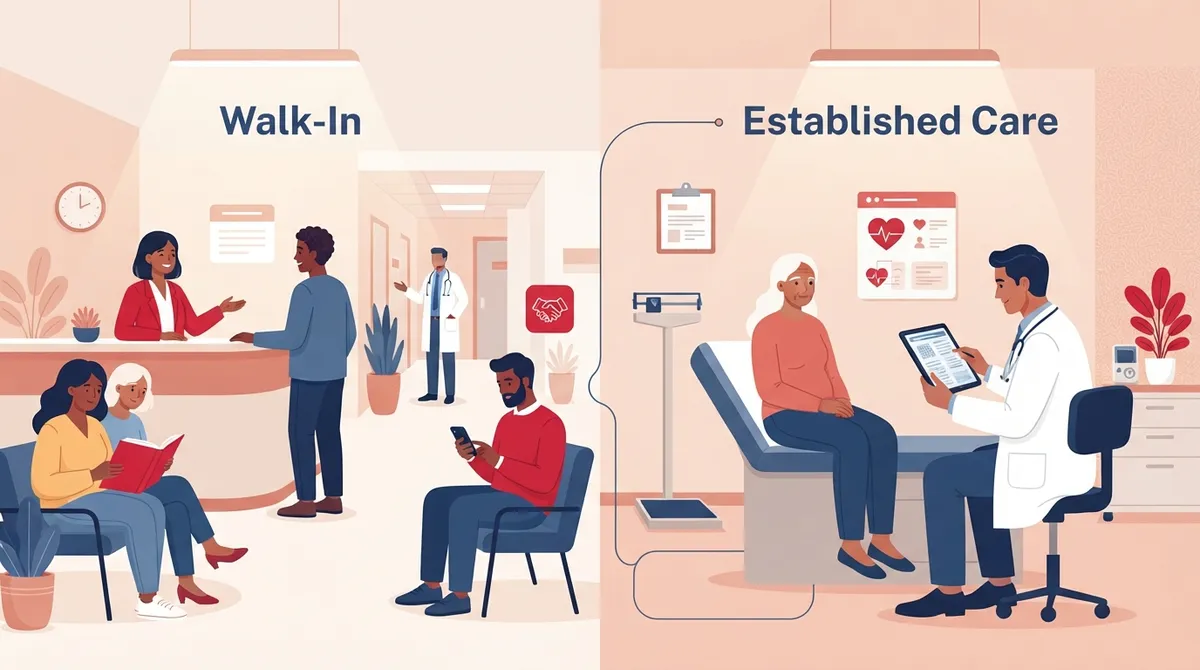
This path pays off over time. Your clinician learns your baseline, spots changes early, and coordinates referrals when you need a specialist. For chronic conditions such as high blood pressure or diabetes, that continuity is hard to replace. You can read more about how primary doctors help manage chronic illnesses.
Strengths of Established Care
- A clinician who knows your full history and preferences
- Preventive screenings scheduled before problems appear
- Easier refills, referrals, and records management
- Faster follow-up when a concern arises
Limitations of Established Care
- You must find a practice with open capacity
- The first appointment may take time to schedule
- You need to confirm insurance participation up front
Path Two: Walk-In and One-Off Visits
Walk-in care is built for speed. If you wake up with a sore throat or twist an ankle, a walk-in or urgent care visit can get you treated without a long wait. For short-term problems, this path is useful and often necessary. InCare offers urgent care for exactly these moments.
The trade-off is continuity. A walk-in clinician typically treats the problem in front of them and does not follow your long-term health. Preventive screenings, chronic condition management, and whole-body wellness planning are not the main focus of a single visit.
It is also worth knowing that urgent or emergency symptoms are not appropriate for a routine new-patient appointment. Chest pain, severe breathing trouble, and similar warning signs need immediate care, not a scheduling queue. For help deciding where to go, see these urgent care mistakes that could cost you your health.
Side-by-Side Comparison
|
Factor |
Established Primary Care |
Walk-In or One-Off Visit |
|---|---|---|
|
Best for |
Prevention, chronic care, long-term wellness |
Sudden, short-term illness or injury |
|
Continuity |
High; one team knows your history |
Low; each visit starts fresh |
|
Preventive screenings |
Planned and tracked |
Rarely addressed |
|
Speed of first visit |
May require scheduling ahead |
Often same day |
|
Referral coordination |
Built into your care |
Limited |
|
Insurance check |
Needed before registering |
Needed at the visit |
Why Access Is Tight: The Workforce Picture
If finding an open practice feels hard, the data explains why. HRSA's 2025 workforce report found 8,466 primary-care shortage areas, and 63.1% of them were in rural communities. HRSA estimated that 15,628 additional primary-care physicians would be needed to remove all primary-care shortage designations. It also projected a shortage of 70,610 full-time-equivalent primary-care physicians by 2038.
A shortage designation is a community-level indicator, not a guarantee that every practice nearby is closed. Many offices still take new patients. But it does mean you should start your search early and have backup options ready.
Payer mix matters too. MedPAC reported that among non-pediatric office-based physicians who said they accepted new patients, 88% accepted new Medicare patients and 89% accepted new privately insured patients. Those figures come from 2021 data cited in its 2024 report, so treat them as a general guide rather than a promise about any one practice.
How to Check If a Practice Is Truly Accepting New Patients
A short, organized approach saves time. Follow these steps:
- Start with the practice website. Look for provider bios, locations, and new-patient instructions. You can browse the InCare providers page to see the clinicians on our team.
- Check your insurer's directory. This helps confirm network status, though listings may be outdated.
- Call the office directly. Ask whether the specific clinician and your specific plan are accepted.
- Ask about the earliest appointment. Also ask whether telehealth is offered for the first visit.
- Confirm what to bring. Records, medication lists, and your insurance card speed up registration.
Good questions to ask on the call include which clinicians are open, how urgent concerns are handled before your first visit, and whether a cancellation list exists. A practice that answers these clearly is usually one that runs well.
What to Do If No One Is Accepting New Patients
If your first choice is full, you still have options:
- Ask to join a cancellation or waitlist.
- Request another clinician or location within the same organization.
- Explore community health centers, which may serve patients with or without insurance.
- Consider telehealth primary care to get started sooner.
While you wait, urgent care can cover short-term needs. Just remember it does not replace a primary care relationship. Many people use both: urgent care for the unexpected, and a primary care home for everything else.
Who Benefits Most From Establishing Care
Different readers have different reasons to find a practice that is accepting new patients.
- Busy young families: One practice can handle checkups, preventive screenings, and sick visits for the household, which saves scheduling time. See family primary care and why it matters.
- Tech-savvy millennials: Virtual visits and online booking make routine care easier to fit into a packed week.
- Wellness-focused adults: Advanced services like DNA gene testing and cancer screening work best when guided by a clinician who knows your history.
- Young adults and women without a regular doctor: A first wellness visit sets a baseline for future decisions, from screenings to weight management.
Where InCare Fits In
InCare is a personalized primary care and wellness clinic serving Tampa and Riverview, Florida. We combine state-of-the-art technology with medical expertise to deliver primary care, urgent care, and advanced wellness services under one roof. That means one team can handle your annual visit, your preventive screenings, and your wellness goals, from weight loss programs to IV hydration therapy.
For many patients, the value is simple: you do not have to choose between a doctor who knows you and a clinic that can see you quickly. Our approach focuses on prevention and whole-body optimization, so your care addresses the whole picture rather than a single complaint. If you are curious what the first appointment looks like, read about what to expect at a new patient appointment.
You can learn about our locations on the locations page or see what patients say by visiting our InCare reviews on Google. We also share health tips on Instagram and Facebook, and short wellness videos on TikTok.
The Verdict: Which Path Wins?
For short-term problems, walk-in care wins on speed. For nearly everything else, established primary care wins. It gives you continuity, prevention, and a trusted clinician who can see patterns that a single visit would miss. The smartest strategy is to do both well: keep a primary care home and know where to go for urgent needs.
The key is to act before you need care urgently. Finding a practice that is accepting new patients takes a few phone calls today, but it can save you stress, time, and potentially serious health setbacks later.
Take the Next Step
Ready to establish care with a team that puts prevention first? Book your new-patient appointment with InCare today, or contact our team with any questions about insurance, providers, or what to bring to your first visit.
FAQs
Q: What does "accepting new patients" mean at a primary care office?
A: It means the practice is currently willing to register and schedule people who are not already established patients. Availability can vary by clinician, location, insurance plan, and appointment type, so it is best to confirm directly with the office.
Q: How can I check whether a primary care doctor accepts my insurance?
A: Start with your insurer's provider directory, then call the practice to verify that the specific clinician is in-network and that the office is accepting your exact plan. Online listings may not reflect current openings, so a direct call is the most reliable step.
Q: What should I bring to my first primary care appointment?
A: Bring your insurance card, a photo ID, a list of current medications and supplements, and any prior medical records or test results. Having this information ready helps the clinician review your history and plan preventive care more efficiently.
Q: What can I do if no primary care doctors near me are accepting new patients?
A: Ask about a cancellation list, another clinician or location within the same organization, community health centers, or telehealth options. For short-term needs, urgent care can bridge the gap while you secure a long-term primary care home.
Q: Can I become a new patient through a telehealth primary care practice?
A: Many practices offer telehealth for new-patient visits, though the availability depends on the clinic and the type of care needed. Ask the office whether your first appointment can be virtual and whether any in-person follow-up will be required.


