
Key Takeaways
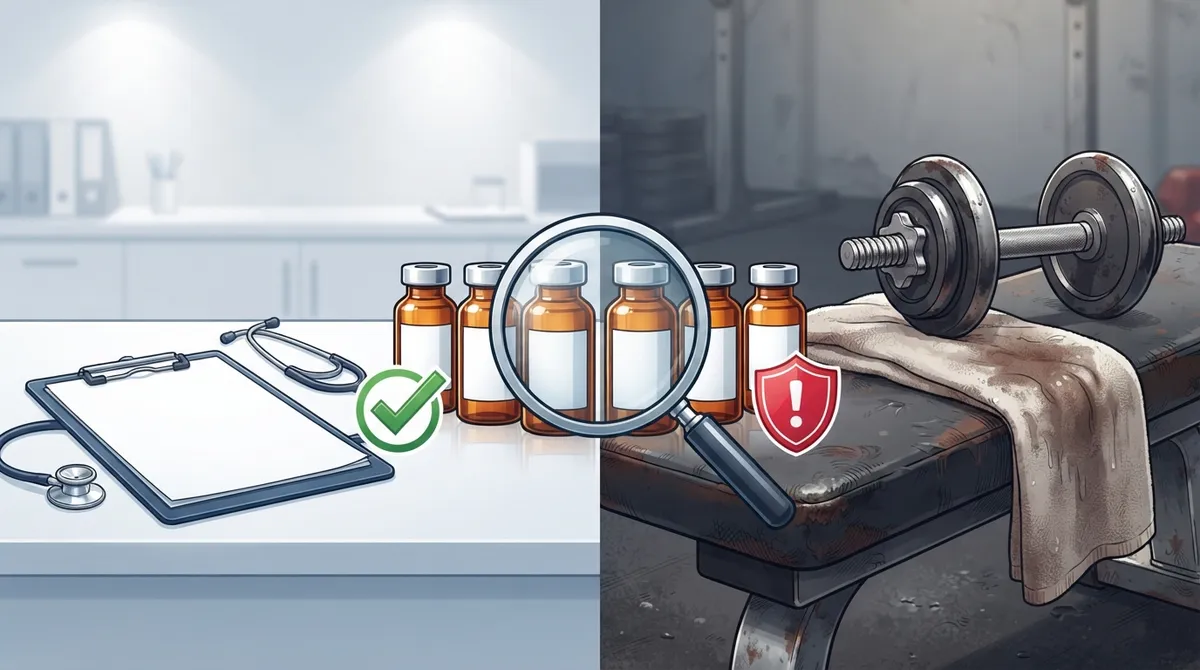
- Clinic and gym peptides are marketing labels, not regulatory categories; what matters is the exact substance, its FDA status, product quality, intended use, and whether a clinician monitors you.
- A prescription does not make a compounded peptide FDA-approved, and the FDA does not review each compounded product for safety, effectiveness, or quality before it is marketed.
- Popular peptides like BPC-157, CJC-1295, and ipamorelin are not FDA-approved for muscle gain or recovery, and FDA materials raise safety concerns about several of them.
- Before starting any peptide, ask the exact drug name, its FDA status, the human evidence, the pharmacy source, known risks, the monitoring plan, and whether established treatments should be tried first.
Walk into many gyms and you will hear the same pitch: a peptide that heals faster, builds muscle, and burns fat. Then you visit a wellness clinic and hear a similar story, only with a white coat attached. So are clinic peptides different from gym peptides, or is it the same product with a different sales pitch? The honest answer is more nuanced than most people expect.
"Clinic peptides" and "gym peptides" are marketing labels, not medical or regulatory categories. What matters is the exact substance, its FDA status, where it was made, why it is being used, and whether a licensed clinician is watching your health. In 2026, FDA materials still raise safety questions about several popular peptides, and many promoted benefits lack strong human evidence.
This guide walks through eight common mistakes people make when they assume one source is automatically safe and the other is not. It is written for busy adults who want clear facts before putting anything into their bodies.
The Short Answer: Labels Do Not Equal Safety
A peptide is a short chain of amino acids. Some peptide drugs are FDA-approved for specific medical conditions. Many others sold for muscle gain, recovery, or anti-aging are not approved for those uses. The setting where you hear about the product does not change its regulatory status.
Here is what actually separates one peptide product from another:
- The exact substance: An approved medicine is very different from an experimental compound.
- Regulatory status: FDA-approved, compounded, or sold as "research use only."
- Product quality: Identity, strength, sterility, and storage all vary.
- Intended use: Approval applies to a specific product and a specific condition.
- Clinical oversight: Lab monitoring, a full health history, and follow-up care.
So when someone asks whether clinic peptides differ from gym peptides, the better question is: which peptide, from which source, for which reason, under whose care?

Mistake 1: Assuming a Clinic Prescription Means FDA Approval
This is the most common error. A prescription feels official, but it does not make a product FDA-approved. Compounded drugs are not FDA-approved, and the FDA does not review each compounded product for safety, effectiveness, or quality before it is marketed.
Compounding is generally meant for a patient-specific medical need when an approved drug cannot meet that need. It is not a loophole for any substance a patient requests. Always ask your clinician two direct questions: "Is this exact product FDA-approved?" and "For what condition?" A trustworthy provider will answer plainly.
Mistake 2: Believing Gym Peptides Are Always Unsafe and Clinic Peptides Are Always Safe
Both extremes are wrong. Unregulated online and gym channels carry real risks, including uncertain identity, strength, and sterility. But a clinic setting is not a guarantee either. Safety depends on the substance and the supervision.
A clinic does offer advantages that a gym or an online seller cannot: a licensed clinician, a documented medical history, lab testing, and a plan for monitoring side effects. Those protections matter. They simply do not turn an unproven peptide into a proven one.
Mistake 3: Trusting Popular Peptides Because Everyone Talks About Them
Peptides such as BPC-157, TB-500, CJC-1295, and ipamorelin are widely discussed in fitness circles. None is an FDA-approved drug for bodybuilding or injury recovery. Much of the supporting evidence comes from animal or laboratory work rather than strong human clinical trials.
FDA materials describe concerns about certain peptides used in compounding, including BPC-157, CJC-1295, and ipamorelin. These concerns include possible immune reactions linked to peptide aggregation or impurities, limited safety information, and, for some substances, reported serious adverse events. For deeper reading, see our guides on BPC-157 FDA approval status in 2026 and ipamorelin FDA approval status in 2026.
Mistake 4: Ignoring Where the Product Actually Comes From
Source matters more than setting. Products labeled "research use only" are not made for human use. They may have unknown purity, incorrect dosing, or contamination. Injectable products add risks such as infection and dosing errors.
The table below compares common sources at a high level.
|
Source |
Typical Oversight |
Key Risk to Consider |
|---|---|---|
|
FDA-approved peptide medicine |
FDA-reviewed for a specific condition |
Approval applies only to that product and use |
|
Compounded peptide from a licensed pharmacy |
Licensed pharmacy and prescriber, but no FDA review of each product |
Limited safety and effectiveness data |
|
"Research use only" product |
Little to none for human use |
Uncertain identity, strength, and sterility |
|
Gym or online seller |
Often none |
Contamination, mislabeling, no medical monitoring |
If you are weighing a product, our article on ways to verify CJC-1295 quality before you try it explains practical checks worth knowing.
Mistake 5: Expecting Guaranteed Muscle Gain or Fast Healing
No reliable source we reviewed offered strong clinical-trial data showing that commonly gym-marketed peptides deliver muscle-building or injury-recovery benefits. Promotional claims are not clinical outcomes. A responsible clinician should never promise muscle gain, accelerated healing, or other results the evidence does not support.
If your goal is recovery from an injury, established care often works better and carries less risk. Our overview of peptides for athletes: hype versus medical reality looks at this in more detail.
Mistake 6: Overlooking Hormone and Heart Effects
Growth-hormone-releasing peptides can influence hormone pathways. They may carry metabolic or cardiovascular consequences. FDA information notes serious adverse-event reports associated with CJC-1295 and ipamorelin. Those reports do not prove cause, but they show that safety cannot be assumed.
This is why monitoring is not optional. Anyone using hormone-affecting products should have baseline labs and follow-up testing. Read more in what monitoring is needed with growth hormone peptides.
Mistake 7: Skipping the Questions a Good Clinic Welcomes
The strongest protection you have is a good conversation. Before starting any peptide, ask:
- What is the exact drug, and what is its intended use?
- Is it FDA-approved, compounded, or something else?
- What evidence supports this use in humans?
- Which pharmacy supplies it, and how is quality verified?
- What are the known risks, and how will I be monitored?
- Are there established treatments I should try first?
A clinic that avoids these questions is a warning sign. For a longer checklist, see 15 questions to ask a peptide therapy clinic in Tampa.
Mistake 8: Forgetting About Sports Rules and the Bigger Health Picture
If you compete in organized sports, many peptide products may be restricted or banned. Check the rules of your governing body before using anything. Beyond competition, remember that fatigue, slow recovery, and low energy often have simple, treatable causes such as poor sleep, thyroid problems, low vitamin levels, or hormone changes. A primary care visit can uncover these without injections.
If sleep is part of the picture, our guide on when to see a doctor for poor sleep is a useful starting point.
How a Primary Care Approach Changes the Equation
The real difference between a gym conversation and a clinical one is not the peptide. It is the process. A primary care and wellness clinic starts with your history, symptoms, and lab results. It then looks at proven options first and discusses higher-risk or experimental options honestly, including what is unknown.
At InCare, our team in Tampa and Riverview focuses on prevention and whole-body health. That includes cancer screenings, metabolic breath analysis, body composition analysis, DNA gene testing, and personalized weight loss programs. Our approach is to measure first, treat what the evidence supports, and be transparent when a trend runs ahead of the science. You can see what patients say by visiting our InCare location on Google, where we hold a 4.8 rating across hundreds of reviews.
We also share health education on Instagram, Facebook, and TikTok so patients can stay informed between visits.
A Simple Checklist Before You Say Yes
- Confirm the exact substance and its FDA status.
- Know whether the product is approved, compounded, or "research use only."
- Ask for the evidence in humans, not just animals or marketing.
- Make sure a licensed clinician will order labs and follow up.
- Walk away from any promise of guaranteed results.
The Bottom Line
So, are clinic peptides different from gym peptides? Sometimes the substance is identical and only the sales channel differs. Sometimes a clinic offers a truly approved medicine, and sometimes it offers a compounded product with limited evidence. The difference that protects you is clear information and real medical supervision, not the label.
If you want a straight answer about your goals, labs, and options, our team is ready to help. Book Now to talk with an InCare clinician, or contact us with questions before your visit.
FAQs
Q: Are peptides prescribed by a clinic safer than peptides bought online or at a gym?
A: Not automatically. A clinic can offer a medical history, lab testing, and follow-up, which adds real protection. However, a prescription does not make a compounded or unapproved peptide FDA-approved, so the specific substance and its source still matter.
Q: Are BPC-157, TB-500, CJC-1295, or ipamorelin FDA-approved?
A: These peptides are not FDA-approved drugs for bodybuilding or injury recovery. FDA materials have raised safety concerns about several of them in compounding, including BPC-157, CJC-1295, and ipamorelin, and human evidence for advertised benefits is limited.
Q: Are compounded peptides FDA-approved or tested by the FDA?
A: No. Compounded drugs are not FDA-approved, and the FDA does not review each compounded product for safety, effectiveness, or quality before it is marketed. Compounding is generally intended for a patient-specific need when an approved drug cannot meet it.
Q: What should I ask a clinician before starting peptide therapy?
A: Ask for the exact drug and intended use, its FDA status, the human evidence behind it, the pharmacy source, the known risks, and the monitoring plan. Also ask whether established treatments are available first.
Q: What are the risks of injecting peptides?
A: Injectable products carry risks such as infection, dosing errors, and possible immune reactions from impurities or aggregation. Products with uncertain sterility or strength, such as those sold as research use only, raise these risks further.


