
Key Takeaways
- Peptides are not one safe group: approved GLP-1 drugs like semaglutide and tirzepatide have clinical trials and labels, while wellness peptides like BPC-157 or TB-500 have little human safety data.
- Do not stack two GLP-1-based medicines such as semaglutide and tirzepatide on your own, since overlapping effects can raise nausea, vomiting, and other side effects.
- Avoid 'research use only' peptides and be cautious with compounded GLP-1 products, which are not FDA-approved and have been linked to dosing errors and adverse events.
- Share your full medication list, including prescriptions, supplements, and peptides, with a clinician, since GLP-1 drugs can raise low blood sugar risk with insulin and affect how oral medicines are absorbed.
Many patients ask the same question in 2026: can you combine peptides with GLP-1 medicines? The honest answer is that it depends. The word "peptide" covers a huge range of products. Some are approved medicines. Others are sold online with little safety data. Mixing the wrong ones can lead to side effects, dosing errors, or wasted money.
Semaglutide and tirzepatide are peptide-based drugs themselves. Other products, such as BPC-157, CJC-1295, ipamorelin, and TB-500, are very different. They have different evidence and different risks. No rule says every combination is safe or unsafe. Safety depends on the exact products, doses, medical history, and other medications you take.
This guide explains seven common mistakes people make and how to avoid them. At InCare, our clinicians in Tampa and Riverview review every medication and supplement before building a plan. Use this article to prepare smart questions for your next visit.

First, Understand What "Peptides" Really Means
A peptide is a short chain of amino acids. That is a broad definition. Insulin is a peptide. So are semaglutide and tirzepatide. Many wellness products sold online are also called peptides, but they are not the same thing.
The table below shows how these categories differ.
|
Category |
Examples |
General Status |
Key Concern |
|---|---|---|---|
|
Approved GLP-1 medicines |
Semaglutide, tirzepatide |
FDA-approved, with labeled uses |
GI side effects, hypoglycemia with some drugs |
|
Wellness-marketed peptides |
BPC-157, CJC-1295, ipamorelin, TB-500 |
Often not approved for these uses |
Limited human safety data |
|
Compounded GLP-1 products |
Compounded semaglutide or tirzepatide |
Not FDA-approved |
Dosing errors, quality variation |
|
"Research use only" products |
Various online peptides |
Not intended for human use |
Impurities, unknown content |
Because these groups differ so much, the question "can you combine peptides with GLP-1" has no single answer. You need to name the exact product.
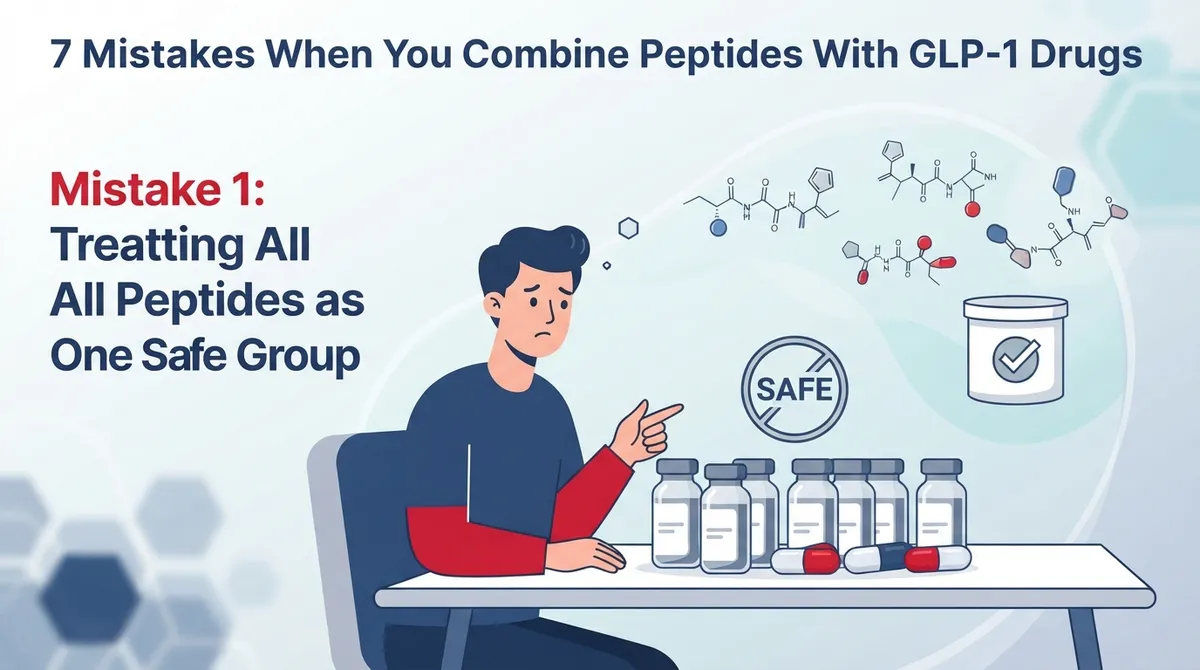
Mistake 1: Treating All Peptides as One Safe Group
The first mistake is assuming that every peptide behaves the same way. It does not. An approved GLP-1 drug has gone through clinical trials and has a detailed label. Many wellness peptides have only animal studies or small reports behind them.
Ask these questions before adding anything:
- Is this product FDA-approved, and for what use?
- If it is compounded, who made it and where?
- Is there human safety data for this specific combination?
- What happens if I have side effects from both products at once?
If nobody can answer these clearly, pause. Our guide to what peptides are explains the basics in more detail.
Mistake 2: Stacking Two GLP-1-Based Drugs
Some people wonder if more is better. For example, they ask whether semaglutide can be paired with tirzepatide. These drugs act on overlapping pathways. Using both can raise the chance of nausea, vomiting, and other side effects.
Do not combine two GLP-1-based medicines unless a qualified prescriber directs it for a specific reason. It is not a routine approach. If your current drug is not working well, the safer step is to talk with your clinician about changing the dose or switching products.
You can learn how the two main options compare in our article on semaglutide vs. tirzepatide.
Mistake 3: Buying Peptides Labeled "Research Use Only"
This is one of the riskiest mistakes. Products labeled "research use only" are not made for people. They are not reviewed for purity, strength, or safety. A vial may contain less, more, or something different from what the label says.
The FDA has raised concerns about impurities, immune reactions, and a lack of safety data for certain peptide categories. Rules can change, so always check current FDA guidance. A clinic that supports your care should verify the source, the approval status, and whether a product is lawfully compounded.
If a product comes without a prescription, a pharmacy source, and clear documentation, treat it as a red flag.
Mistake 4: Ignoring Compounded GLP-1 Risks
Compounded drugs are not FDA-approved. The FDA does not review them for safety, effectiveness, or quality before they are sold. The agency has received reports of dosing errors with compounded injectable semaglutide, and some reports involved hospitalization. It has also noted adverse-event concerns with compounded tirzepatide.
The FDA advises that compounding should generally be reserved for cases where an approved drug cannot meet a patient's medical need. Adding another peptide on top of a compounded product makes it harder to know what caused a side effect.
Current counts of adverse-event reports change over time, so check the latest FDA update rather than relying on an old number. If you want to understand the pricing and options, read our guide on weight loss injection costs in 2026.
Mistake 5: Skipping a Full Medication Review
GLP-1 medicines can interact with other drugs. Two issues matter most:
- Low blood sugar. Using a GLP-1 drug with insulin or a sulfonylurea can raise the risk of hypoglycemia. Your clinician may need to lower the dose of those medicines.
- Slower stomach emptying. GLP-1 drugs slow how fast food leaves your stomach. This can change how well some oral medicines are absorbed.
- Overlapping side effects. Nausea, diarrhea, constipation, and abdominal pain are common with GLP-1 drugs. Adding another product can blur the cause of symptoms.
- Unknown supplement effects. Many peptides and supplements have not been studied alongside GLP-1 drugs.
A pharmacist or primary care clinician should review your full list. Include prescriptions, over-the-counter products, vitamins, and any peptides. Our prescription management tips can help you organize that list.
Mistake 6: Starting Without Baseline Testing and Monitoring
Many people begin a new injection plan without any baseline data. That makes it hard to tell what is helping and what is causing trouble. A responsible plan includes a starting point and regular follow-up.
Useful baseline steps include:
- A medical history and medication reconciliation
- Blood pressure, weight, and relevant lab work
- A body composition scan to track fat and muscle, not just the scale
- A metabolic breath analysis to understand how your body uses energy
This matters because rapid weight loss can include muscle loss. Tracking body composition helps your clinician adjust your plan. Our article on preserving lean muscle while losing weight goes deeper on this topic.
Mistake 7: Missing the Warning Signs
Even approved drugs can cause serious problems in some patients. Do not wait to get help if symptoms are severe or do not improve. Contact a clinician quickly if you notice:
- Severe or persistent abdominal pain, with or without vomiting
- Signs of dehydration, such as dizziness or very dark urine
- Symptoms of low blood sugar, such as shakiness, sweating, or confusion
- Signs of an allergic reaction, such as swelling, rash, or trouble breathing
- Redness, swelling, or drainage at an injection site
For emergencies such as trouble breathing, call 911 or go to the nearest emergency room. For less severe issues that still need prompt attention, urgent care can help. Our guide on managing GI side effects offers more practical tips.
A Safer Way to Approach Peptides and GLP-1 Therapy
If you are curious about adding a peptide to a GLP-1 plan, follow a clear process. A careful primary care approach looks like this:
- Name the exact products. Write down each peptide, its dose, route, and source.
- Verify the source. Confirm whether the product is approved or lawfully compounded.
- Reconcile every medicine and supplement. Include anything you take, even occasionally.
- Check for risks. Review your conditions, such as diabetes, kidney issues, or a history of pancreatitis.
- Monitor and adjust. Track symptoms, labs, and response, and revisit the plan often.
This process protects you. It also gives your clinician the information needed to say yes, no, or "not yet." Sometimes the best answer is to focus on one proven therapy first, then reassess.
How InCare Supports Safe, Personalized Care
At InCare, we combine primary care with advanced wellness tools. Our team can review your medications, discuss weight loss options, and explain how peptide therapy in Tampa may or may not fit your goals. We do not recommend unverified online products. Our focus is on safety, clear documentation, and follow-up.
Patients also benefit from having one team that sees the whole picture. Our providers can coordinate your primary care, lab work, and wellness services together. You can also see what other patients say by reading InCare reviews on Google. For updates and wellness tips, follow us on Instagram, Facebook, and TikTok.
Conclusion: Ask Before You Mix
So, can you combine peptides with GLP-1 medicines? Sometimes a clinician may approve a specific plan, but there is no blanket rule. The safest path is to avoid guesswork. Do not stack two GLP-1 drugs on your own. Avoid "research use only" products. Be careful with compounded items. Always share your full medication list.
Your health is worth a careful approach. If you are using or considering a GLP-1 medicine, or you are curious about peptides, bring your questions to a clinician who will review the details. Book your visit with InCare today, or contact our team to learn how we can build a safe, personalized plan in Tampa or Riverview.
FAQs
Q: Can I take BPC-157 while using semaglutide or tirzepatide?
A: There is no proven, general answer. BPC-157 is not FDA-approved for most wellness uses, and human safety data is limited. A clinician or pharmacist should review the exact product, source, and dose before you consider combining it with a GLP-1 medicine.
Q: Can you combine two GLP-1 medications, such as Ozempic and Mounjaro?
A: This is not a routine or recommended approach. These drugs have overlapping effects, which may increase side effects. Only a qualified prescriber should direct this, and only for a specific medical reason.
Q: Are peptides like BPC-157, CJC-1295, or ipamorelin FDA-approved?
A: Many peptides promoted for recovery, muscle gain, or anti-aging are not FDA-approved for those uses. The FDA has noted safety concerns for certain substances, including impurities and limited safety data. Regulatory status can change, so always check current FDA guidance.
Q: Can GLP-1 medications interact with insulin or other prescriptions?
A: Yes. Combining a GLP-1 drug with insulin or a sulfonylurea can raise the risk of low blood sugar, and your clinician may need to adjust those medicines. GLP-1 drugs also slow stomach emptying, which can affect how some oral medicines are absorbed.
Q: What should I tell my primary care clinician before starting a peptide or GLP-1 medication?
A: Share every prescription, over-the-counter product, supplement, and peptide you use, along with doses and sources. Also mention your medical conditions, such as diabetes or kidney problems. This full picture helps your clinician spot risks and monitor you safely.