

Key Takeaways
- GHK-Cu is not FDA-approved for aging, hair loss, wounds, or other medical conditions, and human evidence is limited mostly to small, short topical cosmetic studies.
- Injectable GHK-Cu carries the most uncertainty: no reliable human safety or efficacy data, and the FDA has raised concerns about possible immune reactions.
- Compounded products do not go through FDA premarket review for safety, effectiveness, or quality, even when prepared by a licensed pharmacy.
- Before choosing a clinic, ask which route is proposed, what the evidence is, where the product comes from, what the risks and alternatives are, and whether a clinician will review your history and medications.
Copper peptide products are everywhere in 2026. Social media, med spas, and online stores all promise younger skin, thicker hair, and faster healing. Yet the science behind these claims is far thinner than the marketing suggests. For anyone researching GHK-Cu copper peptide therapy in Tampa, the biggest risk is not the peptide itself. It is making a decision based on hype instead of evidence.
GHK-Cu is a small copper-binding peptide. Researchers have studied it for skin remodeling, collagen-related pathways, inflammation, and wound repair. Most of the mechanism data comes from lab and animal work. Human data is limited, and it is mostly about topical cosmetic products. It is not an FDA-approved treatment for aging, hair loss, wounds, or any other medical condition.
This guide walks through seven common mistakes patients make. It also explains what a responsible visit should look like. Our goal is simple: help you ask better questions, avoid products that do not fit your needs, and know when to talk to a licensed clinician first.
What Is GHK-Cu Copper Peptide Therapy?
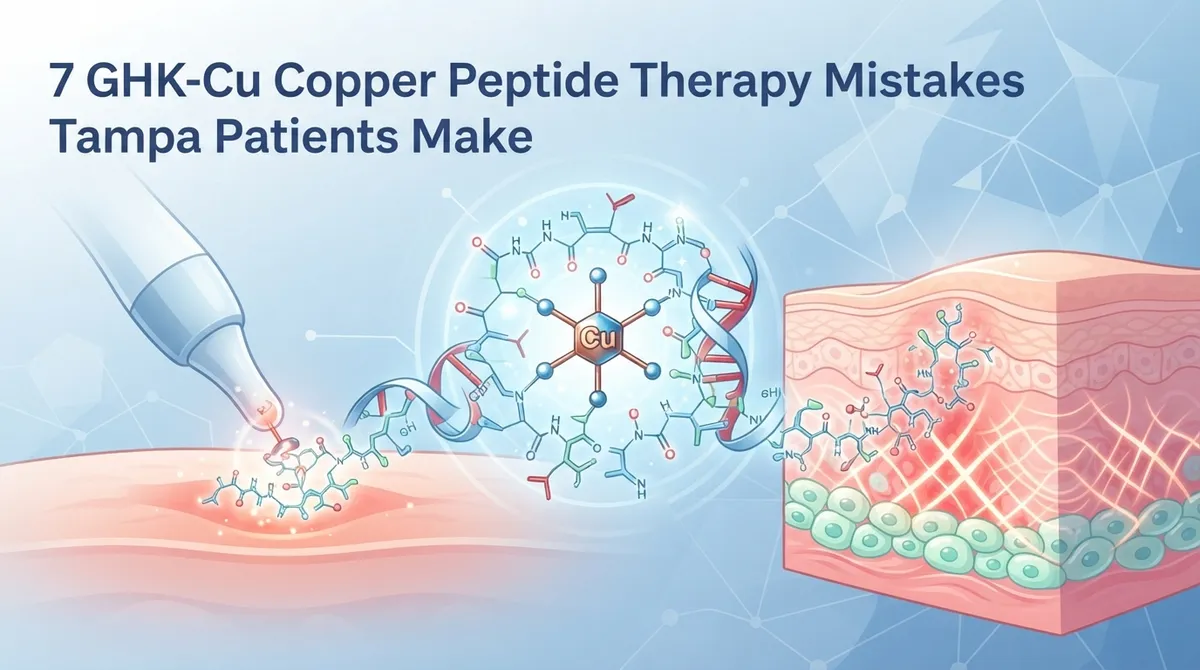
GHK-Cu stands for glycyl-L-histidyl-L-lysine copper. It is a short chain of three amino acids bound to a copper ion. The body makes small amounts naturally, and levels appear to decline with age. That decline is one reason the peptide drew research interest.
In Tampa, the phrase "GHK-Cu therapy" can mean very different things. Patients may see it used for three routes:
- Cosmetic topical products: Serums, creams, and masks sold as skincare.
- Compounded topical medications: Custom-prepared creams from a compounding pharmacy.
- Injectable products: Offered by some wellness clinics, with far less evidence behind them.
These are not the same thing. Each route carries different evidence, different oversight, and different risk. Mixing them up is the root of many of the mistakes below.
Mistake 1: Treating a Cosmetic Product Like a Proven Medical Treatment
Copper tripeptide-1 appears in many cosmetic products. The Cosmetic Ingredient Review panel found it safe for the cosmetic uses and concentrations it reviewed in 2014. That finding is useful, but it has limits. It does not prove that injections are safe. It also does not prove that compounded drug products work.
A skincare serum is a cosmetic. It is not a drug, and it is not a medical therapy. Patients sometimes expect cosmetic products to behave like prescription treatments. They do not. Setting realistic expectations from the start prevents disappointment and wasted money.
Mistake 2: Assuming the Evidence Is Stronger Than It Is
The human evidence for GHK-Cu is small. Here is what the research actually shows:
|
Study or Review |
What It Found |
Key Limitation |
|---|---|---|
|
12-week facial cream study (71 women) |
Reported changes in skin appearance measures |
Small, short, topical only |
|
12-week eye cream study (41 women) |
Reported changes in wrinkle-related measures |
Small, short, topical only |
|
One-month thigh skin study |
Collagen increased in 70% of GHK-Cu users, versus 50% with vitamin C and 40% with retinoic acid |
Limited result, not a general success rate |
|
2026 systematic review |
Described 11 human clinical studies, mostly small |
No large phase III randomized trial; GHK-Cu often a comparator |
|
2025 hair-loss case series |
Four patients used a combination protocol that included copper peptide |
Too small, with multiple treatments, so GHK-Cu's own effect is unknown |
Taken together, these studies are interesting. They are not proof. A patient who reads "collagen increased" in a headline should remember the sample sizes and the short time frames. Early signals are a reason for more research, not a reason for confident promises.
Mistake 3: Assuming Injectable GHK-Cu Is Approved or Proven Safe
This is the most important mistake on the list. Injectable GHK-Cu has much more uncertainty than topical use. Reliable human safety and efficacy data are lacking. The FDA has raised concerns about possible immune reactions with peptide products. Those concerns include reactions linked to impurities or peptide clumping.
A clinic offering an injection does not mean the injection is approved. It also does not mean it is proven safe. Patients should never assume either one. If a provider presents injectable GHK-Cu as an established treatment, that is a red flag. Our related guide on GHK-Cu supplement facts covers the same caution in more detail.
Mistake 4: Confusing Compounded Products With FDA-Approved Drugs
Compounded medications are not FDA-approved. They do not go through the same premarket review for safety, effectiveness, and quality as approved drugs. That is true even when a licensed pharmacy prepares them.
You may also hear that the FDA is reviewing bulk substances or has interim policies in place. Those updates are evolving. They are not approval of GHK-Cu. They are also not proof that a compounded product is safe or effective. Patients can read more in our comparison of FDA-approved vs. compounded peptides.
Mistake 5: Skipping the Right Questions Before Choosing a Clinic
Tampa has many wellness providers. They do not all hold themselves to the same standard. Before you book, ask these questions:
- Which route are you proposing? Cosmetic topical, compounded topical, or injection.
- What is the goal? A clear, realistic target for skin, hair, or healing.
- What is the evidence? A good provider will explain limits honestly.
- Where does the product come from? Ask about the source, pharmacy, and quality testing.
- What are the risks? Including allergic or immune reactions.
- What are the alternatives? Established options should be on the table.
- Will a clinician review my history and medications? This should always be yes.
If a clinic cannot answer these clearly, keep looking. Our checklist of 15 questions to ask a peptide therapy clinic in Tampa goes even deeper.
Mistake 6: Using GHK-Cu Instead of Evidence-Based Care
Some patients try copper peptides before getting a diagnosis. That can delay real treatment. Here is how to think about the most common concerns:
|
Concern |
Better First Step |
Where GHK-Cu Fits |
|---|---|---|
|
Wounds or slow healing |
Evidence-based wound care and evaluation |
Should never replace care or delay evaluation of a nonhealing wound |
|
Hair thinning |
Diagnosis of the cause, then established options |
Evidence is very limited |
|
Wrinkles and skin texture |
Sun protection, retinoids, and clinician guidance |
Some small topical studies exist |
|
Scars and skin repair |
Skin assessment by a clinician |
Possible adjunct, not a proven fix |
A nonhealing wound deserves prompt medical attention. Hair loss can come from thyroid problems, nutrient gaps, hormones, or medications. Skin changes can have medical causes too. A primary care visit can sort these out. For more on skin concerns, see our guide to skin repair steps doctors recommend.
Mistake 7: Skipping a Full Medical Review
Copper plays a role in many body processes. Peptides can interact with other conditions or medications. A skincare serum may seem harmless, but a compounded or injected product deserves a proper review.
A responsible visit should include:
- A review of your medical history and current medications
- A discussion of allergies and past reactions to skin products
- A clear statement of whether the product is cosmetic, compounded, or injectable
- An honest explanation of what is known and unknown
- A follow-up plan to monitor your response
This is where primary care shines. A clinician who knows your full health picture can tell you whether a product makes sense. They can also tell you when it does not.
What a Responsible Tampa Consultation Looks Like
A good consultation does not start with a sales pitch. It starts with your goals and your health history. The clinician explains the options and the evidence behind each one. If GHK-Cu is discussed, the route is stated clearly. Limits are named. Alternatives are offered.
At InCare, we combine primary care with advanced wellness services at our Tampa and Riverview locations. That means your questions about skin, hair, or wellness can be reviewed alongside your overall health, not in isolation. Our approach centers on prevention, honest guidance, and personalized plans. Patients can also visit us on Google — InCare to read what other patients say about their care.
If you are weighing wellness peptides more broadly, our overview of how to evaluate peptide therapy for wellness safely is a helpful next read. You can also follow practice updates on Instagram, Facebook, and Tik Tok.
How GHK-Cu Fits Into a Wider Wellness Plan
Skin and hair health rarely come down to one ingredient. Sleep, nutrition, sun protection, stress, hormones, and chronic conditions all play a part. A peptide cannot fix a problem that starts elsewhere.
For many patients, the best path starts with basics:
- Get a baseline checkup. Labs can reveal thyroid, vitamin, or hormone issues.
- Protect your skin daily. Sunscreen remains the most proven anti-aging step.
- Address the root cause. Treat the condition, not just the symptom.
- Discuss add-ons last. Consider peptides only after the basics are covered.
This order protects both your health and your budget. It also makes any later decision about GHK-Cu much more informed.
Conclusion: Make Evidence Your Starting Point
GHK-Cu is an interesting peptide with early, limited human data. It is not an FDA-approved treatment. Injectable use carries the most uncertainty, and compounded products do not receive the same review as approved drugs. The seven mistakes above all come from one problem: treating a promising idea as a proven therapy.
The smart move is to start with a licensed clinician who will listen, review your history, and tell you the truth about the evidence. If you are exploring GHK-Cu copper peptide therapy in Tampa, begin with a conversation instead of a purchase. Ready to talk it through? Book Now with InCare, or contact our team with your questions. We will help you sort out what fits your health and what does not.
FAQs
Q: What is GHK-Cu copper peptide therapy, and what is it used for?
A: GHK-Cu is a copper-binding peptide studied for possible effects on skin remodeling, collagen pathways, inflammation, and wound repair. It is used in cosmetic skincare, and some clinics offer compounded or injectable versions. Human evidence is limited, so any use should be discussed with a licensed clinician.
Q: Is GHK-Cu FDA-approved for injections or skin treatment?
A: No. GHK-Cu is not FDA-approved as a drug to treat aging, hair loss, wounds, or other medical conditions. Cosmetic products with copper tripeptide-1 are different from prescription drugs and compounded medications, and injectable use has the most safety and evidence uncertainty.
Q: Does GHK-Cu help with wrinkles, collagen, or skin firmness?
A: Small human studies of topical products have reported changes in skin appearance, thickness, or wrinkles. However, these studies are small and short, so they do not establish reliable clinical benefits. Results should be viewed as early signals rather than guaranteed outcomes.
Q: What are the risks of injectable GHK-Cu compared with topical products?
A: Injectable GHK-Cu lacks reliable human safety and efficacy data. The FDA has raised concerns about potential immune reactions, including those tied to peptide impurities or aggregation. Topical cosmetic products have a longer track record, though skin irritation is still possible.
Q: What should I ask a Tampa provider before considering compounded GHK-Cu?
A: Ask which route is proposed, what the goal is, where the product comes from, and what risks and alternatives exist. Also confirm that a clinician will review your medical history and medications. A trustworthy provider will explain the evidence limits honestly.


