

Key Takeaways
- A peptide describes a molecule (a short chain of amino acids), while a supplement is a legal product category; a product labeled "peptide" is not automatically a supplement.
- Supplements are not FDA-approved for safety or effectiveness before sale, whereas FDA-approved peptide medicines must show evidence for a specific use and condition.
- Many injectable peptides sold online are not FDA-approved and carry risks like uncertain dose, purity, contamination, and immune reactions, so ask for the exact product name and manufacturer.
- Both peptides and supplements can interact with prescription medications, so share every product you use with your clinician for a full medication review before starting.
Peptides and supplements often appear side by side in wellness marketing, so many people assume they are the same thing. They are not. If you are asking how do peptides differ from supplements, the short answer is this: a peptide is a type of molecule, while a supplement is a legal product category. That one distinction shapes how each is regulated, tested, prescribed, and monitored.
For patients in Tampa and Riverview, the stakes are real. Some peptide-based medicines are FDA-approved. Many injectable peptides sold online are not. Supplements are easier to buy, but they are not approved for effectiveness before they reach the shelf. Knowing the difference helps you ask better questions and avoid risky products.
This guide walks through ten clear differences, from chemistry to regulation to safety. It also explains what a primary care clinician should review before you start anything new. For personalized guidance, you can contact the InCare team before you buy or inject anything.
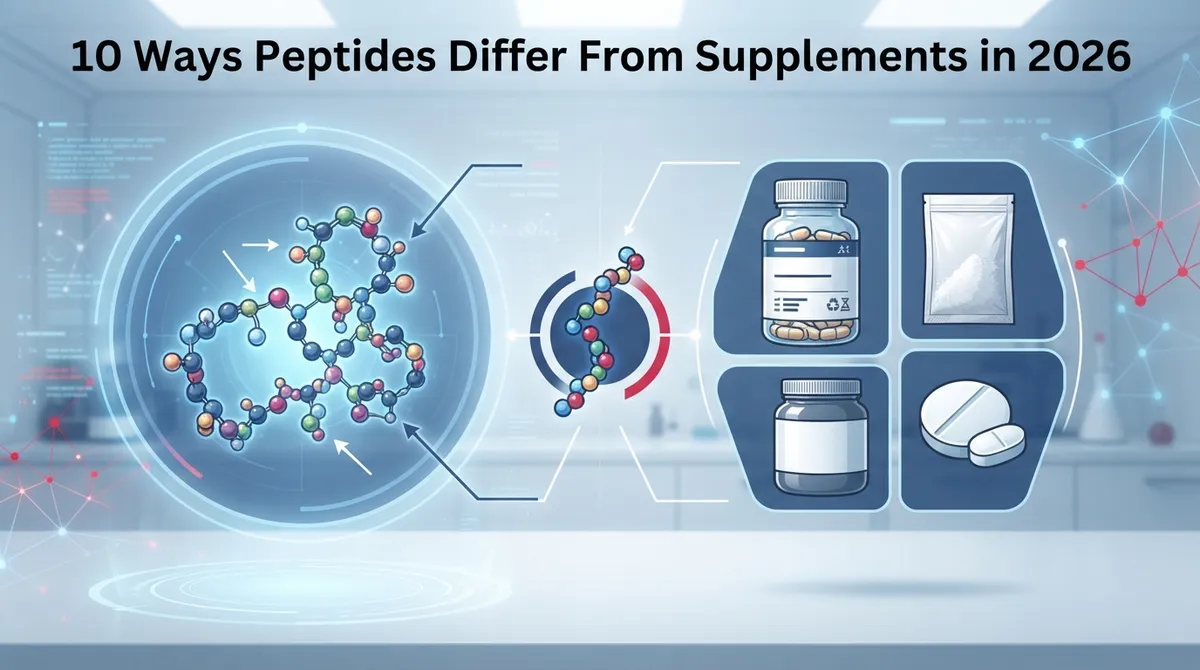
1. A Peptide Is a Molecule, a Supplement Is a Category
Peptides are short chains of amino acids. Proteins are generally longer chains. Some peptides act as signaling molecules or hormones in the body, and others are used as medicines. The word "peptide" describes chemistry. It says nothing about safety, approval, or proof of benefit.
A dietary supplement, by contrast, is a legal category. It is a product taken by mouth to supplement the diet and labeled as a supplement. U.S. law lists ingredients such as vitamins, minerals, herbs, and amino acids. So a product labeled "peptide" is not automatically a supplement.
This is the core idea behind how peptides differ from supplements. One term describes what a substance is. The other describes how the law treats a product.
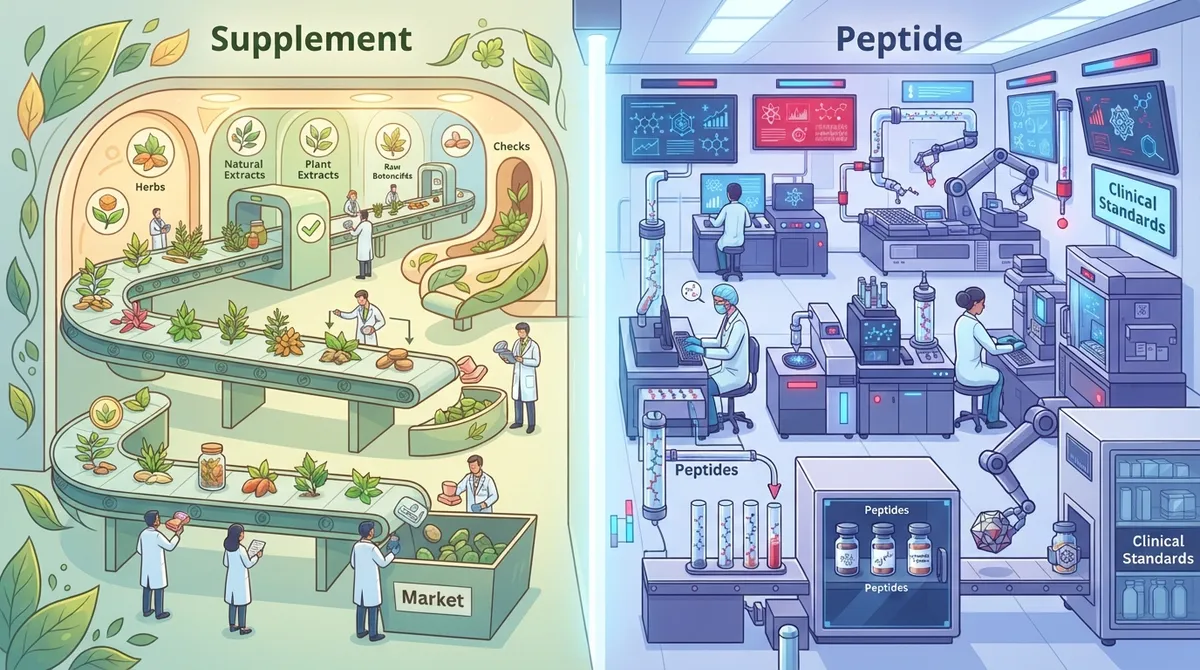
2. Regulation Works Very Differently
The framework for supplements comes from the Dietary Supplement Health and Education Act (DSHEA), which became law in 1994, according to the NIH Office of Dietary Supplements. Under that law, manufacturers are responsible for the safety of their products and for truthful, non-misleading claims.
Peptide-based medicines follow the drug pathway instead. An FDA-approved peptide drug has been reviewed for a specific product and a specific condition. That approval does not extend to all peptides, or to other products making similar claims.
|
Feature |
Peptide Medicine (FDA-Approved) |
Dietary Supplement |
|---|---|---|
|
Legal category |
Drug |
Dietary supplement |
|
Reviewed for effectiveness before sale |
Yes, for the approved use |
No |
|
Typical route |
Often injection |
Taken by mouth |
|
Prescription required |
Yes |
No |
|
Clinician oversight |
Built into care |
Optional |
3. Pre-Market Review Is Not the Same
The FDA does not approve dietary supplements for safety or effectiveness before they are marketed. The agency can act against unsafe or misbranded products after they reach consumers. Certain new dietary ingredients do require advance notice to the FDA, generally at least 75 days before the product enters interstate commerce.
FDA-approved peptide drugs go through a different process. Before approval, the product must show evidence for a defined use. That is a meaningful gap in oversight, and it is one reason clinicians ask exactly which product you plan to use.
4. Unapproved Injectable Peptides Are a Separate Problem
This is where confusion causes the most harm. Many injectable peptides promoted online or by some wellness providers are not FDA-approved. They are also not equivalent to approved peptide medicines.
Concerns with unapproved products include:
- Uncertain dose and purity
- Possible contamination
- Immune reactions
- Limited evidence for the claimed benefit
- No established safety record
If you are curious about specific compounds, InCare has explained several in detail. See 4 Facts on BPC-157 FDA Approval Status in 2026 and 9 Facts on Ipamorelin FDA Approval Status in 2026.
5. Route of Delivery Often Differs
Most supplements are swallowed as capsules, powders, or liquids. Many therapeutic peptides, by contrast, are given by injection, because digestion can break down peptide chains before they work. Nasal sprays and topical creams also exist.
Route matters for safety. An injection bypasses some of the body's natural barriers. That is why dose accuracy, sterility, and product quality carry higher stakes with injectable products.
6. Quality Controls Do Not Mean Approval
Supplement makers must follow FDA manufacturing practices. These rules aim to support identity, purity, strength, and composition. They do not mean the FDA has approved a product's benefits.
Labels can also be wrong. Product contents may differ from what the bottle says. That is true for supplements and is a bigger concern for unregulated peptide products. If you want to check a product's quality, review 10 Signs You're Getting 3rd-Party Tested Peptides.
7. Both Can Interact With Your Medications
A common myth is that supplements are harmless because they are "natural." In fact, supplements can interact with prescription medicines or be unsuitable for certain conditions. Peptides can carry their own risks as well.
Here are the situations where a medication review matters most:
- You take blood thinners, diabetes medicines, or blood pressure drugs.
- You have a chronic condition such as kidney, liver, or heart disease.
- You are pregnant, trying to conceive, or breastfeeding.
- You plan surgery or a major procedure.
- You already take several supplements at once.
For example, vitamin and mineral products can still raise questions. Read Nattokinase and Vitamin K2: What to Know Before You Take Them to see why timing and interactions matter.
8. Evidence Varies by Molecule, Not by Label
There is no single statistic that describes the safety or effectiveness of all peptides. Evidence differs widely by molecule, product, route, and intended use. Some peptides have strong data for specific conditions. Others rest mostly on animal studies or small, early trials.
Supplements vary just as much. A well-studied vitamin for a documented deficiency is very different from a trendy blend with limited research. The honest answer is that you must look at the exact product and the exact claim.
For deeper reading, explore Peptides for Recovery: What the Evidence Really Shows and How to Understand Peptides Explained by Your Doctor.
9. Prescribed Versus Compounded Versus Over-the-Counter
It helps to sort products into three buckets. An FDA-approved prescription is one bucket. A compounded or unapproved product is another. An over-the-counter supplement is a third. Each carries different oversight and different risk.
|
Product Type |
Who Oversees It |
What to Ask |
|---|---|---|
|
FDA-approved peptide medicine |
FDA review plus prescriber |
Is this the approved product for my condition? |
|
Compounded or unapproved peptide |
Limited oversight |
What is the evidence, source, and testing? |
|
Dietary supplement |
Manufacturer responsibility |
Is it third-party tested and safe with my medicines? |
To understand this split in a Tampa setting, see FDA-Approved vs. Compounded Peptides: Which Is Safer?
10. A Primary Care Clinician Changes the Equation
The biggest practical difference is what happens around the product. A supplement bought online comes with no medical context. A peptide recommended through primary care should come with a history, a medication review, lab work when appropriate, and a follow-up plan.
Good clinicians ask about every supplement and peptide you use. They distinguish an FDA-approved prescription from an unapproved product. They also make sure you do not replace prescribed treatment with something unproven.
At InCare, our Tampa and Riverview clinicians combine primary care with advanced wellness services, so these questions are part of routine care. If you are weighing a peptide program, read 15 Questions to Ask a Peptide Therapy Clinic in Tampa before your visit.
Questions to Ask Before Starting Either One
Bring this checklist to your appointment:
- What is the exact product name and manufacturer?
- Is it an FDA-approved drug, a compounded product, or a supplement?
- What evidence supports this use in people like me?
- Could it interact with my medicines or conditions?
- How will we monitor safety and results?
Patients who value a preventive approach can also read Peptides in Primary Care: What Works, What's Risky in 2026. You can follow our updates on Instagram as well.
Conclusion: Choose Clarity Over Hype
So how do peptides differ from supplements? Peptides are a class of molecules, some of which are FDA-approved medicines. Supplements are a legal product category that is not approved for effectiveness before sale. Neither label guarantees safety or results, and both deserve a careful look at the exact product.
The safest path is to involve a qualified clinician early. InCare offers primary care, urgent care, and advanced wellness services in Tampa and Riverview, with a strong focus on prevention and personalized plans. See what our patients say by reading InCare reviews on Google. Ready to talk through your options? Book Your Appointment and get clear, evidence-based answers.
FAQs
Q: What is the difference between a peptide and a dietary supplement?
A: A peptide is a short chain of amino acids, which describes a type of molecule. A dietary supplement is a legal category of product taken by mouth to supplement the diet. A product marketed as a peptide is not automatically a supplement.
Q: Are peptides supplements or prescription drugs?
A: It depends on the specific product. Some peptide-based medicines are FDA-approved prescription drugs for particular conditions. Many injectable peptides sold online or in some wellness settings are unapproved and are not equivalent to those medicines.
Q: How are dietary supplements regulated by the FDA?
A: Under the 1994 Dietary Supplement Health and Education Act, manufacturers are responsible for product safety and truthful claims. The FDA does not approve supplements for safety or effectiveness before sale, but it can act against unsafe or misbranded products afterward.
Q: Can supplements or peptides interact with prescription medications?
A: Yes. Both can interact with prescription medicines or be unsuitable for certain health conditions. Share every supplement and peptide product with your primary care clinician so they can review your full medication list.
Q: How can I tell whether a peptide product is FDA-approved?
A: Ask for the exact product name, manufacturer, and approved use, then confirm it with your clinician or pharmacist. An FDA-approved peptide is a prescription drug approved for a specific indication, not a general wellness product.


